
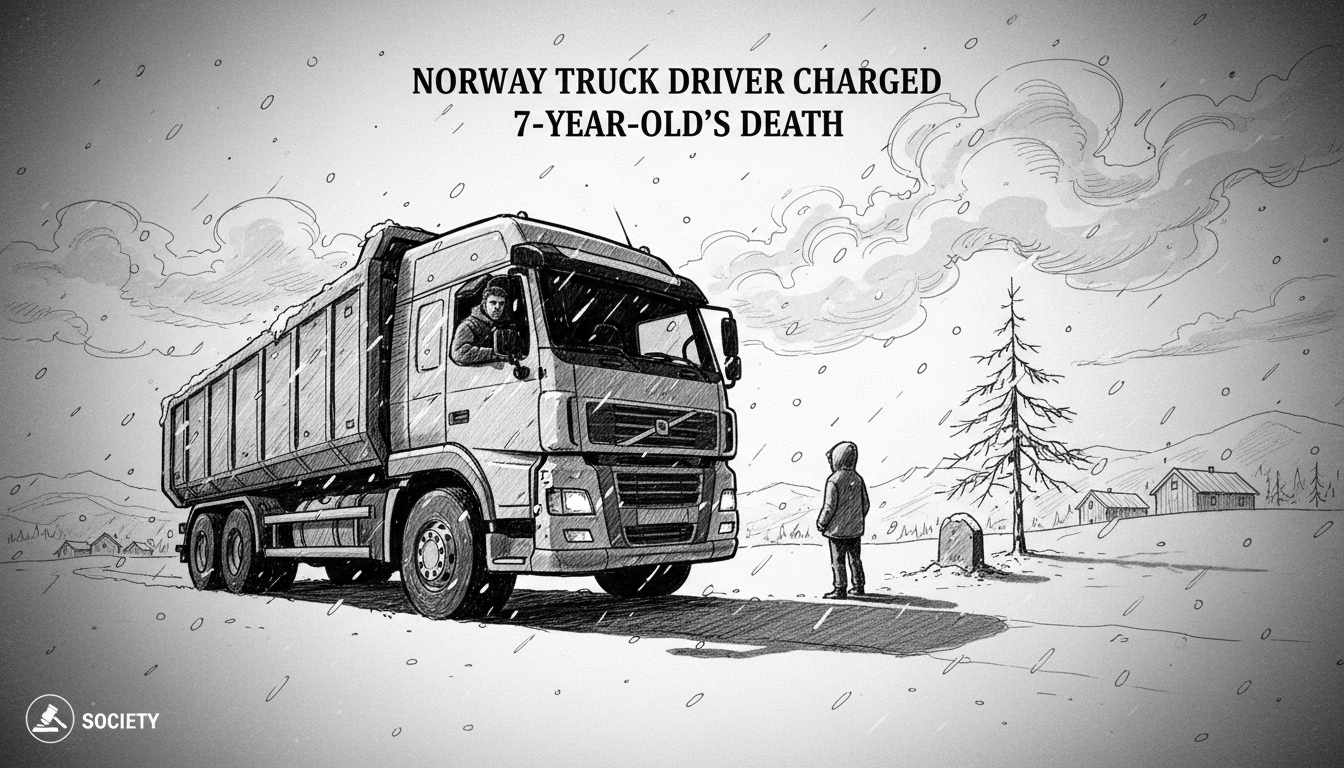
Norway's road safety record faces scrutiny after a trailer driver was formally charged in the death of a seven-year-old boy in Kristiansand. Finn Matre Langeland was killed on Torridalsveien on March 14 last year. The driver now faces a charge of negligent manslaughter, a serious offense in a nation that prides itself on safe streets. The case will proceed to the district court for scheduling, with a trial likely to begin in the new year.
A Community's Grief and a Legal Process
The charge of 'uaktsom forvoldelse av død' translates directly to negligent manslaughter. It carries a maximum prison sentence of six years, though sentences are often lower. Norwegian law requires prosecutors to prove the driver acted with negligence that directly caused the fatality. This legal threshold focuses on whether the driver failed to exercise the care a reasonable person would have in that situation. Factors like speed, attention, and road conditions will form the core of the prosecution's case. The defense will likely examine the same details, potentially arguing the accident was unavoidable.
This case moves beyond a simple traffic violation. It represents a profound tragedy for a family and a test of Norway's traffic safety ethos. The accident occurred in a marked pedestrian crossing, a place designed explicitly for safety. The fact a child died there strikes at the heart of public trust in road infrastructure. Local authorities in Kristiansand, a city in southern Norway, have likely reviewed the crossing's safety features since the incident. Such reviews are standard after fatal accidents, often leading to physical changes like improved lighting, signage, or speed bumps.
Norway's Road Safety Paradox
Norway is a global leader in road safety. In 2022, the country recorded 116 road fatalities. Given a population of over 5.4 million, this gives Norway one of the lowest per-capita traffic death rates in Europe and the world. This achievement is the result of decades of policy: strict drunk-driving laws, extensive investment in road engineering, and a cultural emphasis on safety. The 'Vision Zero' policy, which aims to eliminate all traffic fatalities and serious injuries, is a central tenet of Norwegian transport planning.
Yet, this statistical success offers little solace when a single accident claims a young life. Each fatality triggers a mandatory, thorough investigation by police and sometimes the Norwegian Public Roads Administration. The goal is not just to assign legal blame but to understand systemic failures. Could the road design have been better? Were traffic rules adequate? This holistic approach means a court case is one part of a larger safety audit. The legal outcome for the driver will be one finding; the potential policy changes that follow are another.
The Human Element in a Technical Case
For the family of Finn Matre Langeland, the legal charge is a step in a long process of seeking accountability. Norwegian courts allow victims' families to claim compensation through the civil system, often parallel to a criminal case. The emotional toll, however, is immeasurable. Child pedestrian deaths are particularly rare and shocking in Norway, making this case a prominent local and national story.
Expert legal commentary suggests the court will meticulously reconstruct the event. They will ask: What was the driver's view? What was the speed of the truck? Was the sun a factor? Was the child visible? The driver's actions in the moments before and after the impact will be dissected. In Norway, the principle of proportionality applies; the punishment must fit the degree of negligence. A momentary lapse of attention may be judged differently from a conscious disregard for rules.
Road safety analysts point out that heavy goods vehicles present specific risks in urban areas. Their large blind spots, especially directly in front of the cab, can make pedestrians invisible. Many Norwegian cities, including Oslo, have begun implementing stricter rules for truck traffic, mandating additional mirrors and safety systems. The Kristiansand case may accelerate the adoption of such technology nationwide, even for vehicles operating within the law.
A Broader Look at Traffic Justice
The Norwegian justice system in such cases balances retribution, deterrence, and rehabilitation. A conviction for negligent manslaughter on the roads typically results in a driver's license suspension, a substantial fine, and often a conditional prison sentence. The focus is on preventing future harm. The driver's record, their expression of remorse, and the exact circumstances all influence the final judgment.
This incident also raises public questions about shared space. As Norway encourages walking and cycling for environmental and health reasons, protecting vulnerable road users becomes even more critical. Infrastructure must keep pace. A crossing on a road like Torridalsveien, which handles mixed traffic, must be engineered to compensate for human error—both by drivers and pedestrians.
The Path Forward for Kristiansand
As the case moves to the Tingretten (district court), the community of Kristiansand awaits answers. The trial will provide a public airing of the facts, which can be a painful but necessary process for collective healing. It will also serve as a stark reminder. Even in the world's safest countries, tragedy can occur in an instant on an ordinary street.
The ultimate legacy of this case may be measured not in the sentence handed down, but in the safety improvements it inspires. Will it lead to lower speed limits near schools? More advanced crossing signals? Mandatory safety upgrades for commercial vehicles? In Norway, a single tragedy often catalyzes systemic change, turning grief into a powerful engine for prevention. The memory of a seven-year-old boy now becomes part of Norway's ongoing journey toward its unwavering goal: zero deaths on the roads.