
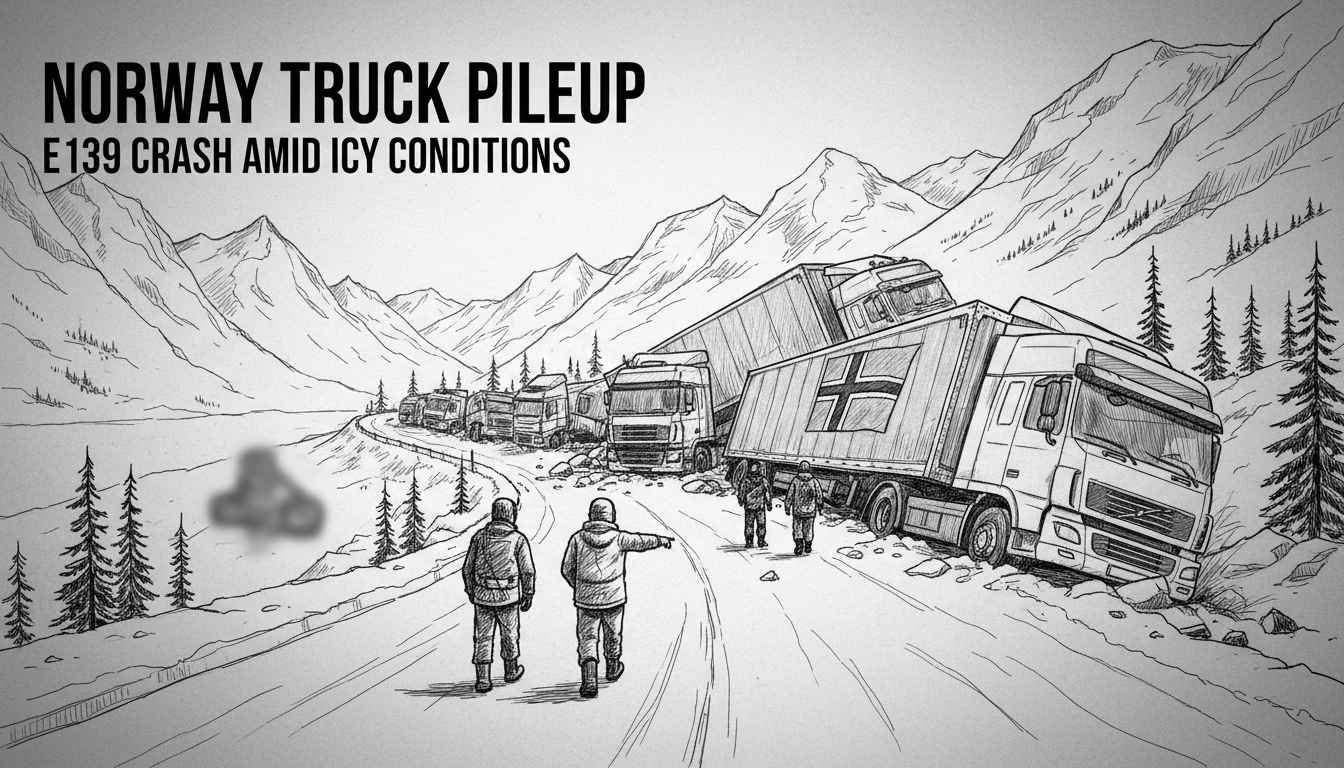
Norway's E139 highway in Innlandet county was the scene of a major multi-vehicle collision involving at least three heavy goods vehicles on Tuesday night. The accident, which also involved passenger cars, occurred on a notoriously slippery stretch of the vital freight corridor. Police confirmed no serious injuries resulted from the crash, with all drivers receiving medical checks at the scene.
Emergency services were alerted just before 10 PM. Initial reports described treacherous ice on the road surface. "We have received reports from our own personnel that conditions are terribly slippery at the location," said operations manager Vidar Flokenes. "So far we know one truck and at least two passenger cars are involved." The situation escalated as more vehicles became entangled, with police later updating that at least three trucks were part of the incident.
A Critical Artery Brought to a Standstill
The E139 is not just any road. As a European route, it forms a critical link between the E6 at Dombås and the major west coast port of Ålesund. For the inland region of Innlandet, it is a principal economic lifeline, transporting timber, goods, and supplies across mountainous terrain. A closure on this route, especially involving multiple articulated lorries, causes immediate logistical disruption far beyond the crash barriers.
This incident highlights the perennial challenge Norway faces: maintaining safe, reliable road transport through harsh and variable winter conditions. The crash site, though not specified in detail, is within a county known for its cold winters and significant snowfall. Innlandet, created in 2020 from the former counties of Hedmark and Oppland, encompasses vast forested and mountainous areas where weather can change rapidly and ice can form with little warning.
The Human and Mechanical Factors in Winter Crashes
While this crash ended without grave physical injury, the psychological and economic shockwaves are real. Road safety experts consistently point to a confluence of factors in such winter truck accidents. "On a road like E139, which is essential for heavy freight, we often see a perfect storm of risk factors," explains Lars Holen, a former truck driver and now a safety consultant for the Norwegian Hauliers Association. "Driver fatigue from long hauls, tight schedules that discourage slowing down, and sudden changes in road surface condition are the main culprits. A black ice patch can appear in minutes, especially in valleys and near rivers."
Vehicle maintenance, particularly tire condition, is another critical element. Winter tires are legally mandated in Norway, but the specific type and their wear level are crucial for heavy vehicles. The stopping distance for a fully loaded truck on ice is immense, and even a slight loss of traction can lead to a jackknife situation that blocks multiple lanes. The involvement of several trucks suggests a chain-reaction event, where one vehicle's loss of control created an unavoidable hazard for others following.
Infrastructure and Response Under Scrutiny
The efficient response from emergency services likely prevented a worse outcome. The coordination between police, ambulance crews, and tow truck operators is a well-rehearsed procedure in Norway, but each incident tests the system. Clearing multiple heavy vehicles from a main road is a complex operation requiring heavy-duty recovery equipment, which must often travel long distances to reach remote crash sites.
This accident will inevitably lead to questions about road maintenance on this stretch of the E139. Were anti-icing agents applied recently? Were warning signs activated? The Norwegian Public Roads Administration (Statens vegvesen) has an extensive network of weather stations and uses a fleet of spreader trucks, but covering every kilometer of national highway is a constant battle against nature. Inland regions often prioritize resources on the most trafficked roads, but as this crash shows, even key routes are vulnerable.
The Broader Context of Norwegian Road Safety
Norway boasts some of the safest roads in the world, a fact attributed to strict enforcement, vehicle safety standards, and a robust driver education culture. However, its geography and climate present unique dangers. Accidents involving heavy goods vehicles are a particular concern due to their catastrophic potential. The Norwegian government's National Transport Plan consistently emphasizes reducing accident numbers, with a focus on improving road markings, installing more barriers, and using technology like variable speed limits that change with conditions.
For the freight industry, accidents like this are a stark reminder of the pressures within the logistics chain. Just-in-time delivery models and high costs put drivers and operators in a difficult position when weather deteriorates. There is an ongoing debate about whether mandatory speed limiters and electronic logging devices to monitor driving hours are sufficient, or if more radical scheduling changes are needed to account for Norway's volatile weather.
Looking Ahead: A Warning as Winter Lingers
The crash on E139 serves as an early-season warning. While major injuries were avoided this time, the outcome could easily have been different. It underscores a simple, non-negotiable rule for all road users in Norway during the winter months: adjust your speed to the conditions, not the posted limit. For truck drivers, the responsibility is even greater, given the mass and momentum they command.
As recovery operations cleared the wreckage and traffic began to flow again, the underlying issue remained. The ice will melt, but the question of how to perfectly balance economic necessity with absolute safety on Norway's winter roads is far from solved. This incident on a dark Innlandet highway is a case study in that enduring challenge—a reminder that in the battle between human infrastructure and Nordic winter, the winter always has the home advantage. Will this near-miss lead to renewed focus on specific vulnerable stretches of road, or will it be forgotten until the next crash?