
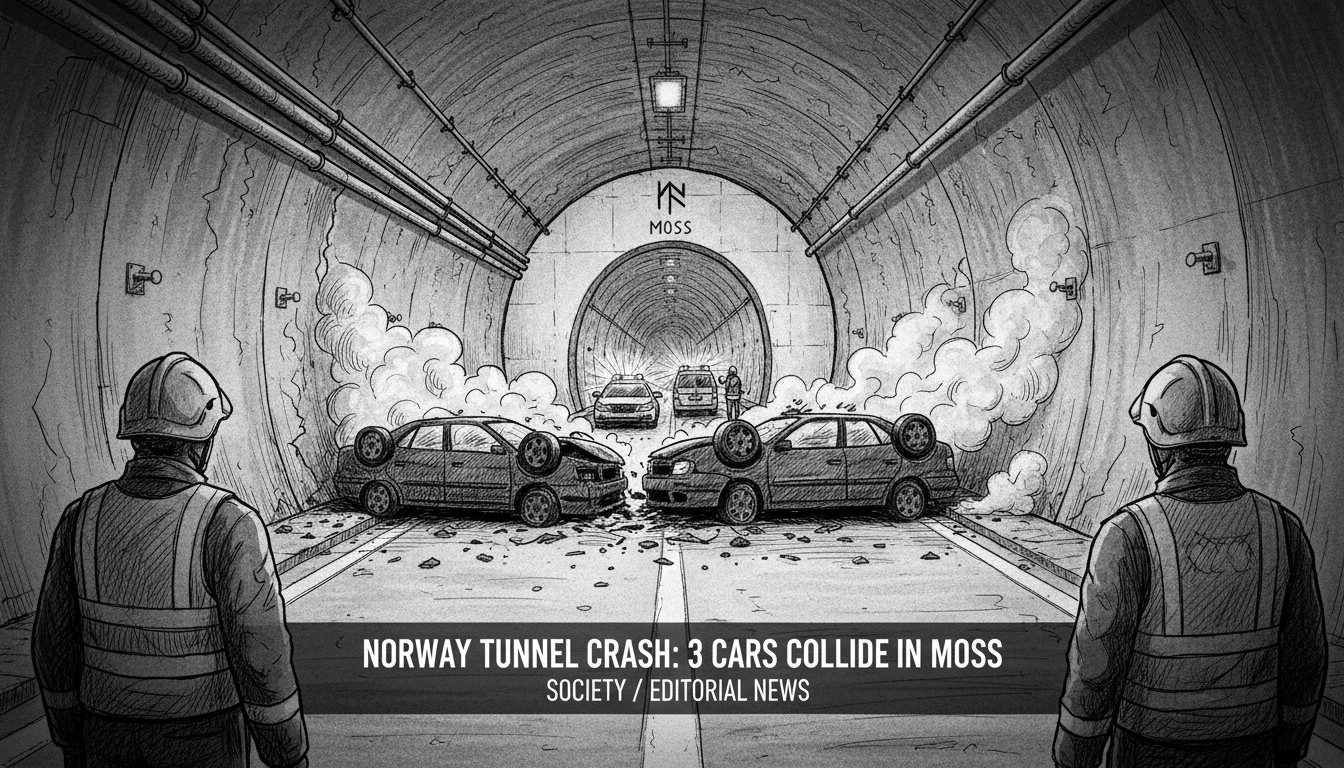
Norway tunnel safety is under renewed scrutiny after a three-car collision inside the Mosseporten tunnel near Moss on Tuesday afternoon. The crash caused significant traffic disruption on a key route out of the Østfold city, with emergency services rushing to the scene. The extent of injuries to those involved remains unclear as police work to secure the accident site and manage the resulting congestion.
A Critical Chokepoint Paralyzed
The Mosseporten tunnel serves as a vital artery for regional traffic, funneling vehicles in and out of Moss. Incidents within such confined spaces create immediate and severe logistical challenges. Unlike open-road accidents, tunnel crashes leave little room for emergency vehicle access or for redirecting stranded motorists. Police confirmed they were on site but had not yet established a full overview of the damage or injuries by late afternoon. The immediate priority was securing the scene and providing any necessary medical aid, followed by the complex task of clearing the wreckage to restore traffic flow.
This disruption highlights the vulnerability of tunnel-dependent infrastructure. When a main route like this is blocked, alternative roads quickly become overloaded, causing ripple effects throughout the local network. Commuters and commercial transport faced lengthy delays during the busy afternoon period. The incident serves as a stark reminder of how a single collision can paralyze a critical transport link for an entire region.
The Inherent Risks of Tunnel Travel
Traffic safety experts consistently point to tunnels as high-risk environments. Factors contributing to this include sudden changes in light, which can temporarily impair driver vision, and the psychological effect of enclosed spaces. Maintaining safe following distances becomes even more crucial inside a tunnel, as braking distances can be misjudged. The potential for a chain-reaction collision, as seen in Moss, is elevated.
"Accidents in tunnels present unique and amplified dangers," explains a senior advisor from the Norwegian Public Roads Administration. "The confined space complicates rescue efforts, can trap hazardous fumes, and even a minor incident can lead to major congestion that blocks emergency access. Investigations in such cases pay extremely close attention to speed, driver attention, and vehicle spacing immediately prior to the impact." The official report on the Moss collision will likely analyze these factors in detail to determine the precise cause and identify any potential lessons for road design or driver education.
Norway's Ongoing Tunnel Safety Dialogue
Norway, with its mountainous terrain and long coastline, relies heavily on its network of over 1,000 road tunnels. This includes some of the world's longest and deepest subsea passages. The country has been a global leader in implementing strict tunnel safety standards, including advanced ventilation systems, frequent emergency bays, and clear signage. Regular safety campaigns remind drivers to turn on their headlights, increase distance, and avoid changing lanes unnecessarily while in a tunnel.
Despite these measures, human error and unforeseen circumstances can lead to accidents. Each incident prompts a review of protocols. The response to the Mosseporten crash tests the coordination between local police, fire services, and road management authorities. Their efficiency in managing the aftermath, providing care, and reopening the tunnel will be closely watched. The event may fuel ongoing discussions about the potential for more automated monitoring systems within tunnels to detect slow-downs or accidents in real-time.
Looking Beyond the Immediate Aftermath
For the drivers and passengers involved, the crash is a sudden and traumatic event. Beyond the physical injuries, which authorities have not yet detailed, such accidents can have lasting psychological impacts. The sudden violence of a collision in a confined, echoing space is profoundly unsettling. Support services often become involved in the days following such incidents to help those affected cope with the aftermath.
For the city of Moss and Østfold county, the crash is a disruptive economic event. Delays in the transport of goods and the loss of productive time for commuters have a tangible cost. It underscores the economic importance of reliable infrastructure and the consequences when it fails, even temporarily. Local businesses that depend on smooth through-traffic may have felt the indirect effects of the afternoon's gridlock.
A Call for Renewed Vigilance
While the investigation into the specific causes of Tuesday's collision in Moss will take time, the event serves as an immediate call to action for all drivers. It reinforces the non-negotiable rules of tunnel driving: maintain focus, keep a safe distance, and obey speed limits. The consequences of inattention are magnified within the unyielding walls of a tunnel.
Norway's infrastructure is remarkably safe, but it is not infallible. This incident is a sobering reminder that safety on the roads is a shared responsibility between engineers who design them, authorities who maintain them, and drivers who use them. As the wreckage is cleared and traffic in the Mosseporten tunnel slowly returns to normal, the key question remains: will this near-miss lead to greater caution, or will the daily commute soon lull drivers back into a false sense of security? The true test of this accident's legacy will be measured in the driving habits exhibited in that very tunnel next week, and in every tunnel across Norway.