
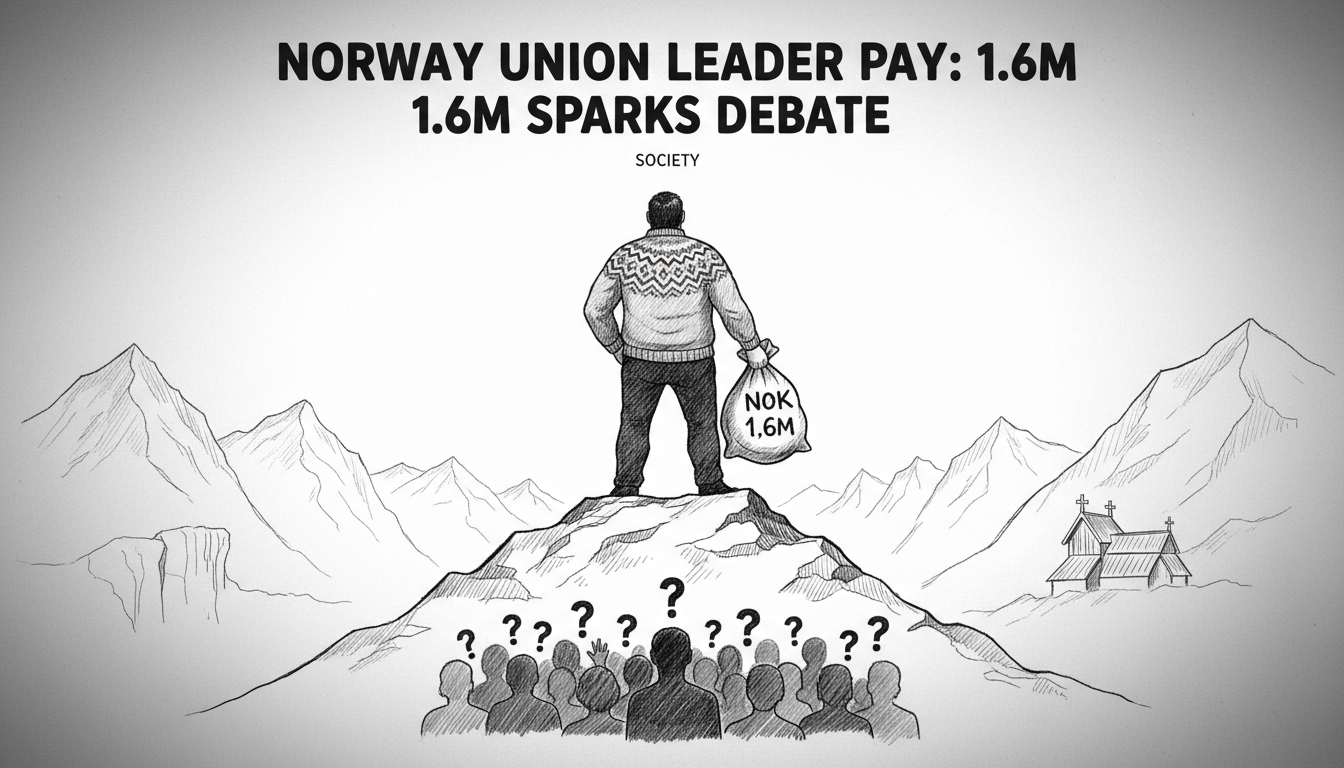
Norway's top union leader Kine Asper Vistnes has received a salary increase, bringing her annual pay to 1.6 million kroner. The raise of 53,826 kroner for Vistnes and her leadership team matches Norway's median monthly wage, a figure that highlights the nation's wage structure and sparks debate about executive compensation in the labor movement. The new salary places the leader of Landsorganisasjonen (LO) below a government minister but significantly above an ordinary member of parliament, while remaining less than one-third of what her counterpart at the employers' federation NHO earns.
This adjustment comes during Norway's annual wage negotiation season, a critical period for the country's tripartite cooperation model. The timing ensures the figures will be scrutinized by both LO's 900,000 members and the broader public. The comparison to the median monthly salary is a deliberate symbolic gesture, but it also opens the union leadership to questions about aligning their own compensation with the workers they represent.
The Numbers Behind the Negotiating Table
Kine Asper Vistnes's new annual salary is 1,645,326 Norwegian kroner. This is a precise figure, calculated from a base salary plus the standardized increase given to all senior LO officials. The raise itself, 53,826 kroner, is not an arbitrary number. Statistics Norway data confirms this sum represents the median monthly gross earnings for a full-time employee in the country. It is the exact midpoint of Norwegian wages, meaning half of all workers earn more per month, and half earn less.
The salary places Vistnes in a distinct bracket within Norway's public salary landscape. A government minister, or statsråd, earns 1,734,020 kroner annually. An elected representative in the Storting, Norway's parliament, receives 1,214,977 kroner. The LO leader's compensation therefore sits between these two pillars of state power, closer to the executive branch than the legislative. This positioning is politically significant, reflecting LO's role as a de facto shadow cabinet on labor issues, constantly engaged with government policy.
The most striking comparison, however, is with the private sector counterpart. Ole Erik Almlid, the director of the Confederation of Norwegian Enterprise (NHO), earns a salary that is more than triple Vistnes's. While NHO does not publicly disclose exact figures, reliable reports from business media and analyses confirm the ratio. This vast disparity between the leaders of the two sides in annual collective bargaining negotiations is a constant feature of Norwegian labor life, often cited by unions to illustrate differing priorities.
Symbolism, Solidarity, and Scrutiny
The decision to set the pay increase at the level of the median monthly wage is loaded with symbolism. "It's a clear signal," said a senior LO advisor who spoke on condition of anonymity. "The leadership's raise is tied directly to the experience of the average worker. It's meant to demonstrate a connection, even at the highest level." This move can be seen as an attempt to preempt criticism and align the union's internal practices with its public advocacy for fair wages.
Yet, the symbolism cuts both ways. Critics, including some voices from smaller political parties and academic circles, question whether any six-figure salary can truly represent solidarity with workers earning a fraction of that amount. "A leader earning 1.6 million kroner is living in a different economic reality than a cleaner, a care worker, or a retail employee," noted Professor Henrik Lunde, a sociologist at the University of Oslo who studies labor markets. "The symbolic tie to the median wage is clever, but it doesn't erase the fundamental gap. The real test is in the outcomes they negotiate for their members."
The debate touches a nerve in Norway's egalitarian social democracy. The country has a compressed wage structure compared to most nations, but high executive pay in the private sector and comfortable salaries in large organizations remain topics of discussion. LO itself frequently campaigns against excessive CEO bonuses and stock options in listed companies. This makes internal compensation decisions for its own top officials a matter of intense interest and potential vulnerability.
The Power Dynamics of Norwegian Labor
To understand the significance of these salaries, one must understand the power LO wields. It is not merely a collective bargaining agent. LO is a central pillar of the Norwegian model, a system of tripartite cooperation between unions, employers (organized in NHO), and the state. This model is credited with maintaining industrial peace, high productivity, and a robust welfare state. LO's political influence is substantial, historically tied to the Labour Party (Arbeiderpartiet), and its leader is a major national figure.
The salary gap between the LO and NHO leaders reflects a deeper structural difference. NHO is an employers' federation; its director is a chief executive officer managing an organization that serves business interests. The compensation for such roles in Norway, while modest by international standards, is set within a competitive market for executive talent. LO, despite its size and influence, is fundamentally a democratic membership organization. Its leader's legitimacy stems from member support and political skill, not from a corporate board.
"The comparison is inevitable, but it's also comparing apples and oranges," said political commentator Eva Larsen. "Almlid's salary is benchmarked against other top CEOs and managing directors in the quasi-corporate sphere. Vistnes's salary is benchmarked against public sector leaders, politicians, and the expectations of her own members. The fact that we compare them at all shows how intertwined these two organizations are in the public mind."
A Look at the Broader Economic Picture
The salary discussion occurs against a complex economic backdrop. Norway is navigating global inflation, high interest rates set by Norges Bank, and uncertainties in its vital oil and gas sector. The annual wage negotiations led by LO and other unions set the tone for the entire economy, influencing inflation and purchasing power. In this context, the moderation shown in the leadership's own pay increase can be interpreted as a strategic message ahead of demanding modest, responsible settlements for members.
Furthermore, Norway's high cost of living, particularly in Oslo, is a factor in any salary discussion. A salary of 1.6 million kroner provides a very comfortable life, but it is not considered exorbitant for leading a massive, complex organization with billions of kroner in assets and influence over national policy. The salary is also subject to Norway's progressive tax system, which takes a significant portion of high incomes to fund the country's universal welfare services.
The median wage figure of 53,826 kroner per month translates to an annual salary of approximately 645,912 kroner. This means the LO leader's total compensation is roughly 2.5 times the median annual full-time salary. This ratio is far lower than the executive-to-worker pay ratios seen in the United States or United Kingdom, but it still represents a substantial differential within Norway's own egalitarian framework.
The Road Ahead for Wage Debates
This revelation about LO leadership pay will inevitably feed into the ongoing national conversation about value, work, and compensation. As LO prepares to negotiate wage increases for hundreds of thousands of workers in the public and private sectors, their own house will be seen as being in order. The disciplined, median-wage-linked increase gives them a solid foundation to argue for fair raises for their members.
However, the enduring chasm between the top union and top employer salaries will remain a potent symbol. It visually represents the different resources and philosophies at the bargaining table. For LO's critics, it may never be enough. For its supporters, the focus will remain on the results achieved for the rank-and-file. The final judgment on the appropriateness of the 1.6 million kroner salary will not come from newspaper headlines, but from the union's members themselves, based on the contracts secured and the standards of living defended in the challenging economic times ahead. Does a leader's compensation define their effectiveness, or is it the outcomes they deliver for those they represent?