
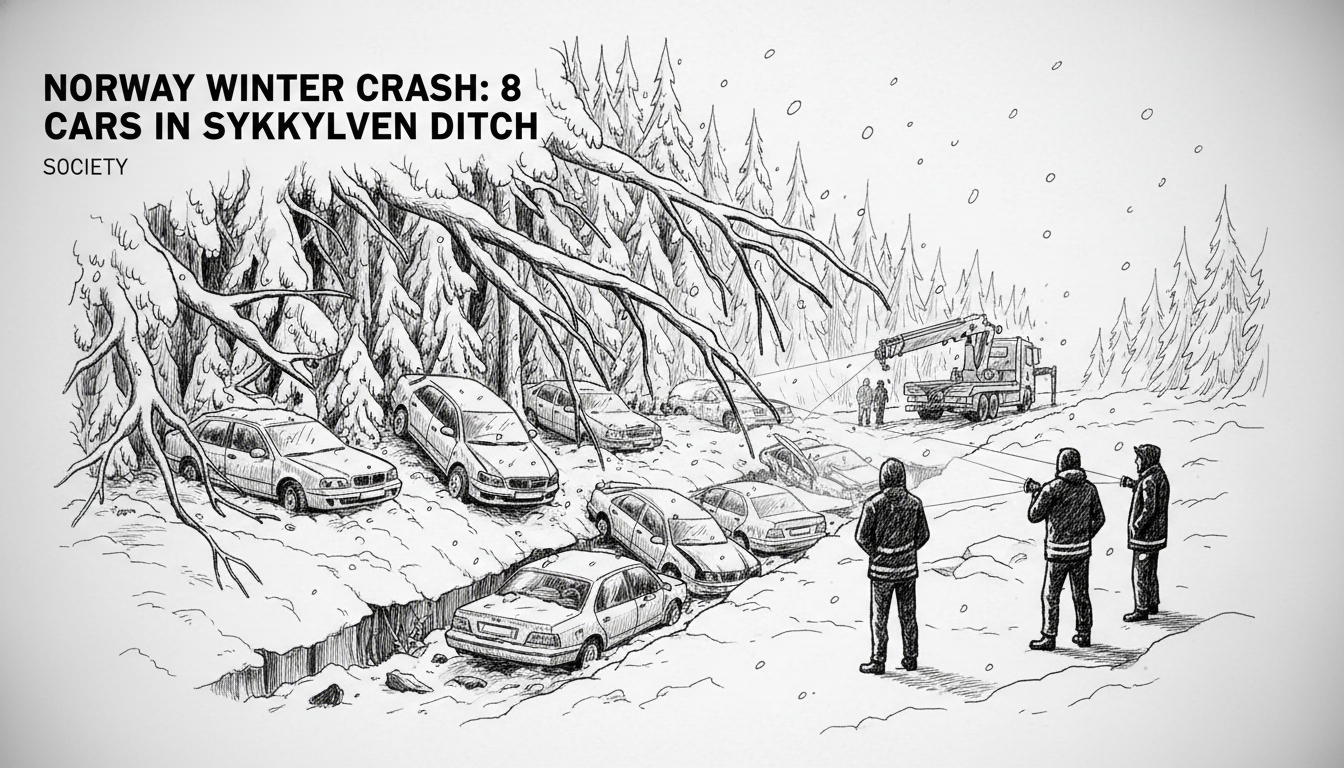
Norway's treacherous winter roads caused a multi-vehicle incident in Sykkylven on Tuesday, sending six cars into a ditch after a two-car collision. The accident near the Nysæterkrysset intersection highlights the persistent dangers of driving in western Norway's mountainous regions during the winter months. Police confirmed no serious injuries resulted from the chain-reaction event, which they attributed to extremely slippery conditions.
"It is a bit unclear, but according to the police patrol on site, there are eight cars total that are involved," said operations manager Arild Reite of the Møre og Romsdal Police District. "Two cars have collided, the other six have driven into the ditch in an attempt to avoid the cars that have collided." Reite described the scene as chaotic in the immediate aftermath, with vehicles sustaining minor material damage.
A Chaotic Scene on a Mountain Road
The incident unfolded on the road towards Fjellsætra, a recreational mountain area in the municipality of Sykkylven. This region, part of Møre og Romsdal county, is famed for its dramatic fjord landscapes and a strong furniture manufacturing industry. Its roads wind through steep terrain, where microclimates can create sudden and severe ice patches. Police reports from the scene emphasized that conditions were "very slippery," a common but dangerous feature of Norwegian winters.
Witness accounts and police descriptions paint a picture of a rapid domino effect. The initial collision between two vehicles created an immediate hazard for following traffic. With limited time to react on the icy surface, six subsequent drivers swerved to avoid the wreckage. Their evasive maneuvers, on a surface with little grip, resulted in all six cars leaving the roadway and ending up in the roadside ditch. The concentration of eight affected vehicles in one location underscores how quickly a single incident can escalate in poor conditions.
The Persistent Challenge of Winter Mobility
This accident is not an isolated event but a seasonal reality in Norway. The country invests heavily in winter road maintenance, with a fleet of plows and gravel trucks working around the clock. Yet, as this crash demonstrates, nature often outpaces these efforts. Black ice, formed when moisture freezes on seemingly dry asphalt, is a particular menace. It gives drivers no visual warning, rendering advanced braking systems and four-wheel drive nearly useless.
Road safety experts consistently stress fundamental adjustments for winter driving. "The single most important factors are reduced speed and dramatically increased following distance," explains Lars Tingelstad, a senior advisor at the Norwegian Council for Road Safety. "On summer asphalt, you might stop in 50 meters. On ice, that same stop could take 200 meters or more. Drivers from milder climates, and even locals who become complacent, often forget this physics." He notes that mountainous areas like Sykkylven present added risks, where shaded corners and bridge surfaces freeze long before other road segments.
Local Response and Systemic Pressures
The Sykkylven incident, while resulting in no physical injuries, ties up significant emergency resources. Multiple police patrols, tow trucks, and possibly road maintenance crews were dispatched to secure the scene, document the incident, and recover the vehicles. Each such event creates logistical headaches and economic costs, from insurance claims to traffic delays.
For residents of municipalities like Sykkylven, these roads are lifelines. They are essential for commuting, school runs, and commercial transport. The pressure to keep them open and safe is immense, balancing the community's need for mobility against the objective hazards of winter. Local politicians frequently face questions about salting schedules and plowing priorities, especially after accidents.
Norway's national road authorities use a detailed system of weather stations and road sensors to monitor conditions. However, covering every kilometer of road, especially in a region of fjords and mountains, is impossible. Drivers ultimately bear the responsibility for adapting to the conditions they encounter. The police in Møre og Romsdal, like districts across the country, routinely issue public warnings following weather forecasts, urging motorists to fit winter tires, carry emergency equipment, and consider whether their journey is absolutely necessary.
A Narrow Escape and a Clear Warning
The outcome of the Sykkylven crash—material damage but no bodily harm—represents a best-case scenario for an eight-vehicle pile-up. It serves as a potent, real-world warning as the region moves deeper into the slippery season. The cars in the ditch are a visual testament to the loss of control that can happen in an instant.
Similar incidents occur annually across Scandinavia, where winter defines nearly half the year. They spark recurring public debates about driver education, tire regulations, and the limits of infrastructure hardening. Some advocates call for even stricter laws on mandatory winter tire use, which already exists in Norway for certain seasons, or for technological solutions like heated road surfaces on critical slopes.
Yet, the consensus among safety professionals remains focused on driver behavior. Technology can assist, but it cannot override the laws of physics. As Arild Reite from the local police indicated, the situation became "chaotic" quickly. Chaos on an icy road is a recipe for disaster, one that was fortunately avoided this time.
Looking Ahead: Preparedness Over Confidence
For the international audience, this incident offers a glimpse into the everyday challenges of life in a Nordic climate. Norway's stunning winter landscapes come with a practical price: demanding and sometimes hazardous travel conditions. The country's generally excellent road safety record is maintained through constant vigilance, not complacency.
The story from Sykkylven is ultimately one of caution. It underscores that safe winter driving is less about vehicle capability and more about driver mentality. It involves planning for the worst, driving for the conditions present, not the posted speed limit, and understanding that sometimes, the safest maneuver is to stay home. As the days shorten and temperatures drop, this message will be repeated across Norway's airwaves and news sites, a necessary reminder in a beautiful but unforgiving environment.
Will this season's warnings lead to fewer vehicles in the ditch, or does the annual cycle of first ice inevitably catch drivers by surprise? The answer plays out on roads like the one to Fjellsætra, where asphalt, ice, and human judgment meet.