
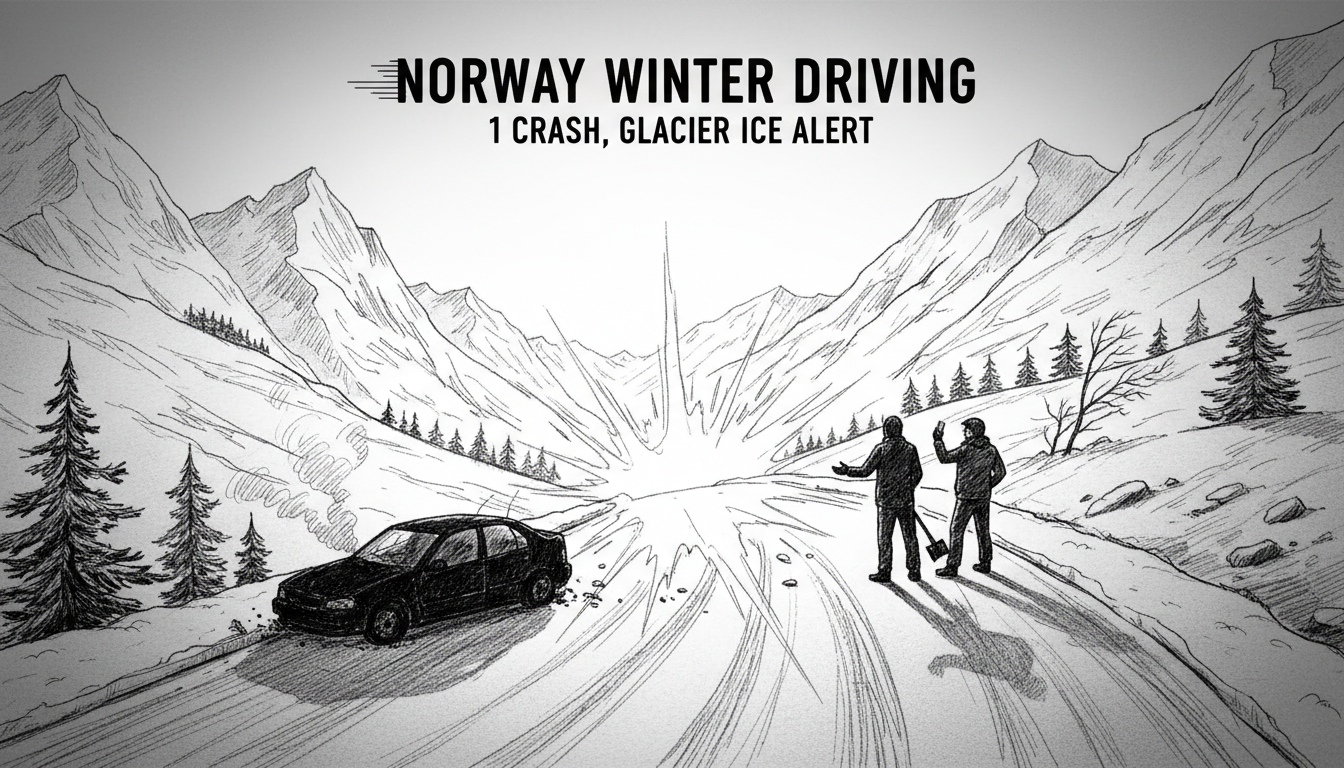
Norway winter driving conditions turned treacherous in Helgeroa on Thursday when a car slid off a bend and crashed into a rock face. The incident highlights the persistent danger of glare ice on coastal roads during seasonal temperature shifts.
“The woman driving the car was conscious when emergency services arrived at the scene. She was taken to hospital by ambulance,” said operations manager Marius Fosvold. Only the driver was involved in the crash, which forced traffic to be directed past the site in a single lane.
Police immediately identified the cause. “It has been reported that the road conditions are slippery,” Fosvold stated. He confirmed that icy roads were present in several locations across the Sør-Øst police district, a region encompassing multiple municipalities in southeastern Norway. Authorities pledged to notify the Norwegian Public Roads Administration (Statens vegvesen) about the hazardous conditions.
The Coastal Freeze-Thaw Hazard
The crash in Helgeroa, a village in Larvik municipality, is a classic example of a specific Norwegian winter peril. Coastal areas like Vestfold og Telemark county often experience temperatures hovering around zero degrees Celsius. This leads to repeated melting and refreezing, creating nearly invisible patches of black ice, or ‘glareis’, on road surfaces. Drivers can be caught completely unaware, especially on shaded bends or exposed stretches of road like the one where Thursday’s accident occurred.
“These conditions demand extreme vigilance,” says road safety expert Lars Tore Andreassen. “A road that looks merely wet can be a sheet of ice. The difference between safe passage and losing control is a matter of a single degree in temperature.” He emphasizes that standard all-season tires are wholly inadequate for Norwegian winters, where studded or advanced friction winter tires are a legal requirement during the colder months.
A National Priority: Winter Road Maintenance
Norway invests heavily in combating these inherent dangers. The Norwegian Public Roads Administration operates a extensive winter maintenance regime, deploying thousands of snowplows and salting vehicles across the national network. Their goal is clear: to keep major arteries open and safe regardless of weather. Decisions on when and where to salt are based on sophisticated weather station data and forecasts.
However, the system faces immense challenges due to Norway’s long coastline and varied topography. A sudden drop in temperature after rain, or freezing fog, can outpace treatment efforts, particularly on local and county roads. The incident in Helgeroa suggests such a gap, where conditions deteriorated faster than preventive measures could be applied. The police warning to the road administration is a standard but critical feedback loop in this constant battle.
The Human Factor in Icy Conditions
While infrastructure and maintenance are crucial, experts consistently return to driver behavior as the most significant variable. The core advice from police and safety organizations is timeless but often overlooked: reduce speed, dramatically increase following distance, and avoid sudden steering or braking maneuvers.
“Modern cars give us a false sense of security,” notes Andreassen. “Anti-lock brakes and stability control cannot override the laws of physics on ice. If you enter a bend too fast for the conditions, technology may not save you.” He points out that adjusting one’s driving to the environment is the single most effective safety measure any individual can take.
The driver involved in the Helgeroa crash was fortunate. Many similar single-vehicle accidents on icy Norwegian roads result in more serious outcomes, particularly when collisions with fixed objects like rock faces or trees occur. The fact she was conscious and transported for assessment indicates a likely survivable crash, though the psychological shock of such a sudden, uncontrollable event can be profound.
Statistics Show Progress Amidst Peril
Norway’s overall road safety record is among the best in the world, a testament to continuous investment, strict laws, and public education. In 2023, there were 117 road fatalities in the country. Over the past decade, the number of serious road injuries has fallen by approximately 30%. These figures reflect successes in areas like improved vehicle safety, road design, and combating impaired driving.
Yet, winter remains a persistently dangerous season. A significant proportion of annual accidents still occur on icy or snowy roads. The data suggests that while systemic improvements save lives, the residual risk is intimately tied to weather and individual adaptation to it. Each winter season serves as a renewed test of the country’s defenses and its drivers’ preparedness.
Local Impact and Broader Warnings
For the 47,000 residents of Larvik municipality, Thursday’s crash is a local reminder of a universal seasonal threat. It disrupts travel, consumes emergency service resources, and serves as a sobering topic of community conversation. The police district’s decision to issue a broad warning for the entire Sør-Øst region indicates the weather pattern creating the hazard was widespread, not isolated to a single problematic bend.
Such warnings are now rapidly disseminated through media and official apps, but their effectiveness hinges on drivers heeding the advice. The transition between autumn and full winter, and again during spring thaws, is often the most hazardous period. Drivers may not have fully adjusted their mindset or may be using tires whose tread is worn after months of use.
A Seasonal Challenge with No Simple Fix
The Helgeroa incident underscores that Norway’s relationship with winter driving is a managed conflict, not a winnable war. The geography and climate that define the nation also guarantee annual challenges. The response is a multi-layered strategy: relentless physical maintenance of roadways, continuous public information campaigns, stringent legal requirements for vehicle equipment, and a cultural expectation of cautious winter driving.
As temperatures continue to fluctuate around freezing point in the coming weeks, similar incidents are likely to occur elsewhere along Norway’s coast and inland. The question for every motorist is whether they will treat the Helgeroa crash as a distant news item or as a direct, personal warning. The difference between those perspectives could determine the outcome of their next journey on a deceptively glistening road.
Ultimately, Norway’s winter roads demand respect. Technology and infrastructure provide crucial support, but the final responsibility rests with the person behind the wheel. As the days shorten and the mercury drops, that is the oldest, and most vital, lesson of all.