
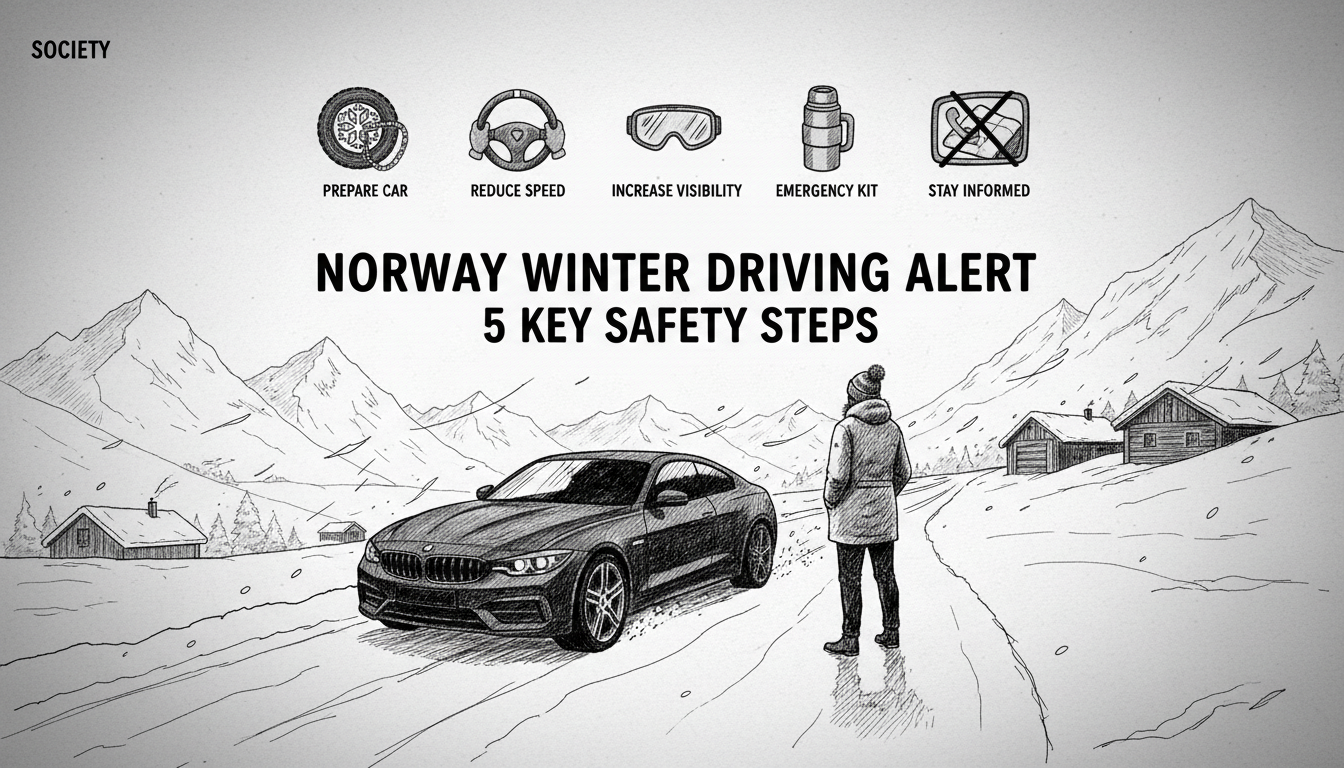
Norway's Traffic Management Center has issued a direct warning to drivers across Eastern Norway following fresh snowfall overnight. The advisory urges motorists to exercise extreme caution due to widespread slippery road conditions, with several accidents already reported during the Friday morning commute. Traffic operator Jeanette Andresen at the Vegtrafikksentralen Øst confirmed the hazardous situation, noting that while traffic volumes were lower than a typical Friday, conditions remain treacherous as activity increases.
This early winter event serves as a stark reminder of the seasonal challenges facing Norway's road network. The Østlandet region, encompassing the populous counties of Oslo, Viken, and Innlandet, is particularly vulnerable to rapid weather shifts that create dangerous driving environments. The combination of new snow and temperatures hovering around freezing creates a perfect recipe for black ice and reduced traction.
The Immediate Hazard on Østlandet's Roads
The fresh snow that fell across large parts of Eastern Norway overnight has transformed the morning landscape into a driving hazard. Jeanette Andresen's warning from the Traffic Management Center is not routine advice; it is a response to real-time data from road sensors and weather stations across the region. "Compared to a normal Friday, there is less traffic than usual, but it is starting to pick up now," Andresen stated, highlighting the window of risk as more drivers take to the roads.
Several accidents have been reported, though specific numbers were not immediately available. This pattern is consistent with historical data from Statistics Norway (SSB), which identifies adverse weather as a significant contributing factor in winter traffic incidents. The Norwegian Public Roads Administration (Statens vegvesen) maintains the network of monitoring equipment that feeds critical information to the Traffic Management Center, enabling these proactive public warnings.
A Systemic Approach to Winter Road Safety
Norway's response to hazardous driving conditions is built on a foundation of technology, regulation, and public education. The Vegtrafikksentralen operates as the nerve center, analyzing data on temperature, precipitation, wind, and actual road surface conditions. This system allows for targeted warnings, like the one issued for Østlandet, rather than blanket advisories for the entire country.
A key component of Norway's strategy is its tire legislation. Norwegian law mandates the use of winter tires (with or without studs) within specific dates, typically from November to Easter, depending on the region and conditions. This legal requirement is a primary defense against accidents on snow and ice. Experts consistently stress that having the correct tires is the single most important equipment factor for safe winter driving, but it must be combined with adjusted behavior.
Traffic safety analysts point to a simple triad for winter driving: appropriate tires, reduced speed, and increased following distance. On a wet road, a safe following distance might be two seconds. On ice, that distance needs to multiply to eight or ten seconds. The warning to "drive calmly" issued by the Traffic Management Center encapsulates this need for a complete mental and operational shift behind the wheel.
The Human Factor in Hazardous Conditions
Despite advanced warning systems and strict regulations, the ultimate variable remains the driver. The transition to winter driving mentality is a challenge each year. After a relatively mild autumn, the first significant snowfall can catch drivers off guard, leading to misjudgments in braking distance and cornering speed.
"The most dangerous conditions are often at the onset of winter, and during periods when temperatures fluctuate around zero," explains a veteran driving instructor from the Norwegian Automobile Federation (NAF). "Black ice, which is nearly invisible, can form rapidly. Drivers must anticipate that bridges, shaded forest roads, and high-altitude stretches will be icier first."
This human element is why the public warnings are phrased in clear, direct language. The message is not merely informational; it is behavioral. It is a call to cancel non-essential trips, to leave earlier, to plan routes using the Traffic Management Center's public online maps, and to fundamentally slow down.
Economic and Social Impact of Winter Disruption
Beyond safety, winter road conditions have a tangible impact on Norway's economy and daily life. The Østlandet region is the country's economic engine, home to the capital Oslo and major logistical corridors. Disruption on the E6, E18, and other major arteries causes delays in freight transport, affects public transit, and leads to widespread absenteeism and lateness in workplaces.
The cost of winter road maintenance is substantial. The Norwegian Public Roads Administration deploys a fleet of plows and spreads thousands of tons of salt and gravel annually. However, chemical de-icing is used sparingly in Norway due to environmental concerns about runoff into waterways and soil. The preference is for mechanical plowing and the use of coarse gravel for traction, a method that is effective but requires constant re-application during ongoing snowfall.
For the average Norwegian, the winter driving season necessitates preparation. It means mounting winter tires, ensuring the vehicle's battery is in good condition, and keeping an emergency kit in the car with blankets, a shovel, reflective vests, and some food and water. This cultural preparedness is as ingrained as the technology of the Traffic Management Center.
Looking Ahead: A Season of Vigilance
The warning for Østlandet on this Friday morning is likely the first of many for the coming season. Climate patterns suggest Norway will continue to experience volatile winter weather, with potential for more frequent freeze-thaw cycles that create especially slick conditions.
The effectiveness of Norway's system will be measured not by the number of warnings issued, but by the accident statistics compiled at season's end. The goal is a reduction in weather-related incidents through prevention. This requires the system—the sensors, the operators, the road crews—and the drivers to work in concert.
As Jeanette Andresen and her colleagues continue to monitor the screens at the Traffic Management Center, their success depends on the public heeding their advice. The message is simple, timeless, and critical: the vehicle may be equipped for winter, but the driver must be too. Will this season's first major warning be remembered as a timely alert that prevented accidents, or merely as the prelude to a spike in collisions? The answer lies with every individual who turns a key and grips a steering wheel on a frosty Norwegian morning.