
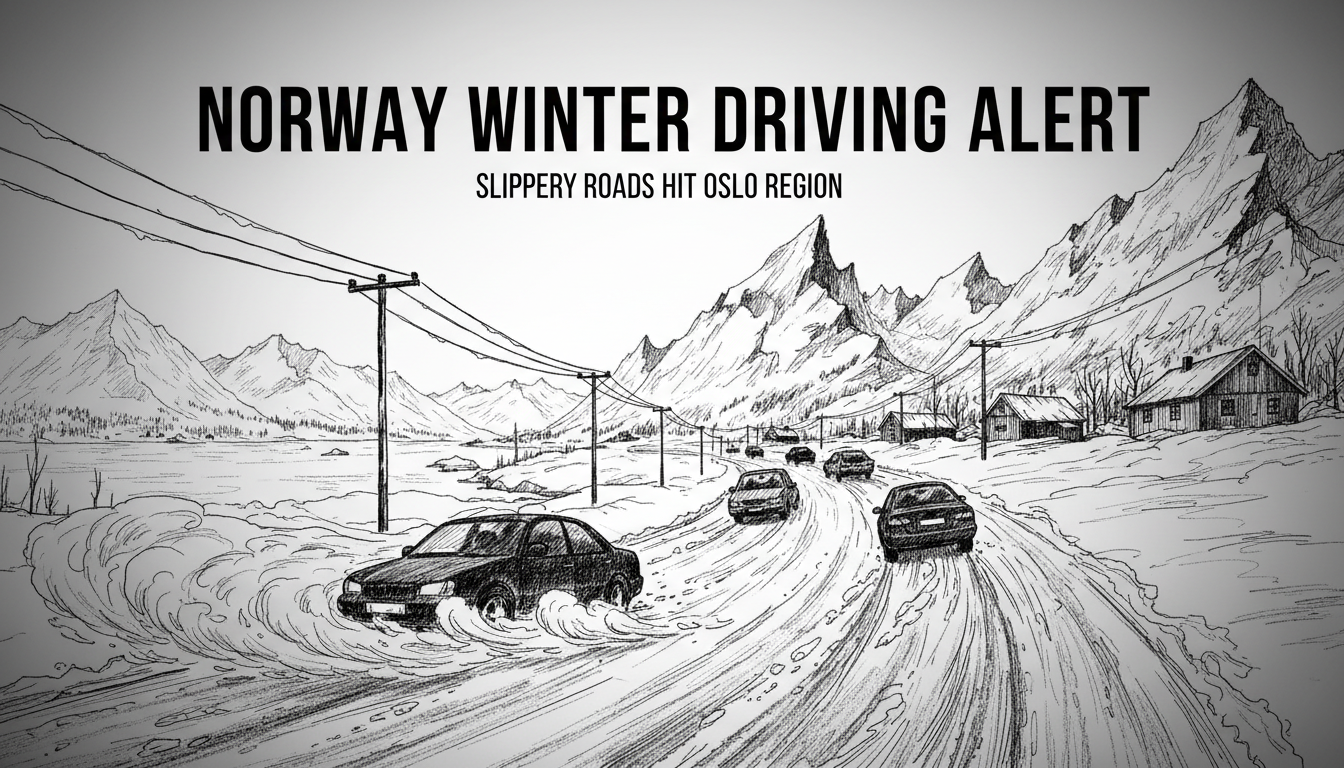
Norway winter driving conditions turned hazardous Friday morning as snow, wind, and sub-zero temperatures hit the Oslo region. The sudden change caught many drivers off guard, leading to warnings of slippery roads and at least one reported accident. Traffic operator Trude Lindstad from Vegtrafikksentralen Øst issued a clear public warning. 'With the snow that has come, it will be slippery. Then it's important to reduce speed and think that it is more slippery than it has been earlier this winter,' she said.
The warning focused particularly on smaller secondary roads, which often receive less immediate attention from snow-clearing crews. On major highways like the E6 and E18, a coordinated effort was already underway. Teams deployed 'brøytetog' – convoys of two or three snowplows driving side-by-side – to clear lanes efficiently. This operation, while effective, itself caused minor traffic delays as the plows moved south past Kløfta toward Oslo during the morning commute.
Despite the conditions, traffic volumes appeared lower than a typical Friday. Lindstad noted the roads were relatively quiet, with few traffic incidents reported overnight. She suggested many people may have avoided travel or taken an extra day off. This lighter traffic likely prevented more serious disruptions. However, the South-East Police District confirmed one accident on the E18 at Farrisbrua in Larvik, where a car spun out and hit a guardrail. The driver was unharmed, and the road reopened quickly after vehicle recovery.
The Science of Slipperiness
Winter road safety in Norway depends on a complex interplay between temperature, precipitation, and road surface treatment. The initial snowfall on cold asphalt creates an immediate slick layer. This 'first snow' phenomenon is particularly dangerous because driver habits haven't yet adjusted from autumn conditions. Road salt becomes less effective below -5°C, often requiring alternative treatments like sand or gravel for grip. The wind reported across the region compounds the problem, causing drifting snow that can re-cover cleared roads minutes after a plow passes.
Traffic management centers use a network of road weather stations to monitor surface temperature, moisture, and friction. This data informs where and when to deploy resources. Smaller roads are prioritized lower because they carry less traffic, but they also cool faster and become icy more quickly. 'Even if we plow, it won't be bare asphalt. It will continue to snow, so reduce your speed,' Lindstad emphasized, highlighting the ongoing challenge during continuous snowfall.
A System Built for Winter
Norway's approach to winter road management is proactive and technologically advanced. The Vegtrafikksentralen (Norwegian Public Roads Administration) operates 24/7, coordinating between regional centers in Øst (East), Sør (South), and elsewhere. Their strategy involves staged preparedness. At the first forecast of snow, treatment trucks are loaded and positioned. Plowing on national highways begins when snow accumulation reaches 3-5 centimeters. The 'brøytetog' method used this morning maximizes efficiency on multi-lane roads, clearing all lanes in one pass to minimize the time drivers spend behind slow-moving plows.
Public communication is a critical component. Warnings are issued through apps, variable message signs, and media. The goal is to give drivers time to adjust plans, fit winter tires, and mentally prepare for slower journeys. Norway has a strict winter tire law, requiring tires with a minimum tread depth of 3mm from November to Easter. Most drivers use studded tires, which provide superior ice grip but also contribute to road wear and dust pollution.
Expert Advice for Cold-Weather Commuting
Traffic safety experts stress that technology and plows can only do so much. The final responsibility lies with the driver. 'Adjusting your speed is the single most important factor,' says Lars Tingelstad, a senior instructor at the Norwegian School of Winter Driving. 'A safe speed on a clear summer road can be lethal on a winter road with fresh snow.' He recommends increasing following distance to at least five seconds behind the car in front, allowing ample time to react if it slides or stops suddenly.
Smooth inputs are key. Sudden braking, sharp steering, or hard acceleration can break a tire's grip on a slippery surface. Modern anti-lock braking systems (ABS) help, but they cannot overcome the laws of physics. If a car begins to skid, experts advise looking and steering in the direction you want to go, not at the obstacle you're trying to avoid. Proper vehicle maintenance is also crucial, including checking battery health, windshield washer fluid rated for low temperatures, and ensuring lights are clear of snow.
The Human Factor in Traffic Flow
Interestingly, the lower traffic volume reported this Friday morning is a significant safety factor in itself. Congestion and stop-start traffic increase the risk of collisions in poor conditions. When drivers have more space, they are less likely to be involved in chain-reaction accidents. The decision by many to work from home or delay travel demonstrates effective risk awareness. This collective behavior, supported by clear warnings, reduces the overall burden on emergency services and road crews.
However, this also presents a paradox. Quieter roads can sometimes foster complacency, encouraging remaining drivers to speed up. Traffic operators must balance their messaging between alerting the public and causing unnecessary alarm. The tone of this morning's warnings was factual and direct, focusing on specific hazards like smaller roads and ongoing snowfall. This helps informed decision-making without sensationalism.
Looking Beyond the Morning Commute
Today's weather event is not an isolated incident but the beginning of a seasonal pattern. As winter deepens, Norwegian authorities and drivers will settle into a routine. The efficiency of this morning's response – from deploying plow trains to quickly clearing a single-vehicle accident – shows a system working as designed. The real test often comes later in the season during major snowstorms or rapid freeze-thaw cycles that create black ice.
Innovation continues to improve winter road safety. Researchers are testing smart road surfaces that can melt snow, while connected vehicle technology may one day warn cars automatically about low-friction zones ahead. For now, the combination of professional road management, public education, and individual driver caution remains Norway's best defense against winter's hazards. The key takeaway from this Friday morning is simple, as Lindstad stated: conditions change rapidly, and driver behavior must change even faster. The season's first significant snow serves as an annual reminder that in Norway, winter driving is not just a skill but a necessary adaptation.