
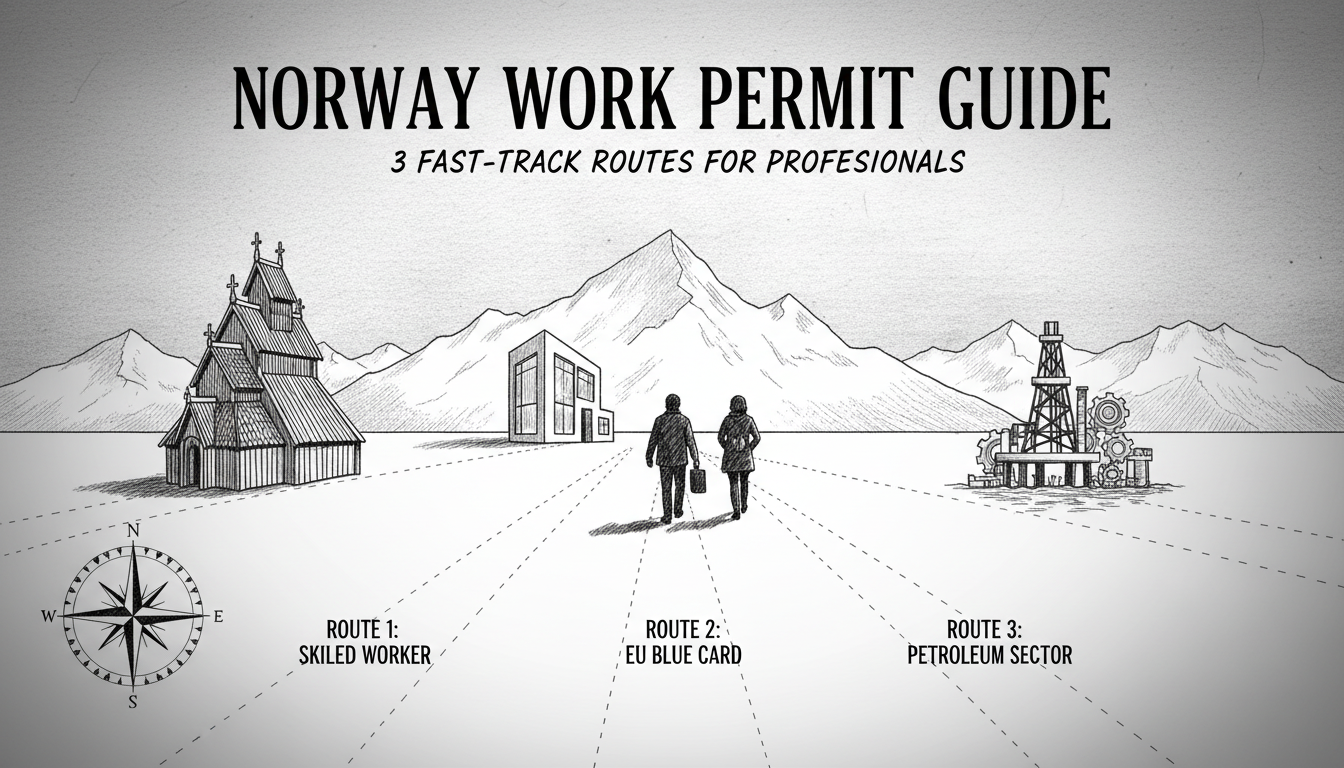
Norway work permit applications can take six months or just 28 days. The difference depends on your profession, salary, and preparation. German software developer Marcus experienced the faster route. His permit was approved in under a month through a special scheme for tech workers. His story is not unique, but it highlights a critical pathway for Norway's economy. The country needs foreign talent to fill persistent gaps in its workforce.
A System Built on Points and Pay
Norway operates a points-based immigration system for skilled non-EU professionals. The Norwegian Directorate of Immigration (UDI) evaluates job offers, qualifications, and salary. A standard skilled worker permit requires a concrete offer from an approved Norwegian employer. That employer must first prove they advertised the position within Norway and the broader European Economic Area (EEA). This safeguard for the domestic labor market is a core principle. The standard process is methodical, with a typical wait time of three to six months.
"The system is transparent but demands precision," explains an immigration lawyer who advises tech startups. "Missing documentation or a salary below the threshold is the most common reason for delay or rejection." For 2024, the general minimum salary for a skilled worker permit is 500,000 Norwegian kroner per year. Some sectors have different benchmarks. For example, a registered nurse might start on a salary between 450,000 and 550,000 kroner. The UDI closely compares the offered salary to Norwegian standards for that specific role.
The Fast-Track Lanes: ICT and Shortage Occupations
For those in high-demand fields, Norway has established expedited routes. The ICT Scheme for tech specialists is the most prominent fast-track. It is designed for companies needing to transfer or hire key ICT personnel from outside the EEA. To qualify, the position must require specialist expertise and the annual salary must exceed 600,000 kroner. Successful applications are often processed within one month, as Marcus discovered.
Norwegian tech firms like Cognite, Aize, and Kahoot! regularly use this scheme. They recruit data engineers, software developers, and cybersecurity experts from a global talent pool. "The ICT scheme is vital for our growth," said the Chief Technology Officer at a rising Oslo-based fintech company. "It allows us to compete for top-tier talent internationally and bring them to our innovation labs in Majorstuen or Fornebu quickly."
Another accelerated route is the skilled worker permit for occupations on the national shortage list. The UDI and Norwegian Labour and Welfare Administration (NAV) publish this list annually. It identifies professions where there are not enough qualified workers in Norway and the EEA. Recent lists have included engineers, electricians, and certain healthcare professionals. Applicants for these roles often benefit from prioritized processing.
Navigating the Application: A Step-by-Step Approach
The journey starts with a valid job contract. Your prospective employer must be registered in the Norwegian Register of Business Enterprises. They initiate the application via the UDI's online portal. The employee then completes their part, submitting a suite of documents. This includes a passport, educational diplomas, and the signed employment contract. All foreign documents require certified Norwegian or English translations.
Salary remains the most critical factor. The UDI conducts a rigorous assessment to ensure the pay is "sufficient." This means it must not only meet the numerical threshold but also be commensurate with the role's standard pay in Norway. An offer deemed too low for the position will result in rejection, regardless of other qualifications. Experts stress that applicants should research typical Norwegian salaries for their role on sites like Finn.no or in collective bargaining agreements.
Strategic Job Hunting for International Candidates
Success begins long before the application form is opened. Targeting the right companies significantly improves chances. Large international corporations like Equinor have dedicated immigration teams and extensive experience hiring from abroad. The energy giant hired over 200 foreign engineers in a recent recruitment drive. Norway's growing tech scene is also a fertile ground. Scale-ups like Oda and gaming company Funcom frequently seek international talent.
Networking is powerful. Attending industry events such as the TechBBQ conference in Copenhagen or the Oslo Innovation Week can lead to direct connections with hiring managers. Online, joining groups like the Oslo Tech Meetup provides insights into the local ecosystem and job openings. When applying, tailor your CV to Norwegian standards. Keep it concise, typically two pages, and focus on measurable achievements and project outcomes. For developers, a well-maintained GitHub profile can serve as a powerful portfolio.
The Bigger Picture: Norway's Reliance on Global Talent
Norway's work permit policies exist at a crossroads. The country is not an EU member but is part of the European Economic Area. This allows for the free movement of EU/EEA citizens, who face no work permit requirements. For non-EU talent, the system is more structured. It aims to address specific economic needs without displacing local workers. With an unemployment rate hovering around 3.6%, Norway's labor market is tight. Key sectors face genuine shortages.
Immigrants already form a substantial part of Norway's workforce. They contribute significantly to healthcare, technology, construction, and the maritime sector. As Norway continues its digital transformation and seeks to diversify its oil-dependent economy, this need for specialized skills will only intensify. The fast-track schemes are a direct policy response to this economic reality.
However, the system is not static. Processing times can fluctuate based on application volumes and changes in political priorities. The official shortage occupation list is revised yearly, reflecting the shifting demands of the Norwegian economy. What is a fast-track profession today may not be one tomorrow.
Final Advice for a Smooth Process
The contrast between a 28-day approval and a six-month wait is stark. For qualified professionals, the key is to align with Norway's economic priorities. Secure a job in a high-demand sector, ensure the salary is unequivocally sufficient, and prepare flawless documentation. Work closely with your prospective employer, as their role in initiating and supporting the application is fundamental.
Norway's doors are open to skilled professionals who can fill its critical gaps. The pathway is clearest for those who bring expertise in technology, engineering, and other fields where local supply falls short. For them, the promise of working in a stable, innovative Scandinavian economy can become a reality in a matter of weeks, not months. The question for Norway is whether its fast-track lanes will widen enough to fuel its future ambitions.