
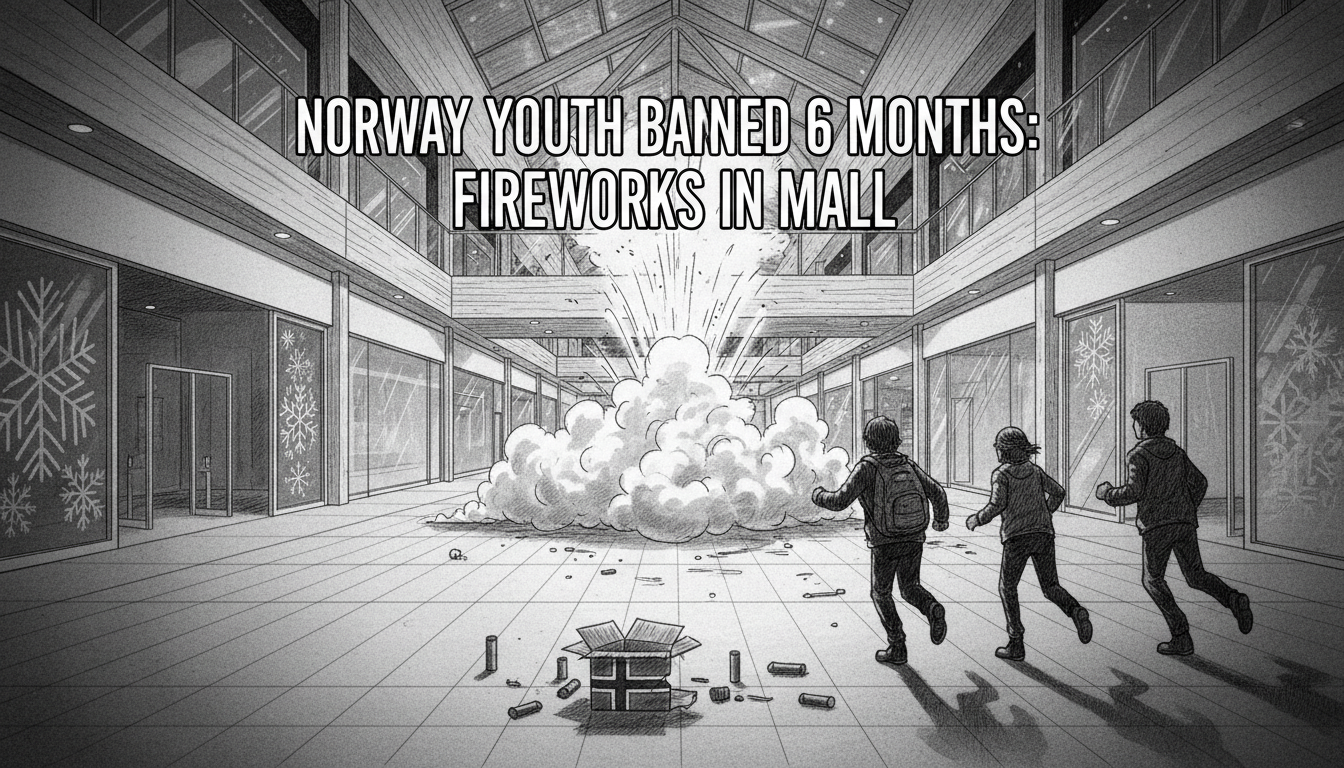
Norway shopping center security faced a stark test this week when a youth gang set off fireworks inside Bergen's Lagunen Storsenter. Two teenagers, aged 15 and 17, now face a six-month ban from the mall and a 24-hour police expulsion order. The incident highlights a persistent challenge for urban centers across the country.
"They are not suspected of having thrown the firework itself, but they were present," said operations leader Knut Dahl-Michelsen of the West Police District. This distinction is central to the legal and social debate now unfolding. Security guards at Lagunen issued the half-year ban, while police used their authority for a shorter, immediate removal.
Lagunen Storsenter is one of the largest retail complexes in the Bergen region. It functions as a central hub for commerce and, inevitably, for youth socialization. Monday afternoon's events transformed a routine shopping day into a scene of alarm, with loud bangs echoing through the enclosed space. No injuries were reported, but the psychological impact on shoppers and staff was immediate.
A Legal Framework for Exclusion
The dual-layer response—a private ban from mall security and a state-sanctioned police expulsion—demonstrates Norway's toolkit for maintaining public order. The Police Act grants officers the power to issue 24-hour expulsion orders from specific areas to prevent immediate disturbances. This is a preventative measure, not a punishment.
Private security firms, employed by shopping centers like Lagunen, operate under different rules. Their six-month ban is a contractual prohibition from entering private property. Violating this ban could lead to a trespassing charge if the individual refuses to leave. "The collaboration between private security and the police is crucial," says Lars G. Svendsen, a security analyst based in Oslo. "The private ban deals with long-term access, while police handle the acute situation. It's a layered approach."
This incident raises questions about the balance between public safety and the rights of young people. A six-month exclusion from a major community space is significant. For teenagers, shopping centers are often more than places to buy goods; they are social arenas, especially during colder months.
Understanding the 'Why' Behind the Act
Criminologists and youth workers point to a complex mix of motivations for such disruptive acts. "We must look beyond the simple label of 'vandalism' or 'thrill-seeking'," explains Dr. Anette Simonsen, a researcher in youth sociology at the University of Bergen. "While the act itself is dangerous and unacceptable, the context matters. Is it about claiming space? Boredom? A response to social exclusion? Often, it is a performance for peers."
Bergen, like other Norwegian cities, grapples with providing engaging alternatives for youth. Municipal youth clubs and organized activities exist, but their appeal can wane for some teenagers. The draw of large, warm, and unstructured spaces like shopping centers is powerful. "When young people gather in these spaces without a purpose, the potential for mischief rises," Dr. Simonsen notes. "The challenge is to channel that energy positively before exclusion becomes the only tool."
There is little evidence to suggest such incidents are rising sharply in Norway. However, each event fuels public debate about youth behavior and social control. The visual and auditory shock of fireworks in a confined public space makes it particularly potent, generating outsized concern compared to other forms of minor delinquency.
The Practicalities of Enforcement and Prevention
Enforcing a six-month ban across a vast shopping center is logistically challenging. Security teams rely on recognition and vigilance. Modern centers often use shared databases of banned individuals and photo alerts for security staff. The effectiveness hinges on a consistent security presence.
Prevention strategies are increasingly focused on collaboration. Many Norwegian malls participate in the "Trygt Senter" (Safe Center) program, which fosters direct cooperation between center management, security, local police, and social services. The goal is to identify recurring issues and individuals early, potentially connecting them with support rather than solely relying on punishment.
"A ban solves the immediate problem for the property owner," says security analyst Svendsen. "But if the young person simply moves the problematic behavior to another public space, society hasn't gained much. Where possible, a follow-up from municipal youth services would be the ideal, though resource-intensive, complement."
For the parents of the two teenagers involved, the consequences are immediate and practical. The police expulsion and the mall ban are formal interventions that bring the behavior into the home in a new way. It can serve as a catalyst for family discussions and potential recourse to parental guidance resources.
A Broader Look at Urban Youth Spaces
The Lagunen incident is a microcosm of a universal urban dilemma. How do communities manage shared spaces where different groups—shoppers, elderly, families, teenagers—must coexist? Norwegian society places a high value on inclusive, open public realms, but this openness can create friction.
Some cities have experimented with dedicated youth spaces with flexible programming, managed with input from young people themselves. The success of such initiatives is mixed, often struggling to attract the very demographics deemed most at risk of anti-social behavior. The informal, unsupervised nature of a mall hangout is part of its appeal.
Business owners have a clear interest in a safe, welcoming environment. Perceived insecurity can deter customers. The swift action by Lagunen's security reflects this commercial reality. Their mandate is to protect property, customers, and staff, not to provide social work.
The Path Forward After the Bangs Fade
The fireworks have detonated, the smoke has cleared, and two teenagers are prohibited from entering Lagunen Storsenter until autumn. The incident is closed from an enforcement perspective. Yet, the questions it prompts linger.
Does a lengthy ban from a central community space risk further alienating young people? Or does it provide a necessary, clear boundary and consequence for actions that endanger public safety? There is no simple consensus in Norway, a country deeply committed both to social welfare and the rule of law.
For the police, the case is a routine application of public order powers. For the mall, it is a security incident managed. For youth workers, it is a potential signpost pointing to a need for engagement. For the public, it is another data point in an ongoing conversation about youth, freedom, and responsibility in shared spaces.
The ultimate test will be what happens over the next six months. Will the exclusion be a turning point, or merely an intermission? The answer depends less on security guards and more on the community structures that exist to catch young people when they start to fall, long before the fuse is lit.