
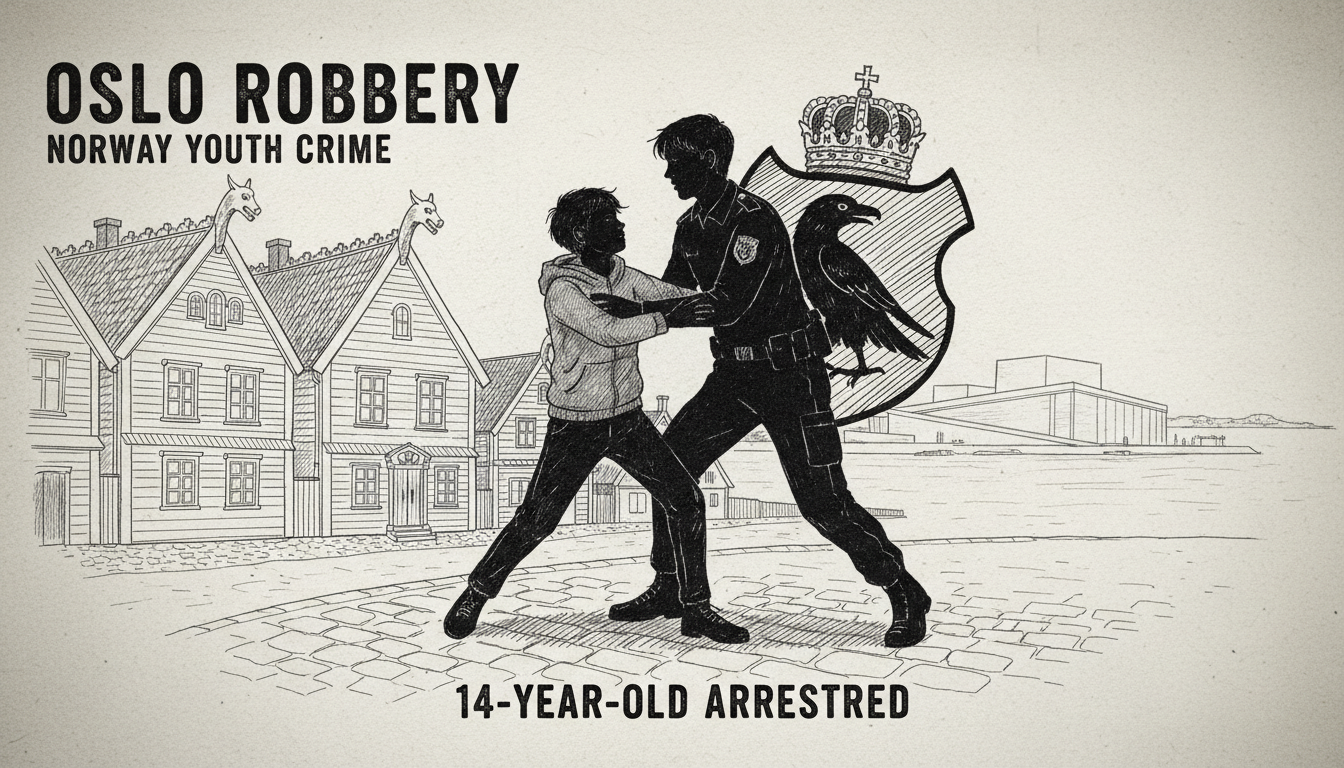
Norway youth crime concerns are rising after Oslo police arrested a 14-year-old boy for robbing a 15-year-old. The incident occurred in the capital, with the suspect allegedly wearing the victim's stolen jacket and watch when apprehended. Officers recovered the items and returned them to the teenage victim. This case highlights a persistent challenge for Norwegian authorities, who balance a welfare-focused justice system with public demands for safety.
A Disturbing Pattern in the Capital
While violent crime rates in Norway remain low by international standards, incidents involving minors as both perpetrators and victims generate significant public and political attention. The Oslo Police District logs hundreds of robberies annually, with a portion involving youth. This specific arrest follows a recognizable pattern: a confrontation between teenagers, often over valuables like designer jackets, smartphones, or watches. Police efficiency in this case—quickly identifying the suspect and recovering the property—demonstrates standard investigative protocol. Yet, the ages involved prompt deeper questions about prevention.
"Every case where children are involved in serious crime is a failure," said a senior Oslo police officer, who requested anonymity as they were not authorized to speak publicly on the specific case. "Our job is to solve the crime, but the bigger task for society is to stop it from happening in the first place."
The Juvenile Justice Dilemma
Norway's approach to youth crime is fundamentally rehabilitative. The minimum age of criminal responsibility is 15, meaning the 14-year-old suspect in this robbery cannot be formally charged under the Penal Code. Instead, the case will be handled by the Child Welfare Services (Barnevernet). The focus shifts from punishment to intervention, assessing the child's home environment, school situation, and potential need for support services. This system, praised internationally for its humanity, can frustrate victims and a public seeking clear accountability.
Experts argue the system's strength is its long-term view. "A 14-year-old who commits a robbery is a child in crisis," said Kari Lossius, a researcher at the Norwegian Center for Violence and Traumatic Stress Studies. "The punitive response might satisfy a short-term urge for justice, but it often cures a career criminal. The welfare model seeks to understand the 'why'—is it poverty, peer pressure, neglect, or substance abuse?—and address that."
However, critics point to repeat offenses. Some youths cycle through multiple interventions without apparent change, eroding confidence in the rehabilitative model. The government has periodically tightened measures, allowing for more secure placements in child welfare institutions for the most serious or persistent young offenders.
Socioeconomic Factors and Urban Pressure
Analysis of crime data often reveals concentrations in specific Oslo neighborhoods. While police do not release detailed location data for individual cases to protect identities, broader statistics show higher reports of theft and robbery in certain inner-city and eastern districts. These areas frequently grapple with higher population density, lower average incomes, and greater ethnic diversity. Correlation is not causation, but researchers identify clear risk factors.
"Social inequality is the single largest driver of crime, including youth crime," said Lossius. "Oslo is a prosperous city, but that prosperity is not evenly shared. When young people feel they cannot achieve status or wealth through legitimate means, some turn to alternatives. A branded jacket isn't just clothing; it's a symbol of belonging and success."
Community policing initiatives, where officers build relationships in neighborhoods, are a key part of Oslo's strategy. The goal is to create trust and provide positive adult contact points outside of school and family.
A National Conversation on Prevention
This robbery incident feeds into an ongoing national debate. The Conservative (Høyre) and Progress (FrP) parties often advocate for stricter consequences, arguing that the current system fails to deter crime. The Labour (Arbeiderpartiet) and Socialist Left (SV) parties typically defend the welfare model while calling for increased investment in social programs, schools, and family support.
Prevention programs are widespread but vary in effectiveness. Schools implement anti-bullying campaigns and social competency training. Municipalities fund youth clubs and sports activities to provide structure and positive peer groups. The challenge is measuring success; it is impossible to count crimes that never happen.
"The easy political answer is to promise more police and tougher sentences," said the police officer. "The harder, more expensive, and less visible answer is to fund social workers, youth mentors, and school counselors. That is often where the real difference is made for a 14-year-old on the edge."
Looking Ahead: Recovery and Responsibility
For the 15-year-old victim, the immediate trauma of the robbery may be compounded by the knowledge that the suspect, due to his age, will not face a traditional trial. Victim support services in Norway are robust, offering counseling and legal guidance. The return of the stolen property is a small but tangible step toward restoration.
For the 14-year-old suspect, a complex process begins. Child Welfare Services will conduct a comprehensive assessment. Possible outcomes include mandatory counseling, participation in structured programs, or, in rare cases for severe or repeated offenses, placement in a secure care facility. The process is confidential, focused on rehabilitation and reintegration.
This case is a single data point in Oslo's crime statistics. It will not drastically alter annual figures. Yet, it encapsulates a central tension in one of the world's most affluent societies: how to maintain both its deeply held commitment to social welfare and the absolute safety of its citizens. The answer, as Oslo's authorities know, lies not in choosing one over the other, but in the difficult, daily work of pursuing both.
The true test of Norway's model will be what happens to both boys in five years' time. Will the victim feel secure? Will the suspect have become a productive adult? The system is betting on redemption, but it is a wager that requires constant resources, patience, and public faith.