
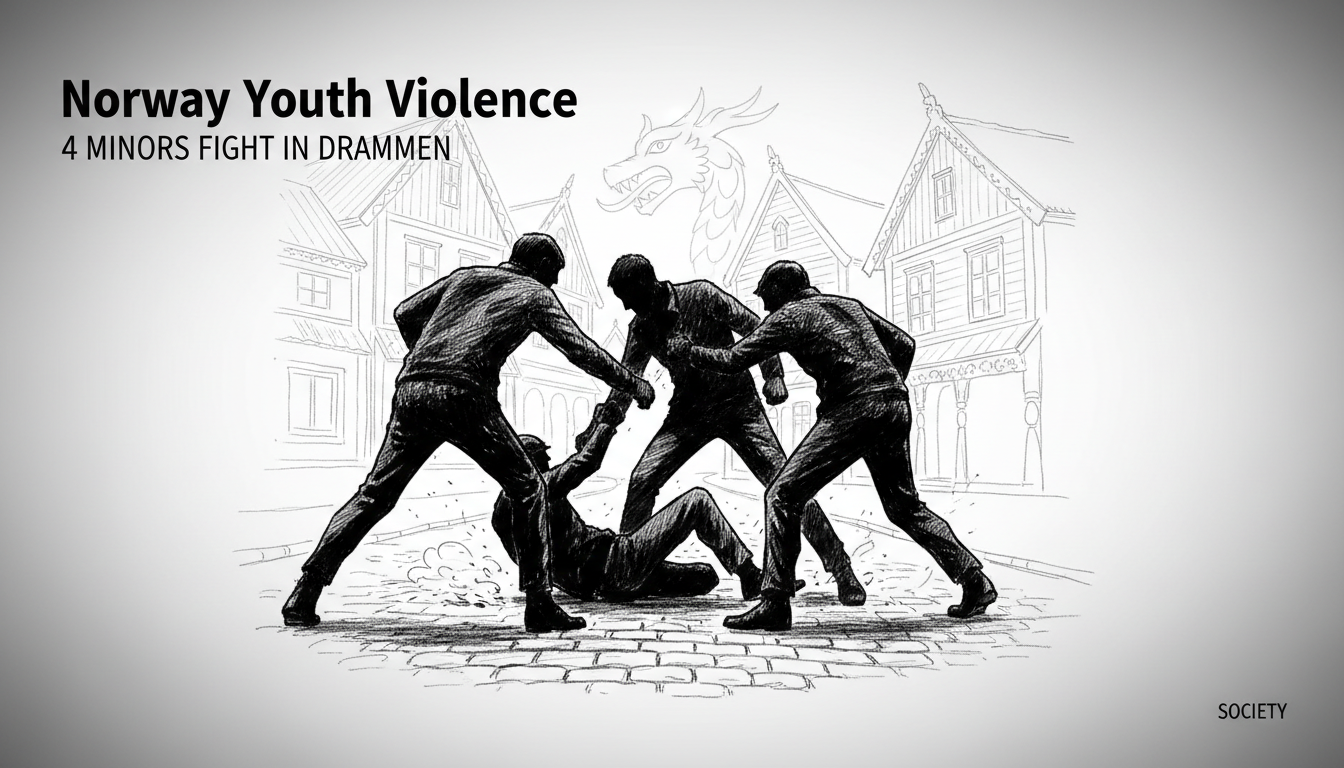
Norway youth violence concerns resurfaced after a fight involving four underage boys at a shopping centre in Krokstadelva. Police and ambulance services responded to reports of a violent incident on Tuesday afternoon. One boy was transported to the emergency room for further assessment, though authorities believe his injuries are not life-threatening. Drammen Police District confirmed no weapons or objects were used during the altercation.
Officers are investigating the sequence of events and collecting witness statements at the scene. The incident occurred in a public space frequented by families, raising immediate questions about safety and conflict resolution among local youth. While violent episodes involving minors are not statistically common in Norway, each event triggers a focused response from both law enforcement and social services.
A Community's Response in Krokstadelva
Krokstadelva is a village within the Drammen municipality, situated along the Drammenselva river in Viken county. It is typically a quiet area, making this public altercation particularly jarring for residents. Local shop owners and patrons witnessed the police response, which included multiple patrol cars and an ambulance. The visible emergency presence at the Krokstadelva shopping centre disrupted the normal afternoon routine.
“Our primary focus is to establish a clear picture of what happened and why,” a police operations leader said in a statement. “We are speaking with everyone involved and those who saw the event. At this stage, we are treating it as an isolated conflict between known individuals.” The police emphasized their standard procedure for youth incidents combines immediate law enforcement with later referral to child welfare services, known as Barnevernet, for follow-up.
The Broader Context of Youth Conflicts
This incident fits into a broader, though limited, pattern of physical conflicts among minors in Norwegian communities. National crime statistics show that most youth offenses are non-violent, but physical altercations in public places draw significant attention. Experts point to a range of potential underlying causes, from interpersonal disputes and social media friction to deeper issues of integration or family challenges.
“An event like this is a signal,” said Dr. Henrik Lunde, a sociologist at the University of Oslo who studies adolescent behavior. “It rarely exists in a vacuum. The key question for prevention is what happened before the boys met at the shopping centre. Was there an online argument? A prior disagreement? Effective intervention requires mapping the social dynamics around these individuals, not just the incident itself.” Lunde stresses that Norway’s system is generally good at reactive measures but that consistent, early preventative work in schools and communities is crucial.
How Norwegian Systems Intervene
The response to youth violence in Norway is a multi-agency effort. Police handle the immediate law enforcement and investigative aspects. If the children are below the age of criminal responsibility, which is 15 in Norway, the case typically transitions to the municipal child welfare services. Their mandate is to assess the child’s overall situation, provide necessary support, and implement measures to prevent reoccurrence. This can include family guidance, mentoring programs, or other social services.
For the minors involved in the Krokstadelva fight, this process likely began as police concluded their initial on-scene investigation. The boy taken to the emergency room will receive medical clearance before being released into the care of parents or guardians. All parties will then await contact from follow-up services. This integrated approach aims to address both the symptom—the fight—and any potential root causes in the youths’ environments.
Local Impact and National Reflections
In Drammen, local politicians and community leaders often discuss youth engagement and safety. The municipality funds various after-school programs, sports clubs, and youth centres designed to provide positive outlets and supervision. Incidents like the one in Krokstadelva inevitably lead to renewed scrutiny of these resources' availability and reach.
“It’s a reminder that we must constantly evaluate how we connect with our young people,” said Marianne Solberg, a member of the Drammen City Council. “Are our youth clubs open at the right times? Do children know where to turn if they feel excluded or are in conflict? We will be looking at this closely.” The challenge for many Norwegian municipalities is ensuring these resources are known and accessible to all children, not just those who actively seek them out.
Looking Beyond the Immediate Incident
The Krokstadelva event, while minor in terms of injury severity, acts as a case study. It highlights the standard Norwegian protocol: a swift police response to secure public safety, medical attention for any injured parties, and a subsequent shift toward welfare-based interventions. This model is designed to be restorative rather than purely punitive, especially for minors.
However, experts like Dr. Lunde argue the real test occurs in the weeks and months that follow. “The system is activated, but does it lead to meaningful change for these boys?” he asks. “Success is not measured by the police report being closed. It is measured by whether these youths are better supported and less likely to end up in similar situations in the future.” This requires sustained effort from social workers, schools, and families—a collaboration that is sometimes difficult to maintain after the initial crisis fades.
Norway’s overall rates of youth violence remain low by international standards, a fact often attributed to its robust welfare state and high levels of social trust. Yet, as the response in Krokstadelva shows, no community is entirely immune to flashes of conflict among its youngest members. The incident serves as a periodic check on the nation’s preventative infrastructure, prompting local officials to ask whether they are doing enough to reach children before a disagreement escalates into a public fight.
The story from Krokstadelva is not one of systemic failure, but rather of a system being tested. The efficient emergency response is a given in Norway. The longer, quieter work of prevention and support continues, often unnoticed, until an afternoon at a shopping centre reminds everyone why it is necessary.