
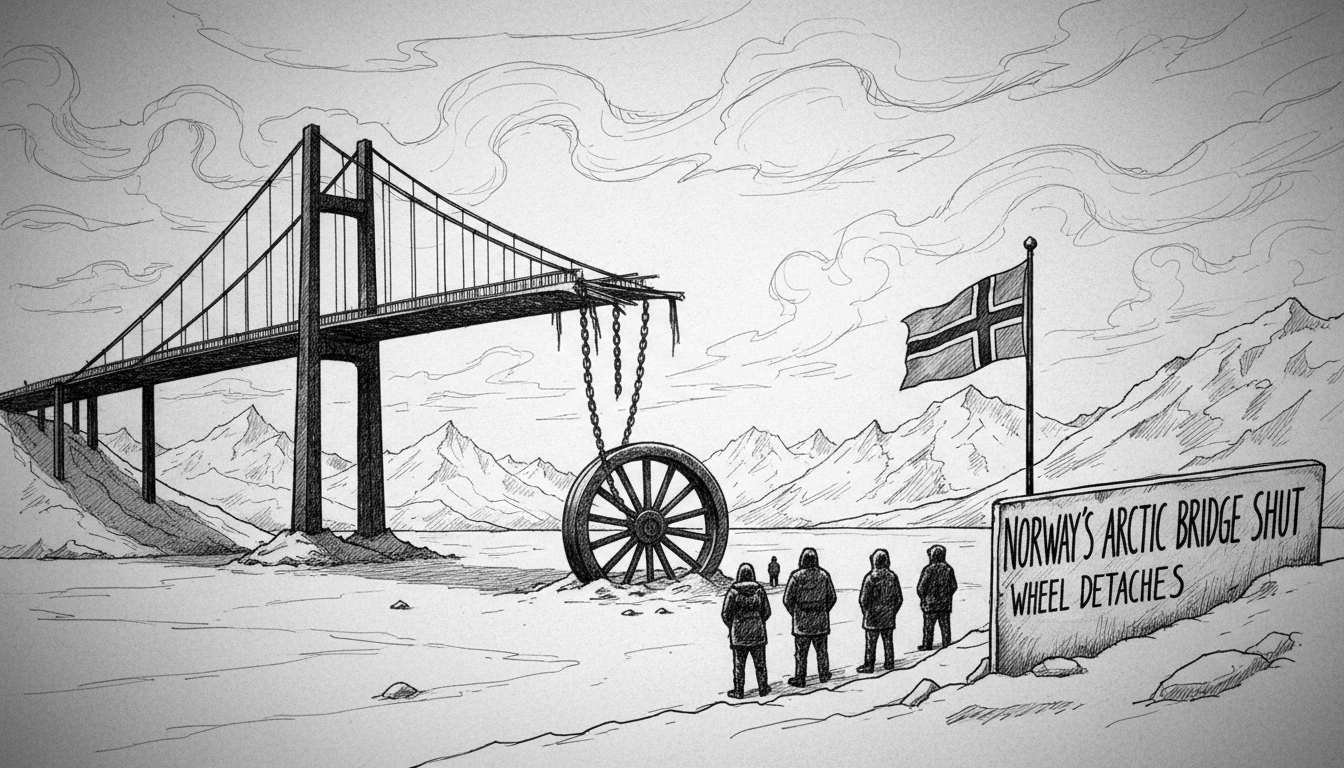
Norway's vital Sandnessund Bridge connecting Tromsø to Kvaløya was closed for hours after a minibus lost a wheel, striking two other vehicles. The dramatic incident on the key Arctic transport link caused major material damage but, authorities confirmed, no injuries. Police worked urgently to clear the scene and reopen the crucial crossing, highlighting the fragility of Northern Norway's island-dependent infrastructure.
A Critical Link Severed
The closure of the Kvaløy Connection, centered on the 1,220-meter Sandnessund Bridge, immediately severed the primary road link between Tromsø city and the larger island of Kvaløya. For the communities on Kvaløya, the bridge is not merely a convenience but an essential artery. It carries daily commuters, school buses, freight for local businesses, and provides the main access route for emergency services. An unexpected closure triggers immediate logistical crises, stranding people and disrupting supply chains in Norway's far north. The incident occurred during a period of regular traffic, amplifying the disruption for hundreds of motorists.
Police logs stated their immediate priority was to 'get the bridge opened again as soon as possible,' a clear acknowledgment of the route's regional importance. The Sandnessund Bridge, opened in 1974, is a classic example of the ambitious engineering that binds Norway's coastal and island communities to the mainland. Its suspension design is a familiar silhouette against the Arctic sky, but its function is utterly practical. When it stops, a significant part of the Troms region's mobility grinds to a halt.
The Ripple Effect of a Single Incident
While no one was physically hurt, the economic and operational impact of such a closure is substantial. "Every hour a key piece of infrastructure like this is closed has a multiplying effect," said Lars Fjelldal, a transport analyst based in Bodø. "It's not just about the delayed cars. It's about delayed goods, rescheduled appointments, missed work hours, and the strain on alternative routes, which in this case are extremely limited."
The only alternative for reaching Kvaløya from Tromsø involves a lengthy detour using other bridges and roads far to the south, adding hours to any journey. For time-sensitive freight or emergency personnel, this is not a viable option. The incident exposes the vulnerability that comes with reliance on a single, critical point of failure. Municipal contingency plans are tested in real-time, with ferries unable to provide a quick substitute for a modern highway bridge.
Local business owners on Kvaløya expressed immediate concern. A manager at a fish processing plant noted that while their cold storage provided a buffer, prolonged closure would disrupt both incoming supplies and outgoing shipments. The psychological impact is also real for residents, who are reminded of their geographical isolation when the primary tether to the region's urban center is cut.
Infrastructure Resilience in the Arctic Context
This accident forces a broader conversation about the maintenance and monitoring of Norway's aging infrastructure in harsh climates. The Sandnessund Bridge is nearly 50 years old. While Norwegian bridge standards are high, the Arctic environment presents unique challenges. Saltwater corrosion, freeze-thaw cycles, and extreme weather place constant stress on materials and structures. Regular, rigorous inspection regimes are paramount.
The fact that a wheel detachment caused the incident shifts focus onto vehicle safety and roadworthiness checks, especially for commercial and multi-passenger vehicles. It raises questions about whether routine traffic incidents on such infrastructure warrant a different class of response, given the disproportionate consequences of a closure. Should there be faster-deployed temporary bridging solutions or dedicated rapid-clearance teams for critical chokepoints?
"We build these magnificent structures to conquer geography," Fjelldal added. "But we must also invest equally in the systems to protect them from failure and to manage crises when they occur. In the north, a bridge is more than concrete and steel; it's a lifeline."
The Road to Reopening and Future Preparedness
Police and road authorities faced the complex task of securing the accident scene, conducting necessary investigations for potential liability, and clearing the damaged vehicles and debris—all while under intense pressure to restore the flow of traffic. The efficiency of this response is a direct function of planning and resource allocation. The successful reopening of the bridge after several hours likely involved coordinated efforts from the Troms Police District, the Norwegian Public Roads Administration (Statens vegvesen), and possibly towing and recovery specialists.
For local politicians, such events are a stark reminder to prioritize infrastructure budgets. As the climate changes and weather patterns in the Arctic become more unpredictable, the resilience of transport networks will be tested further. Investments in smart monitoring technology, such as sensors that can detect structural weaknesses or unusual vibrations, could provide early warnings. Strengthening alternative routes, though costly in rugged terrain, may also need revisiting.
The incident on the Sandnessund Bridge was resolved without tragedy, but it serves as a powerful drill. It tested emergency protocols, revealed systemic vulnerabilities, and reminded tens of thousands of Norwegians that their modern, connected lives depend on physical links that can, in a moment, be broken. As traffic resumes its flow across the bridge, the questions it raised about safety, maintenance, and contingency planning linger, demanding answers from engineers and policymakers alike. The true measure of resilience is not just in building strong bridges, but in ensuring the system around them can withstand a single, flying wheel.