
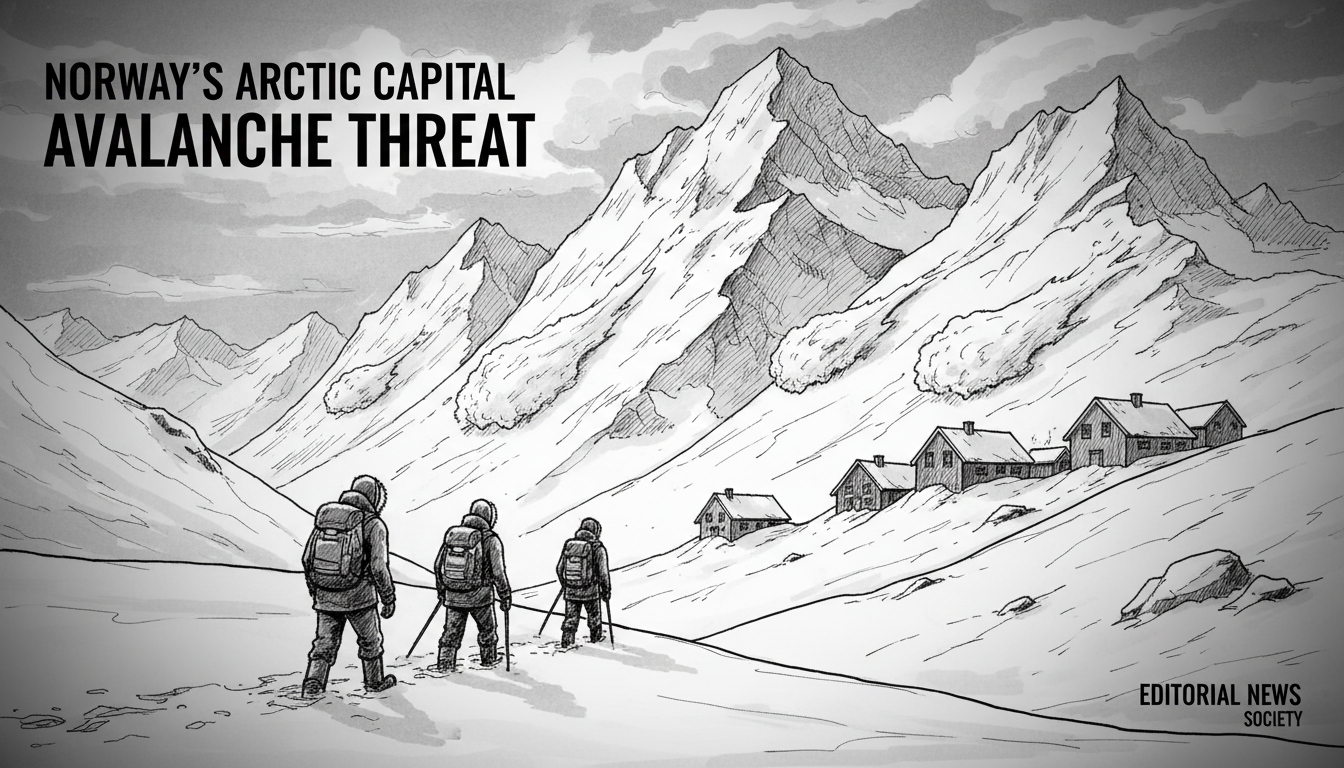
Norway's remote Arctic settlement of Longyearbyen is on high alert as avalanche danger levels escalate to 'considerable' across the Nordenskiöld Land region. The Norwegian avalanche warning service Varsom raised the threat from level two to three, issuing an orange alert effective Thursday and continuing through Friday. Strong winds are creating unstable layers of wind-drifted snow, making human-triggered slides highly probable on steep slopes.
Residents of the world's northernmost town are being urged to avoid steep leeward areas where the snowpack has developed a flaky, fragile surface. This specific warning for 'fokksnø'—a Norwegian term for snow transported and deposited by wind—highlights a precise and dangerous condition familiar to Arctic communities. The alert comes while mainland Northern Norway maintains lower, stable danger levels of one and two, underscoring the unique and amplified risks on the Svalbard archipelago.
A Community Under the Mountain's Shadow
Longyearbyen, home to nearly 2,500 people, is nestled in a valley on the island of Spitsbergen. Its very location, carved into the foothills of steep mountains, makes it inherently vulnerable. The town's history is marked by avalanche tragedies, most recently in December 2015 when two snowslides struck residential areas, killing two people and destroying eleven homes. That event forced a fundamental re-evaluation of the town's safety and led to the permanent evacuation of the most at-risk neighborhood, Lia.
"An orange level three warning is a serious signal for a community like ours," said a local safety official, who requested anonymity as they were not authorized to speak publicly. "It means the conditions are primed on many slopes. It doesn't take much—a skier, a snowmobile, even just the weight of new snow—to trigger a release." The official noted that while the immediate backcountry is the primary concern, the warning puts the entire community's emergency response systems on standby.
The Science of Arctic Instability
The current threat stems from a classic Arctic weather sequence. Recent snowfall followed by strong winds has created what experts call a 'wind slab.' This is a cohesive, stiff layer of snow formed when wind packs crystals together on the lee side of ridges and terrain features. This slab often rests on a weaker layer of older, faceted snow, creating a textbook weak-on-strong instability. The warning specifically mentions areas where the surface has 'flaked,' indicating this fragile interface.
Dr. Lene Kristin Borgesen, a snow physicist with the Norwegian Water Resources and Energy Directorate (NVE), explained the mechanics. "In the High Arctic, the snowpack develops differently than on the mainland. Less snow, extreme cold, and prolonged darkness create persistent weak layers. When a significant wind event deposits a dense slab on top of that, the danger spikes rapidly. The 'considerable' rating means natural avalanches are possible, and human-triggered ones are very likely."
This scientific understanding directly informs the public warning. Authorities are not just telling people to be careful; they are providing the specific terrain to avoid: steep leeward slopes. This targeted advice is crucial in a place where recreation and transportation often involve traversing such terrain.
Living with Risk in a Changing Climate
The avalanche warning intersects with broader, existential concerns for Longyearbyen. Svalbard is warming faster than almost any other region on Earth. Scientists have documented thinner and more unstable permafrost, changing precipitation patterns, and altered snowpack structures. While a single avalanche event cannot be directly attributed to climate change, the increasing frequency of intense weather events that create dangerous conditions aligns with climate models for the Arctic.
"We are operating in a new normal," said the local safety official. "The historical data we used for risk assessment is becoming less reliable. We see more rain-on-snow events in winter, more freeze-thaw cycles, and more variable wind patterns. Each of these factors influences avalanche probability and type." This reality has spurred massive public investment in avalanche mitigation, including extensive snow fences above the town designed to hold snow in place and deflection dams built to protect key infrastructure.
Policy and Preparedness in Norway's Far North
The Norwegian government maintains a unique and costly responsibility for Svalbard. The archipelago is under Norwegian sovereignty according to the Svalbard Treaty, but it is a demilitarized zone with an international community. Ensuring safety in such a remote, extreme environment is a significant logistical and financial undertaking. The avalanche warning system, run by Varsom in collaboration with local authorities, is a critical piece of this infrastructure.
Following the 2015 disasters, the Norwegian Parliament, the Storting, allocated substantial funds for protective measures and a revised town plan. The long-term strategy involves a gradual shift of housing and critical infrastructure away from the highest-risk zones. However, the town's constrained geography limits options, creating an ongoing tension between community preservation and resident safety.
For now, the response to the orange alert is operational and immediate. The Governor of Svalbard's office (Sysselmesteren) disseminates the warnings, local schools and businesses review their contingency plans, and the volunteer Red Cross rescue unit prepares for potential call-outs. The community's small size and isolation foster a high degree of self-reliance and collective awareness of natural hazards.
A Global Sentinel in a Warming World
Longyearbyen's avalanche alert is a local story with global resonance. The town functions as a sentinel for climate change, its experiences offering a preview of challenges other northern communities may face. The meticulous process of monitoring, modeling, and warning about snow stability is a microcosm of the broader adaptation required in the Arctic.
As the winds continue to shape the snowpack around Longyearbyen, the orange warning stands as a stark reminder. It highlights the delicate balance between human presence and the powerful natural forces of the High Arctic. The community's vigilance this week is not just about avoiding specific slopes; it is a practiced ritual of resilience in one of the planet's most demanding environments. The question hanging in the frigid air is not if the conditions will change, but how a community on the front lines of a warming world will continue to adapt to the increasing volatility of its frozen landscape.