
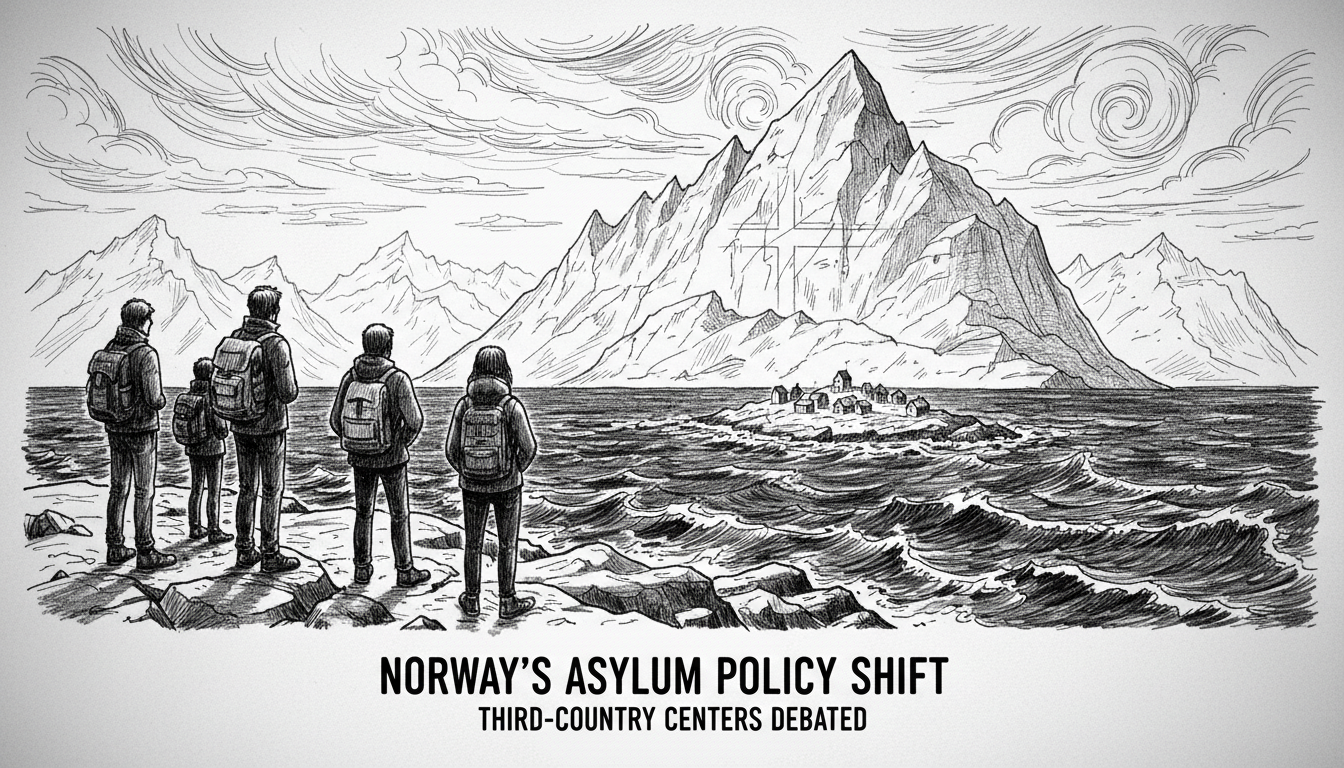
Norway's government is considering a controversial proposal to process asylum seekers in third countries, sparking a fierce political debate that threatens to fracture the country's traditional humanitarian consensus. The move follows a recent agreement by EU interior ministers to explore establishing such centers outside the bloc. Prime Minister Jonas Gahr Støre has signaled openness to the idea, stating his government will not "close the door" if it is pursued in a European context with fundamental legal principles. This potential policy shift has ignited immediate and passionate opposition from the Socialist Left Party (SV), a key supporter of the minority Labour-led government, and exposed deep divisions within the Norwegian left.
"This is unworthy," said Anne Lise Fredlund, SV's immigration policy spokesperson, in a sharp critique of the Labour Party's new position. "There is a reason why so many courts have put their foot down against asylum reception in third countries. Asylum is a right and asylum seekers are human beings. You simply cannot guarantee their rights and safety in a third country." Fredlund's comments underscore the legal and ethical concerns at the heart of the debate, referencing the international legal principle of non-refoulement which prohibits returning refugees to danger.
A European Trend Reaches Norwegian Shores
The proposal under consideration mirrors a broader European trend toward stricter external border management. EU ministers have agreed on a draft law that would allow the establishment of asylum reception centers outside the EU. Asylum seekers could be sent to these centers while their applications are processed by EU authorities. The proposal also includes a common EU list of so-called "safe countries of origin," which includes nations like Bangladesh, India, Morocco, and Tunisia. Applicants from these countries would face expedited procedures and likely return, as they are not considered to need protection.
For Norway, a non-EU member but part of the Schengen passport-free zone, the pressure to align with European migration policy is significant. Tage Pettersen, the Conservative Party's immigration policy spokesperson, argues alignment is essential. "There is no reason for the government to spend a long time considering this. Norway is completely dependent on following the EU's tightening of policies to not become a free haven in Europe," Pettersen said. This view highlights a recurring theme in Norwegian politics: the need to coordinate with the EU on migration to avoid becoming a primary destination due to perceived softer rules.
Internal Rifts and Accusations of Copying the Right
The debate has caused significant internal strife, particularly within the political left. Nimrah Ramzan, leader of the Workers' Youth League (AUF), the Labour Party's own youth wing, launched a surprising and direct attack on the party's leadership. "This proposal is completely unoriginal. The Progress Party proposed this last year. Three months ago, the left-wing got a large majority behind it in the parliamentary election. Then I think it is foolish of the Labour Party to copy the Progress Party," Ramzan stated. Her criticism points to a perceived betrayal of electoral mandates and a shift toward policies traditionally championed by the populist right.
This internal discord presents a tangible problem for Prime Minister Støre. His government relies on support from the Socialist Left Party to pass legislation in the Storting. SV's vehement opposition to third-country centers could force Labour to either abandon the proposal or seek support from right-wing parties, a politically delicate maneuver. The controversy also follows recent warnings from Labour's Knowledge Minister, Tonje Brenna, about further immigration restrictions, signaling a broader strategic shift that is unsettling its traditional allies.
Legal Precedents and Humanitarian Principles
The legal feasibility of third-country processing remains a major hurdle. As SV's Fredlund noted, courts in various jurisdictions have previously blocked similar schemes over human rights concerns. The core challenge lies in ensuring that asylum seekers' rights are fully protected in a third country, including access to fair legal representation, safe accommodation, and protection from refoulement. International refugee law, anchored by the 1951 Refugee Convention, places obligations on the state where an asylum claim is made, complicating the outsourcing of these responsibilities.
Norway has historically been a strong proponent of this international legal framework. The Norwegian Directorate of Immigration (UDI) processes applications with a focus on individual assessment. In 2023, Norway received approximately 3,500 asylum applications, a number significantly lower than during the 2015 crisis but which continues to fuel political discussion. The acceptance rate has generally decreased in recent years, reflecting stricter interpretations and an increased focus on returns.
Experts in immigration law consistently warn of the complexities. "The model raises profound questions about accountability and the practical application of refugee law," said a professor of international law at the University of Oslo, who spoke on background. "If the processing state (Norway) contracts out the reception and procedure to another state, it must have ironclad guarantees that all legal standards are met. History shows such guarantees are extremely difficult to enforce in practice, often shifting burden to less capable nations and putting vulnerable people at risk."
The Road Ahead: Negotiations and National Debate
The EU proposal is far from finalized. It must now be negotiated with the European Parliament, where a more skeptical stance is expected from some political groups. This process will take months, if not longer. Norway's government, led by Justice Minister Astri Aas-Hansen, has stated it will study the final EU agreement closely before making any decision.
The domestic political path is equally uncertain. For the Labour Party, the calculation involves balancing a desire to demonstrate control over immigration, address public concerns, and maintain European cooperation against the risk of alienating its political base and coalition partners. The passionate reactions from SV and the AUF suggest the party may have underestimated the strength of feeling on this issue within its own political sphere.
The debate transcends a single policy. It touches on Norway's self-image as a humanitarian actor on the global stage, its relationship with European integration, and the ongoing redefinition of social democratic politics in an era of polarized migration debates. The proposal for third-country centers, whether it becomes reality or not, has already succeeded in exposing the fragile and shifting alliances that define Norway's current political landscape. As the EU negotiations proceed, the discussion in Oslo will continue to grapple with a fundamental question: Can a nation outsource its asylum responsibilities without undermining the very principles upon which its international reputation was built?