
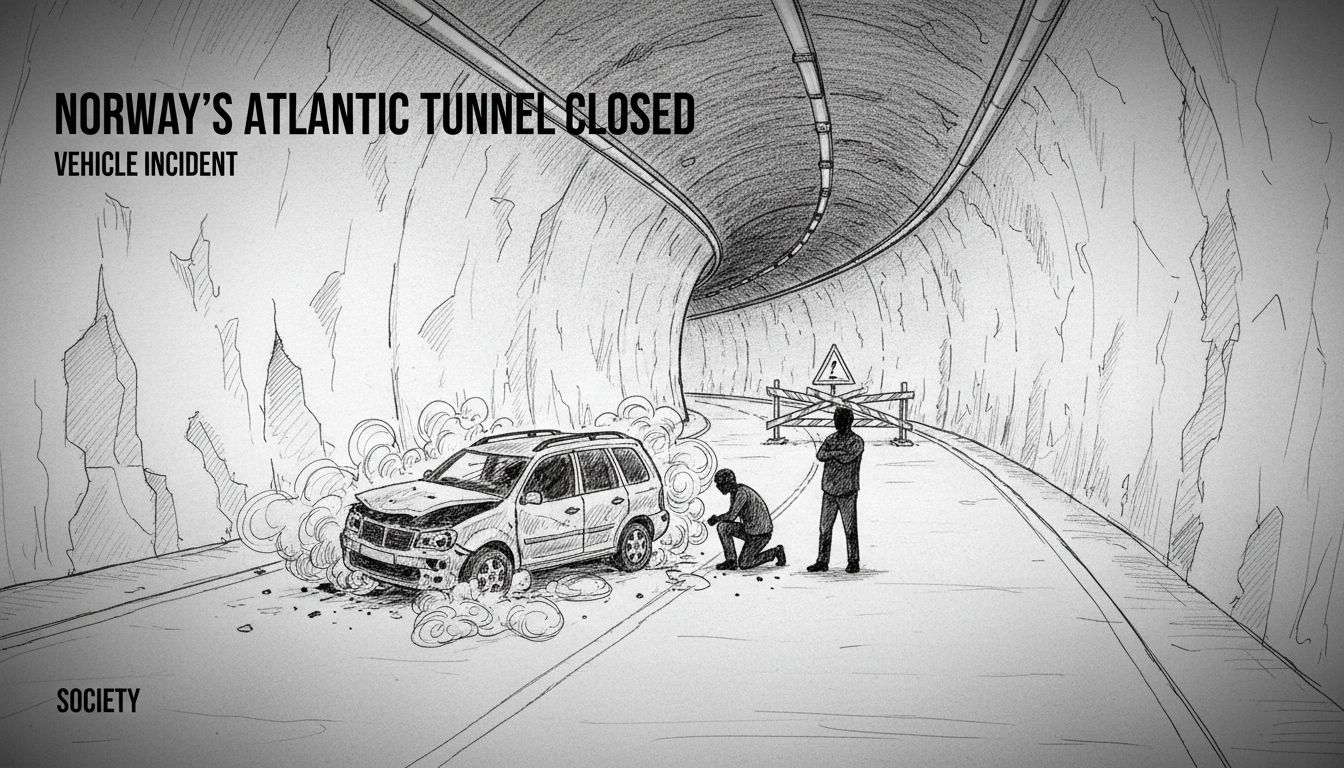
Norway's Atlanterhavstunnelen is closed in both directions after a vehicle stopped inside the 5,727-meter subsea passage. The sudden shutdown of County Road 64's key link between Averøy and Kristiansund occurred without warning, trapping the vehicle and halting all traffic. Emergency services from Møre og Romsdal county are on site, working to secure the tunnel and assist the occupants. Authorities have not yet released details on the cause of the stoppage or any potential injuries.
Tunnel Sealed: Immediate Response
Police and road operation crews sealed the tunnel entrances shortly after the incident was reported. No vehicles are being permitted to enter from either the Averøy or Kristiansund sides. The confined space of the subsea structure presents unique challenges for rescue operations. A tow truck and technical team must navigate the steep 8% grade to reach the stranded vehicle, a process that can take considerable time at such depth.
Officials have established a crisis management team to coordinate the response. Their priority is ensuring the safety of all individuals inside before clearing the tunnel for reopening. The closure is indefinite, with updates promised via the Norwegian Public Roads Administration's channels. This incident underscores the vulnerability of critical infrastructure to sudden mechanical failure.
A Depth of Disruption
The Atlanterhavstunnelen is no ordinary road closure. It plunges to 250 meters below sea level, making it one of the deepest undersea road tunnels globally. Its average daily traffic of 3,000 vehicles has been forced to find alternatives immediately. The only viable detour requires a lengthy ferry crossing from Averøy to Kristiansund, a route largely supplanted by the tunnel's opening in 2009.
Ferry operator Fram Shipping has announced it is adding extra departures to handle the surge in demand. However, capacity is limited, and significant delays are inevitable, especially for commercial freight. The tunnel is a crucial artery for the region's fisheries and offshore supply chain. A prolonged closure could disrupt deliveries to the important maritime hub of Kristiansund.
Local politicians have expressed concern. "This shows our absolute dependence on this single piece of infrastructure," said a representative from the Kristiansund city council. "We have built our daily commutes and economic activity around its reliability. Today, that model is stressed." The closure tests the redundancy of Norway's famed coastal transportation network.
Engineering Marvel, Practical Lifeline
The Atlantic Ocean Tunnel was a monumental engineering achievement when it opened. It reduced travel time between Averøy and the mainland from a 45-minute ferry ride to a swift 7-minute drive. The project cost approximately 1.2 billion Norwegian kroner and was part of a broader effort to fix fast, reliable road links along Norway's rugged western coast.
Its construction involved drilling through hard gneiss and granite rock beneath the frigid waters of the Norwegian Sea. The tunnel features powerful ventilation systems and extensive safety niches every 250 meters. These protocols are now being activated in real-time. The incident will likely trigger a review of these safety measures and response times.
For residents of Averøy, the tunnel is more than concrete and light fixtures; it is their lifeline to schools, hospitals, and jobs in Kristiansund. Its closure severs that connection, forcing a return to a pre-2009 reality of weather-dependent ferry schedules. This human impact is the most immediate consequence of the mechanical failure.
Expert Voices on Subsea Safety
Road traffic engineers emphasize that incident management in deep subsea tunnels is a high-stakes operation. "The confined environment, depth, and slope create a complex scenario for any recovery," explained a professor of tunnel safety at the Norwegian University of Science and Technology. "Efficient protocols are not just about clearing the road; they are about managing air quality, risk of fire, and psychological stress for those trapped."
The expert noted that Norwegian tunnel safety standards are among the world's highest, but every incident provides data for improvement. The focus now is on whether communication systems functioned correctly and if drivers received adequate instructions via the tunnel's radio broadcasts. These details will emerge in the official post-incident report.
Another analyst pointed to the broader infrastructure context. "Norway has over 1,000 tunnels, and many are subsea," they said. "This event is a reminder that as we build deeper and longer to conquer fjords, we must equally invest in monitoring and rapid response. The engineering courage that builds these tunnels must be matched by operational vigilance."
Regional Ripples and Economic Impact
The economic ripple effect begins immediately. Tourism along the Atlantic Road, a scenic route that often includes the tunnel, faces disruptions. Trucking companies are recalculating routes and costs, with ferry expenses cutting into margins. The local chamber of commerce has warned of potential delays for time-sensitive goods, including fresh seafood exports.
Energy sector traffic is also affected. The region serves as a base for offshore oil and gas activities in the Norwegian Sea. Service vehicles and personnel movements can be delayed, though companies often have contingency plans for such infrastructure failures. The incident highlights how land-based transport snarls can have maritime industry consequences.
Commuters are facing the most direct hardship. Social media channels are filled with accounts of missed appointments and rearranged childcare. The reliance on a single, deep tunnel for daily life exposes a strategic fragility in an otherwise robust transportation system. Community resilience is being tested on a brisk Norwegian morning.
Looking Ahead: Resilience Questions
When will the Atlanterhavstunnelen reopen? Authorities cannot provide a timeline until the vehicle is recovered and the tunnel inspected. Every minute of closure accumulates economic and social cost. The incident will fuel debates about building redundant links or investing in smarter tunnel monitoring technology to predict failures.
Norway continues to rely heavily on tunnels to connect its scattered coastal communities. This closure serves as a stark, real-world drill for emergency services. It also asks a pointed question of planners: as climate change brings more extreme weather, how do we future-proof these vital, vulnerable subterranean links? The answer will shape Norway's infrastructure policy for decades.
The Atlantic Ocean Tunnel will reopen, and traffic will flow again beneath the sea. But the memory of this shutdown will linger in the minds of planners and passengers alike. It is a reminder that even the most solid engineering achievements are only as strong as the daily processes that keep them moving.