
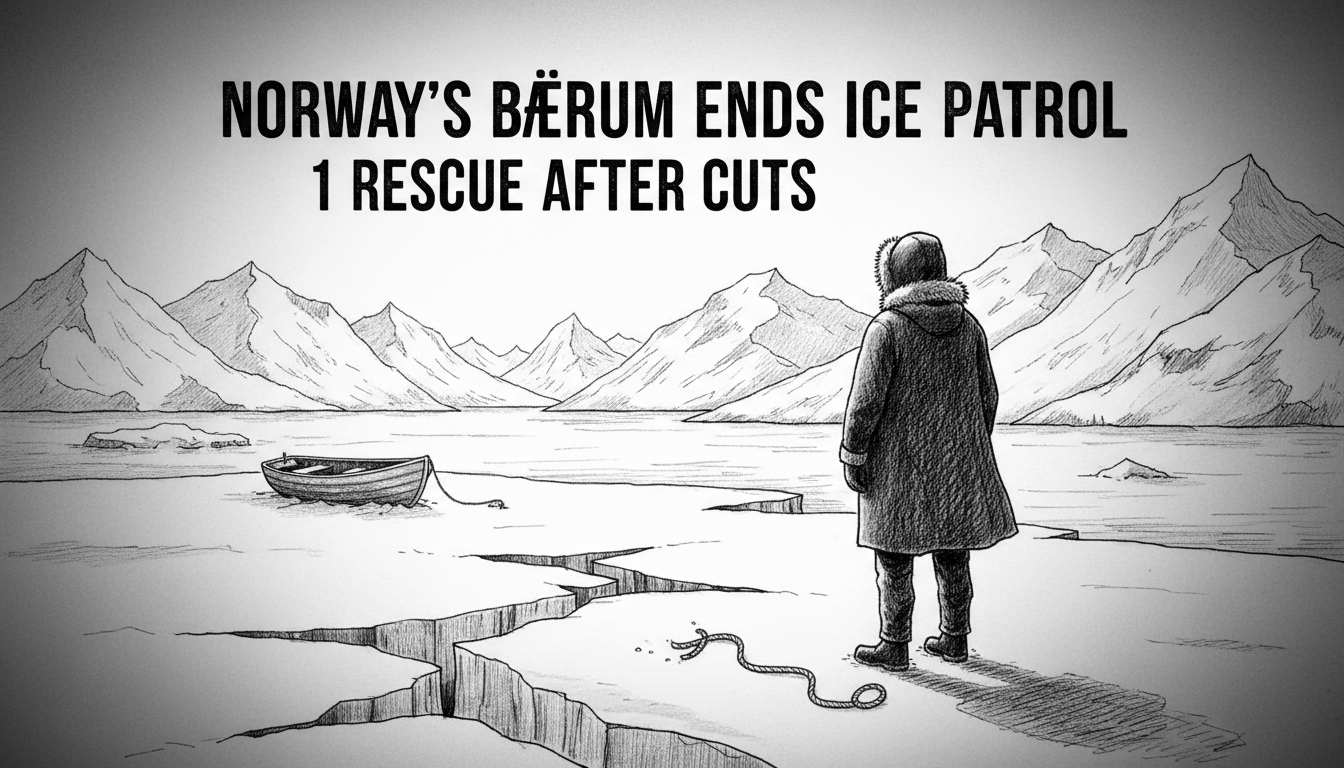
Norway's Bærum municipality has stopped monitoring ice safety on the Oslofjord to save money, a decision tested this week when a young woman fell through the ice. The affluent municipality west of Oslo officially ended its decades-old fjord ice surveillance program on January 1. Local politicians approved the cut last year, estimating it would save 300,000 Norwegian kroner annually. On Tuesday, a woman in her twenties broke through the ice between the islets of Kalvøya and Saraholmen. She managed to pull herself out and was examined by ambulance personnel, but the incident has ignited a fierce debate about public safety versus budgetary restraint.
A Calculated Risk in Affluent Suburbs
The decision places Bærum, one of Norway's wealthiest municipalities with a strong tax base, in a paradoxical position. It is known for its expansive waterfront properties and residents who actively use the fjord for recreation year-round. For generations, the municipal ice watch provided a critical service, assessing thickness and declaring areas safe for skating, skiing, and walking. Deputy Mayor Håkon Kvenna Veum of the Conservative Party (Høyre) acknowledged the service was popular. "The ice monitoring was a service that was well-liked and that we would have liked to continue," Kvenna Veum said. "But in tough economic times, you have to make tough financial priorities."
The 300,000 kroner saving represents a minuscule fraction of Bærum's multi-billion kroner annual budget. Critics argue the sum is symbolic, questioning whether such a marginal saving justifies removing a layer of community protection. Proponents of the cut contend that all expenditures, regardless of size, must be scrutinized, and that personal responsibility is paramount for adults engaging in inherently risky winter activities.
The Immediate Aftermath of a Policy Change
The incident between Kalvøya and Saraholmen occurred in a popular area for winter excursions. The narrow sound separating the two small islands often freezes over, creating a tempting shortcut or skating track. Without official patrols flagging dangerous thin spots or variable currents, individuals must now rely entirely on their own judgment. The woman involved was fortunate; falling through ice near shore in a frequently trafficked area carries different risks than a plunge in a remote location. Her successful self-rescue prevented a tragedy, but it served as an immediate warning signal.
Emergency services responded, but their role is reactive. The core function of the ice watch was prevention—stopping people from venturing onto unsafe ice in the first place. The Norwegian Society for Sea Rescue (RS) and local fire brigades often handle ice rescue operations, but their resources are stretched, and response times are critical in cold water immersion cases. A spokesperson for the Norwegian Water Resources and Energy Directorate (NVE) stated that while municipalities have local responsibility, there is no national mandate for ice monitoring, making it a classic example of discretionary local spending.
Expert Analysis on Safety and Responsibility
Public safety experts express concern about the trend. "When a municipality officially monitors ice, it creates a shared knowledge base and a clear point of accountability," said Dr. Lena Holm, a professor of public administration at the University of Oslo. "Removing that service downloads the entire risk assessment onto the individual. For experienced outdoors people, that may be fine. But for families or less experienced individuals, that official warning was a crucial piece of community infrastructure."
Holm notes that the decision intersects with Norway's deep cultural connection to nature, or friluftsliv. The right to roam freely is cherished, but it is coupled with an expectation of personal competence. "The social contract has subtly changed," she argues. "The municipality is signaling that this aspect of winter safety is now purely a private matter. The challenge is ensuring the public receives that message clearly and adjusts their behavior accordingly."
Alternative solutions exist but require initiative. Some Norwegian regions use web-based maps with user-submitted ice condition reports. Others rely on prominent signage at popular access points. Bærum may now explore such lower-cost options. However, these lack the authority and regular physical inspection of a dedicated municipal patrol.
A National Conversation on Local Priorities
Bærum's move is being watched by other coastal municipalities around the Oslofjord and in southern Norway. Many face similar budgetary pressures and may consider following suit if no major incidents occur. The debate echoes larger discussions in Norwegian governance about the core duties of local government. Where does the line fall between essential public welfare and optional services?
For residents, the change is palpable. "We always looked for the green flag by the boathouse," said Marte Hansen, a long-time Bærum resident and avid skater. "It was a part of winter. You knew someone had checked. Now it feels like you're on your own. That 300,000 kroner—it's nothing for the municipality, but the service meant a lot."
The financial argument is also scrutinized in the context of Bærum's wealth. With high property values and a large commercial sector, its per capita revenue is among Norway's highest. This makes a cost-cutting measure targeting a visible safety service politically sensitive, suggesting the cut may be as much about political philosophy as fiscal necessity.
Looking Ahead on Thinning Ice
The coming winter months will be the true test. A severe cold snap could create seemingly perfect, thick ice across large sections of the fjord, tempting many out. Without the municipal oversight to identify hidden dangers like tidal cracks or areas weakened by freshwater runoff, the risk of more incidents increases. The pressure will now fall on local news media, community groups, and social networks to spread informal warnings.
Deputy Mayor Kvenna Veum's statement frames the issue as one of unavoidable austerity. However, the incident this week poses a difficult question: how many successful self-rescues, or worse, tragedies, would it take to make 300,000 kroner a year seem like a wise investment? For now, the policy stands. The ice on the Oslofjord will form and melt with one less set of official eyes watching it, leaving citizens to navigate the uncertain surface alone, bearing both the freedom and the full weight of responsibility.
The ultimate cost of this budgetary decision remains uncalculated. It is a figure not found in an annual financial statement, but potentially measured in future emergency response calls, community anxiety, and the fragile trust between residents and their local government. In a nation built on mastering its natural environment, Bærum has chosen to step back from one small part of that stewardship, betting that personal judgment will be enough to counter the fjord's hidden dangers.