
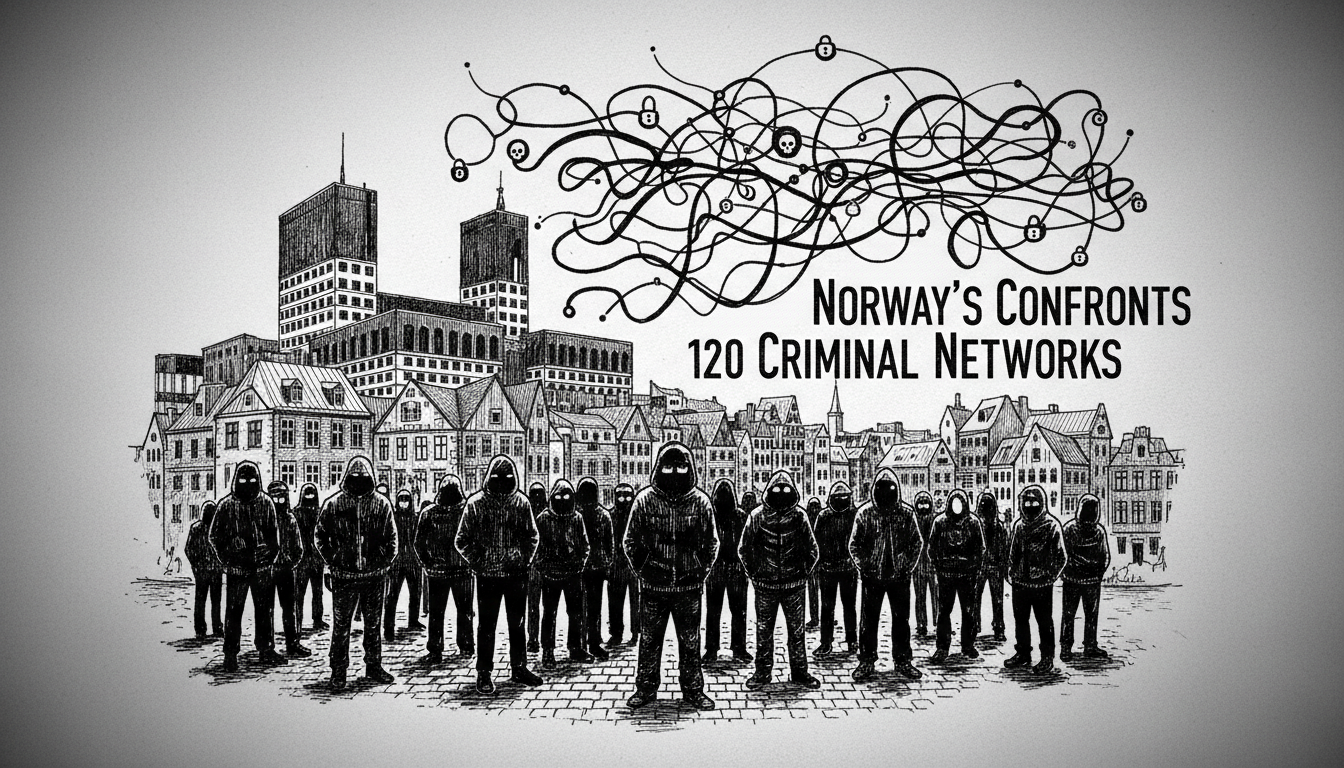
Norway's police have identified 120 active criminal networks operating in the Oslo area, a stark new figure that reveals the scale of organized crime in the capital. Police Chief Ida Melbo Øystese confirmed the data, which shows these networks involve approximately 800 individuals, with around 50 groups primarily focused on violence, weapons, and narcotics. This public disclosure marks a significant shift in transparency from Oslo's police force, which is now grappling with a complex and growing challenge.
"For the first time, we are saying something concrete about the scope of criminal networks in our district," Øystese said in a statement. "In the demanding situation we are in now, it is important that residents know how things are, even if it can be demanding to get that knowledge." The mapping project, which uses definitions established by the national criminal investigation service Kripos, provides the clearest public picture yet of the capital's underworld. It signals a move away from general warnings to a data-driven acknowledgment of a persistent problem.
A New Level of Police Transparency
The release of these specific numbers represents a deliberate policy choice. Norwegian authorities have historically been cautious about publicly quantifying organized crime, often to avoid amplifying gang prestige or causing public alarm. Øystese's decision to break with that tradition indicates the severity with which police now view the situation. The 120 networks are not a sudden emergence but the result of systematic police intelligence work over time. Experts suggest the figure likely reflects improved police mapping capabilities as much as any potential growth in criminal activity.
Kripos, which coordinates the national fight against organized crime, provides the framework for defining these networks. Their criteria focus on structured groups engaged in serious, profit-driven crime over time. The Oslo data shows these groups are deeply embedded, with tentacles reaching into various illicit markets. The concentration of 50 networks in the high-harm areas of violence and drugs underscores the immediate threat to public safety. This activity often manifests in public spaces, affecting community perceptions of security in certain districts.
The Faces Behind the 800 Figure
While the term "network" can sound abstract, the police assessment of 800 involved individuals puts a human scale on the problem. These are not all hardened gang leaders; the figure includes a range of actors from core members to associates, drivers, and money handlers. The structure is often fluid, with alliances shifting between groups based on opportunity or conflict. This fluidity makes traditional law enforcement approaches difficult. Arresting key figures can fragment a network, only for it to reconstitute under new leadership or splinter into competing factions, potentially increasing violence.
Norwegian organized crime has evolved from historically low-profile activities. In recent decades, increased international connections, particularly with groups in the Baltic region, the Netherlands, and the Balkans, have changed the landscape. These links facilitate the flow of drugs and weapons. The lucrative Norwegian market, with its high purchasing power, remains a powerful magnet. Police reports frequently note the use of encrypted communication channels and sophisticated money laundering techniques, often involving legitimate businesses like car washes, restaurants, or construction firms.
Oslo's Challenge in a Nordic Context
Norway's experience mirrors broader regional trends. Neighboring Sweden has faced significant public challenges with gang violence and shootings, often linked to feuds over drug territory. Denmark has implemented strict measures in certain neighborhoods to combat gang influence. Norway's situation, while serious, has generally featured lower levels of public gun violence than Sweden's recent epidemic. However, the police mapping confirms that the foundational elements—the networks capable of violence—are firmly present in Oslo.
The Norwegian model emphasizes prevention and social integration alongside policing. The concern among officials is that criminal networks actively recruit young people from marginalized communities, offering quick money and a sense of belonging. This makes the fight against organized crime a multi-generational social challenge, not just a policing one. The role of the prison system is also critical, as prisons can sometimes function as networking hubs for criminals, strengthening connections rather than rehabilitating individuals.
The Road Ahead for Law Enforcement
Revealing the extent of the network problem is only the first step. The operational response will involve targeted investigations by the Oslo Police District, supported by Kripos and the National Authority for Investigation and Prosecution of Economic and Environmental Crime (Økokrim). Financial investigations aimed at seizing criminal assets are a key pillar of the strategy. The goal is to make crime unprofitable and disrupt the economic engines that sustain these networks.
International cooperation is non-negotiable. Norwegian police work closely with Europol and neighboring countries to track cross-border criminal flows. The upcoming establishment of a new national center for combating organized crime, announced by the Ministry of Justice, aims to strengthen this coordinated effort. Police Chief Øystese's transparency is likely a precursor to requests for more resources—more investigators, better technology, and stronger legal tools for surveillance and asset confiscation.
For Oslo's residents, the news is sobering. It confirms suspicions about criminal activity while challenging the perception of Norway as an idyllic exception to European crime trends. The police hope that public awareness will foster greater community cooperation and vigilance. The next steps will be measured not just in arrests, but in the sustained reduction of the influence these 120 networks wield over neighborhoods, vulnerable youth, and the city's sense of security. The true test is whether this moment of stark transparency leads to a tangible decline in the power of organized crime, or simply becomes an annual statistic tracking its entrenchment.