
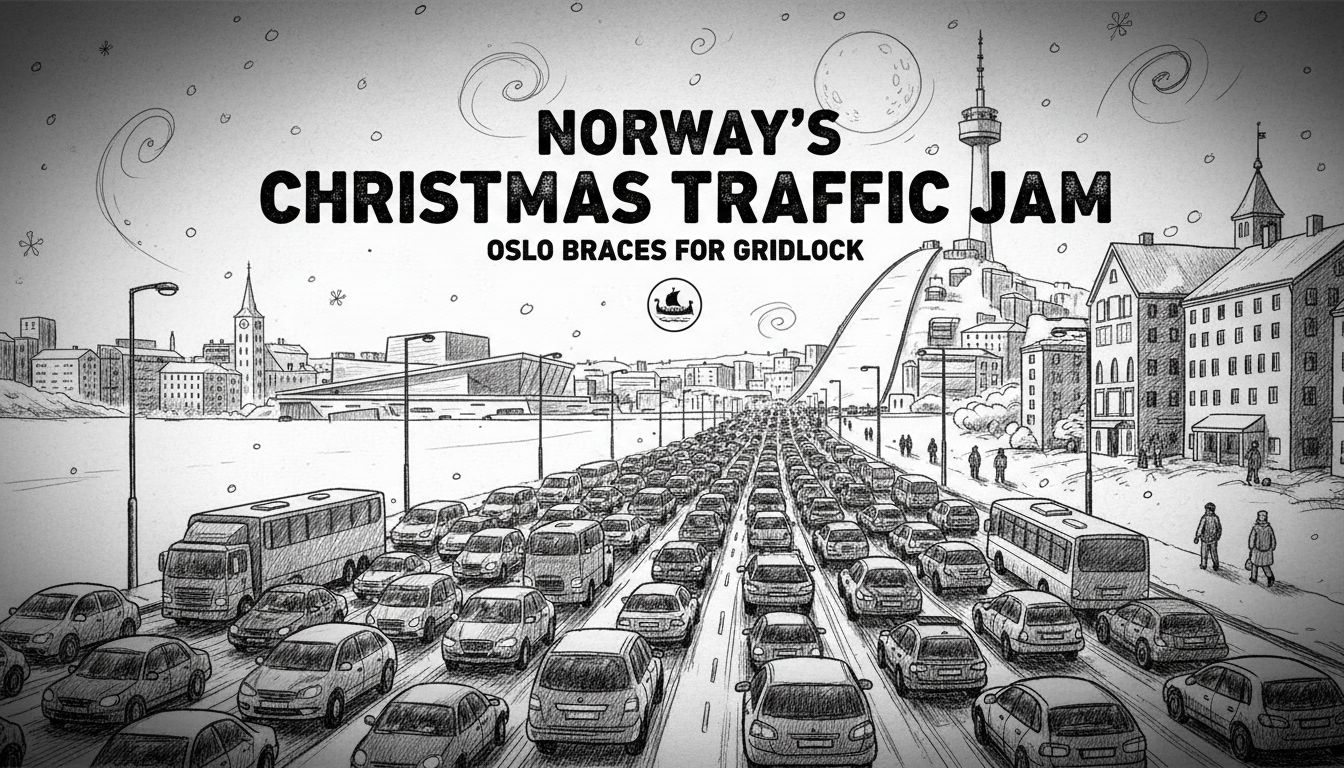
Norway's Christmas holiday travel chaos culminates Sunday as tens of thousands of drivers face treacherous roads and major congestion on all main arteries into the capital. The Norwegian Public Roads Administration (Statens vegvesen) warns of peak traffic pressure between 4 PM and 8 PM, with slippery conditions reported across multiple regions.
Traffic operator Arvid Wahlstrøm at the Eastern Traffic Centre said the heaviest inbound traffic is expected on the E6 near Minnesund and Jessheim, the E18 from Drammen, and the E16 from the Hønefoss area. Significant volumes are also anticipated on National Road 25 from Trysil towards Elverum and Kolomoen. This annual migration back to Oslo after the Christmas break consistently creates one of the year's worst traffic events, testing the nation's winter road network.
The Annual Return: A Predictable Crisis
This post-Christmas traffic surge is a deeply ingrained Norwegian ritual. Families who dispersed to mountain cabins, coastal towns, and childhood homes across the country now converge back on urban centers, primarily Oslo. The timing is remarkably consistent, creating a predictable yet seemingly unavoidable bottleneck. While Statens vegvesen provides meticulous forecasts, the sheer volume of vehicles often overwhelms capacity.
“We expect a lot of traffic towards Oslo from all the major access roads,” Wahlstrøm stated, emphasizing the widespread nature of the congestion. The warning extends beyond just the capital's ring roads. Key inland routes like RV 25, a vital corridor from the popular winter sports municipality of Trysil, are also highlighted for major delays. This indicates the traffic pressure originates from deep within the country's eastern valleys, not just the capital's immediate suburbs.
Winter's Wrath Complicates the Commute
The logistical challenge of moving a nation is compounded by classic Norwegian winter hazards. The agency reports "glatte veier" or slippery roads in several locations. This combination of high volume and potentially dangerous driving conditions significantly raises the risk of accidents and further delays. Black ice, sudden snow squalls, and slush buildup are common culprits during this volatile seasonal transition.
Experts from the Norwegian Automobile Federation (NAF) consistently advise motorists to equip their vehicles with proper winter tires, ensure ample fuel and windshield washer fluid, and pack emergency supplies. They also recommend adjusting travel plans to avoid the absolute peak hours, though for many returning to work on Monday, this window is frustratingly narrow. The advice is simple but critical: patience, preparation, and heightened vigilance are the only tools for navigating this annual trial.
Infrastructure and the Endless Influx
Norway's road network, celebrated for engineering marvels that cut through mountains and cross fjords, faces its ultimate stress test during these holiday bookends. The E6, the nation's north-south backbone, and the E18, the vital link from the southwest, are modern highways, but their capacity is finite. Analysts note that while public transport options exist, the Norwegian preference for personal vehicle travel, especially when returning from remote holiday locations with luggage and family, remains dominant.
This event raises perennial questions about traffic management and the balance between personal freedom and collective efficiency. Could better incentives for staggered return times ease the pressure? Are digital notification systems reaching enough drivers? The data collected by Statens vegvesen during these peaks is invaluable for long-term planning, informing future investments in road expansions, tunnel projects, and alternative route development. Yet, the cultural pattern of a synchronized national holiday exodus and return is a powerful force.
A Look Beyond the Headlines: Economic and Social Impact
The economic cost of this mass standstill is substantial. Lost productivity from delayed workers, increased fuel consumption from idling engines, and the strain on emergency services all tally up. Furthermore, the stress inflicted on drivers and families, often with tired children in the back seat after a long holiday, has a social cost that is harder to quantify.
The traffic jam is more than an inconvenience; it is a snapshot of modern Norway. It reflects a wealthy, mobile society with deep traditions of seasonal migration to nature, now funneling back into its economic engine. The cars are likely filled with discussions of the past week's skiing, family news, and the reluctant mental shift towards the new year's work. The congestion is the physical manifestation of that national transition.
Navigating the Future: Is There a Better Way?
As electric vehicle adoption accelerates in Norway, the environmental impact of this traffic jam is slowly changing, but the spatial problem remains unchanged. Some transport economists suggest that greater investment in and promotion of long-distance coach services or enhanced train capacity for key holiday routes could alleviate some pressure. However, the door-to-door convenience of the private car for a family laden with gifts and ski equipment is a tough advantage to beat.
The reliable, grim forecast from Statens vegvesen serves its purpose. It arms drivers with knowledge. The question is whether that knowledge translates into changed behavior or simply resigned acceptance. For now, the ritual continues. Thousands will switch on their headlights, tune into traffic radio, and steel themselves for a long, slow crawl home. They will navigate the slippery E18 curves near Slependen and watch the taillights stretch into the distance on the E6 through Akershus, participating in a uniquely Norwegian, and universally frustrating, end-of-holiday tradition.
The real test comes not just for the brakes and winter tires, but for the national capacity to rethink a deeply ingrained pattern. Until then, the post-Christmas gridlock remains as predictable as the snow itself.