
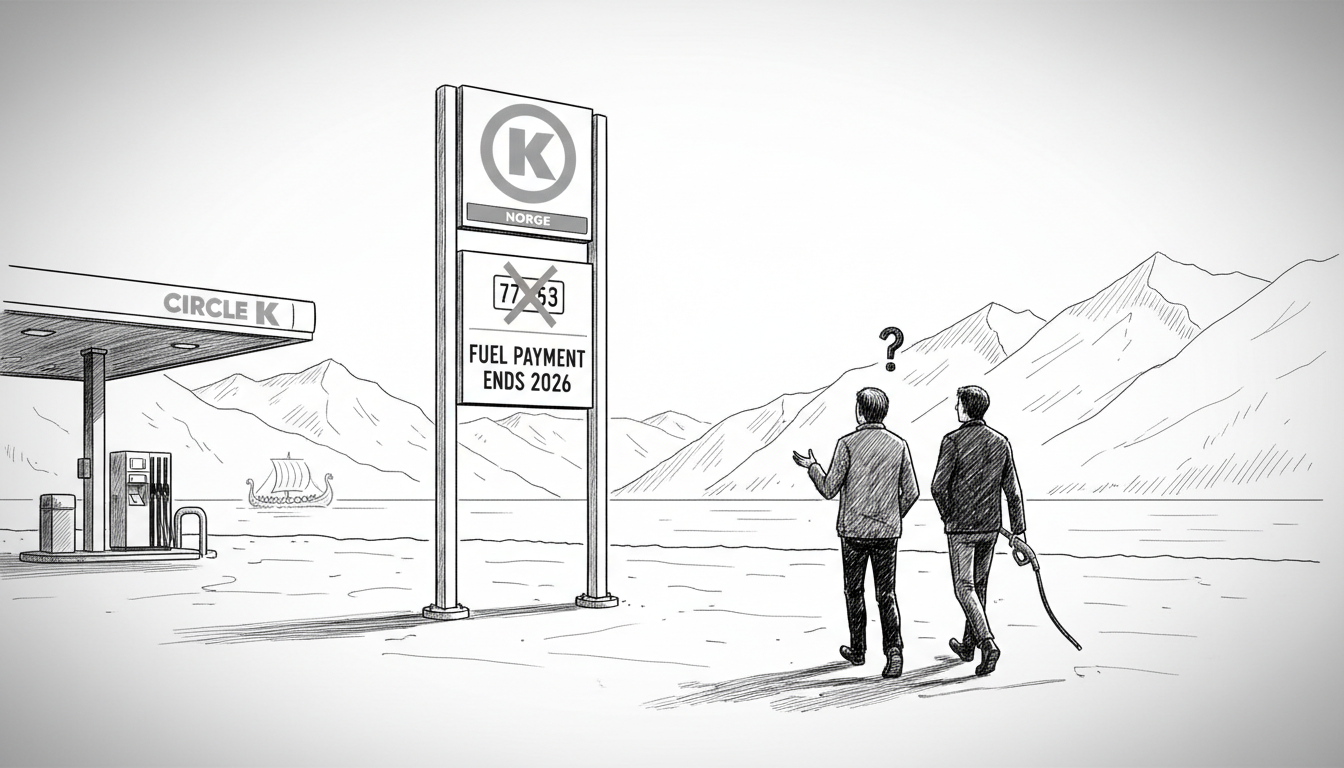
Norway's Circle K fuel stations will discontinue their Easy Fuel license plate payment system in January 2026. The company confirmed the decision this week, citing low customer adoption for the technology launched in 2022. This marks a significant retreat from a contactless payment innovation once seen as the future of refueling.
Kjetil Foyn, Head of Communication and Sustainability at Circle K Norway, said the company is focusing on digital solutions customers use most. "We work constantly to find solutions that make everyday life easier for our customers," Foyn said. "As the first in Norway, we introduced payment for fuel with a license plate in 2022. To simplify and improve our offer, and at the same time strengthen the digital solutions our customers use the most, we have chosen to discontinue payment with license plate."
He acknowledged that users who tried Easy Fuel were satisfied. However, the overall usage numbers failed to justify continued operation. "Even though those who used the solution were very happy, the total use has unfortunately been too low," Foyn stated.
The Rise and Fall of a Digital Experiment
Circle K introduced Easy Fuel in autumn 2022. The system allowed drivers to link their car's license plate and a payment card within the Circle K mobile app. After registration, customers could drive to a pump, fill their tank, and leave. Cameras at the station would recognize the license plate and automatically charge the linked card, eliminating the need to tap a card or use a phone at the pump.
The concept aligned with global trends towards frictionless retail and Norway's reputation as a digitally advanced society. Norwegian tech startups and innovation labs frequently pilot similar contactless solutions in retail and mobility. The initiative reflected Circle K's attempt to lead in Norway's digital transformation of everyday services.
Yet, the convenience did not capture the mass market. While specific download or active user numbers were not disclosed, Foyn's statement confirms adoption remained below a viable threshold. The service will officially end on January 13, 2026, giving existing users over a year and a half to transition to other payment methods.
Strategic Pivot in a Competitive Market
Analysts see this as a strategic recalibration. "This is a classic case of an innovative solution searching for a problem customers felt strongly enough about," said Lars Jensen, a retail technology consultant based in Oslo. "Norway already has extremely efficient, near-universal contactless card payments. The marginal gain in speed from license plate recognition may not have been significant enough for most people to change their habitual behavior."
The decision highlights the challenge for established corporations in matching innovation with user adoption. Circle K invested in installing specialized camera systems at stations to support Easy Fuel. When asked about this infrastructure, Foyn noted it would not go to waste. "In most cases, the cameras will still be in operation to support the safety at our stations," he said. This repurposing turns an innovation cost into a security asset, a practical move for station safety.
This pivot suggests Circle K will concentrate resources on its core mobile app features and other payment integrations that see higher engagement. Norway's digital payment landscape is crowded, with solutions like Vipps, mobile wallets, and contactless cards dominating. For a new system to succeed, it must offer a dramatic improvement or solve a clear pain point.
The Norwegian Digital Payment Context
Norway's fuel payment market operates within one of the world's most cashless societies. According to the Norwegian Central Bank, cash accounts for only 3-4% of all point-of-sale transactions. Card and mobile payments are ubiquitous, fast, and reliable. In this environment, the value proposition of license plate payment is narrower than in markets with slower or less reliable payment terminals.
"The bar for success is very high in Norway," explained Anna Pedersen, a fintech analyst focusing on Nordic technology trends. "Consumers are digitally savvy but also pragmatic. They adopted mobile banking and Vipps because those solutions offered transformative convenience. Easy Fuel offered incremental convenience in a process that already takes just a minute or two. The friction it removed was perhaps too small."
The shutdown also reflects a broader trend where Scandinavian tech hubs see many pilot projects and innovations launched, with only the most resonant surviving. Oslo's innovation districts are full of startups testing new ideas, but market fit remains the ultimate test.
What This Means for Customers and the Industry
For the limited number of Easy Fuel users, the transition will mean reverting to standard payment methods at Circle K stations. These include using the Circle K app at the pump, contactless bank cards, or in-store payment. The company will likely communicate the phase-out plan directly to registered users through its app channels.
The move is being watched by other fuel retailers in Norway and across the Nordic region. Several competitors have explored or implemented their own automated payment solutions. Circle K's experience provides valuable market data on consumer willingness to adopt such systems. It may cause other companies to double down on similar innovations or reconsider their plans, depending on their reading of the situation.
"The key lesson is about integration versus standalone solutions," Jensen, the consultant, added. "Successful digital tools in retail often succeed by being deeply embedded in a customer's routine. A separate system for one specific task—like fueling—faces an uphill battle unless it is exceptionally seamless or offers additional benefits, like integrated loyalty rewards or expense tracking."
Looking Beyond the Pump
The closure of Easy Fuel does not signal an end to innovation at Norwegian gas stations. Instead, it refocuses attention on broader digital transformation efforts. Circle K and its competitors are increasingly acting as convenience and charging hubs, especially with the growth of electric vehicles. Digital solutions for EV charging, convenience store pickup, and loyalty integrations are likely higher priorities.
Norway's world-leading adoption of electric vehicles also changes the landscape. EV charging often involves different payment models, like app-based initiation and billing, which could eventually make pump-side payment innovations less critical. The future of station digitalization may lie more in holistic customer journey apps that handle fuel, charging, car washes, and store purchases in one integrated flow, rather than in single-moment solutions like license plate recognition.
As of January 13, 2026, the cameras at Circle K stations will watch over the forecourts for security, not for payment. The experiment in license plate convenience will end, offering a clear lesson in Norway's demanding digital marketplace: even in a tech-forward society, true innovation must solve a problem customers are eager to pay—or in this case, change their habits—to fix.