
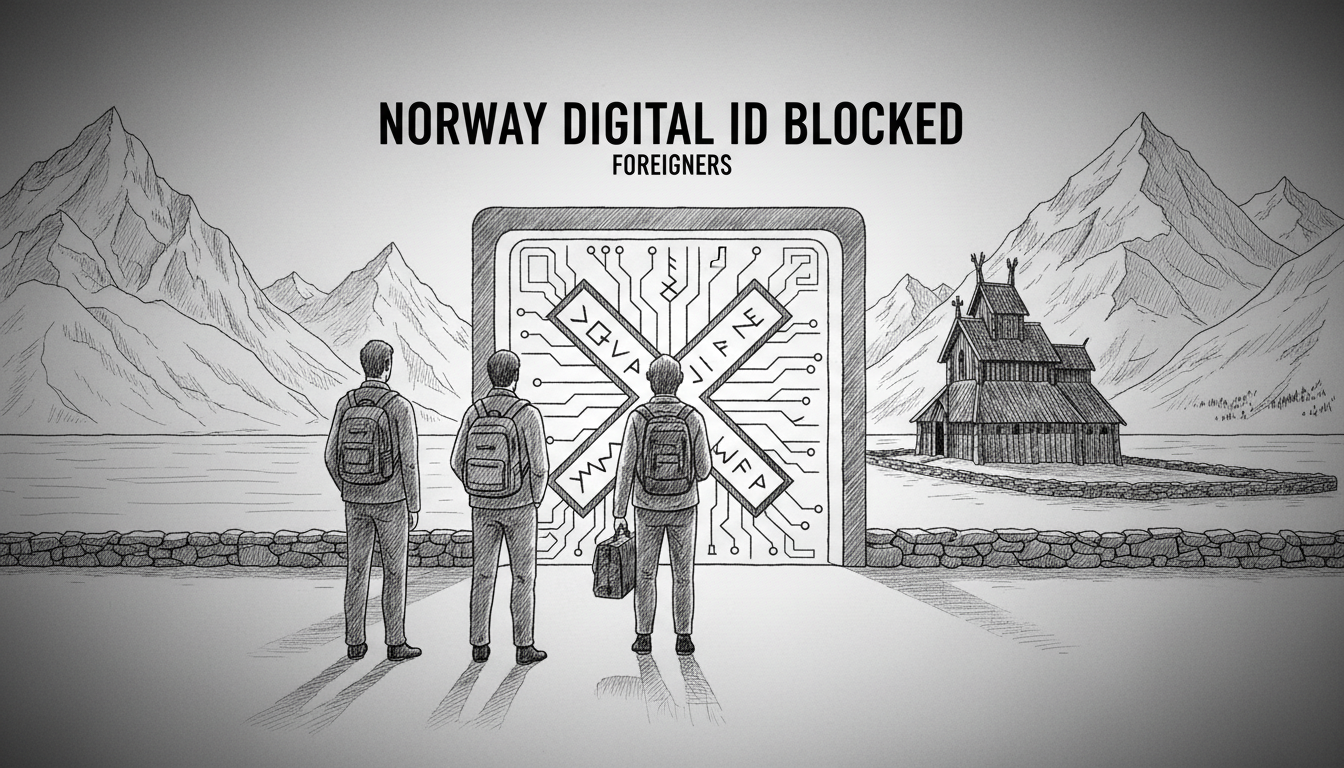
Norway's BankID system authenticates over 90% of the nation's online transactions. This digital key unlocks tax portals, bank accounts, and even apartment rentals. For the growing number of foreign professionals, students, and job-seekers arriving in the country, this creates an immediate barrier. They enter one of the world's most digitized societies but find its foundational tool is often out of reach.
"You land with a job contract, ready to start your life, and you hit a wall immediately," explains Lars Jensen, a tech policy analyst based in Oslo. "The system assumes you are already in the system to get into the system. It's a classic digital catch-22." The core issue is the national identity number, issued by the Norwegian Tax Administration. Banks require it to issue BankID. But to get the number, you typically need proof of a permanent Norwegian address—something many newcomers lack during their first weeks.
The Digital Catch-22
Major banks like DNB and Nordea have strict onboarding rules for non-residents. They often demand six months of documented Norwegian income or a substantial initial deposit. These policies stem from stringent anti-money laundering regulations. For banks, the rules are a necessary compliance step. For a foreign student or a newly arrived software developer from India or Brazil, they represent a frustrating halt. "We followed every rule, but for two months we couldn't pay a deposit for an apartment because we had no BankID," says Anika Patel, a researcher from Canada who moved to Trondheim last year. "We were stuck in temporary housing, paying cash for everything."
The process creates a circular dependency. No BankID means no easy access to digital rental contracts. No rental contract can mean no official address. No address blocks the national identity number application. This stalls everything from getting a mobile phone plan to receiving a salary.
Three Official Pathways Forward
There are structured, official routes to break this cycle. The smoothest path is arriving with a secured job at a major corporation. Companies like Equinor, Telenor, or Kongsberg Gruppen often have relocation services. They assist with tax office registration, which can yield a national identity number in three to six weeks. With that number, opening a bank account and obtaining BankID from a major bank becomes straightforward.
For international students, universities provide crucial support. The University of Oslo, NTNU, and BI Norwegian Business School offer housing guarantees. These documents satisfy the tax office's address requirement. Students can typically get their national identity number within a month of arrival. They then visit local branches of banks like SpareBank 1 to establish an account and request BankID.
EU and EEA citizens have a faster track. They can register with the Norwegian police using their EU citizenship rights. This registration leads to a national identity number, often within two weeks. Presenting this at a bank like DNB allows for relatively quick BankID setup.
Practical Workarounds and New Solutions
For those outside these categories, a small ecosystem of alternatives has emerged. The mobile payment app Vipps now offers a limited-access version for foreigners. Users download the app and then verify their identity in person at a Narvesen or 7-Eleven kiosk using their passport. The service costs 200 kroner. It allows for peer-to-peer payments and some online purchases. It does not, however, function as a full BankID for accessing government services or signing official documents.
Some niche financial institutions have identified this market gap. Bank Norwegian offers a basic account accessible to many newcomers. The online application asks for a passport and proof of address from the user's home country. Approval can come within 48 hours, including a debit card and online banking access. Again, this account does not include BankID, but it provides essential financial functions.
For digital signatures, the company Buypass sells a physical electronic ID. Users order the device online for 400 kroner and verify their identity at a Posten service point. This allows for signing certain digital documents. It is recognized by some public services but is not a universal replacement for BankID's broad functionality.
Innovation and Systemic Gaps
The situation highlights a tension within Norway's tech success story. "Norway has built a remarkably efficient digital public square, but the entrance gate is still very narrow," notes Ingrid Solberg, a CTO at an Oslo-based fintech startup. Her company employs several international developers who initially struggled with access. "We solved it by acting as their guarantor, but not every startup has that capacity. It's a hurdle for attracting global talent to our tech hubs in Oslo, Bergen, and Trondheim."
Experts point to the upcoming EU Digital Identity Wallet as a potential long-term fix. This system aims to provide a pan-European digital ID that member states must accept. Norway, while not an EU member, is part of the European Economic Area and may integrate with this framework. Such interoperability could allow a German or Italian digital ID to be recognized in Norway, bypassing the initial national identity number hurdle.
Domestically, the Norwegian government is developing its own national eID, separate from the bank-owned BankID. The progress of this public alternative is slow. With over 4.5 million active BankID users in a population of 5.5 million, the private system's dominance is overwhelming. Any new solution must achieve near-universal adoption to be effective, a significant challenge.
A Test for an Inclusive Digital Future
The BankID barrier is more than an administrative annoyance. It tests Norway's commitment to inclusive digitization. As the country seeks to attract skilled workers to fuel its economy and innovation sectors, a protracted onboarding process creates a negative first impression. "We preach digital efficiency and then show newcomers a maze of paper forms and catch-22s," says policy analyst Lars Jensen. "It undermines our message as a modern, open society."
For now, the path involves planning, patience, and often relying on the workarounds. The experience of newcomers serves as a real-world stress test for Norway's digital infrastructure. It reveals a system optimized for those already within it, struggling to accommodate those arriving from outside. Solving this puzzle is crucial for Norway's ambitions as a connected Scandinavian tech hub. Can it build a digital front door that matches the sophistication of the house within?