
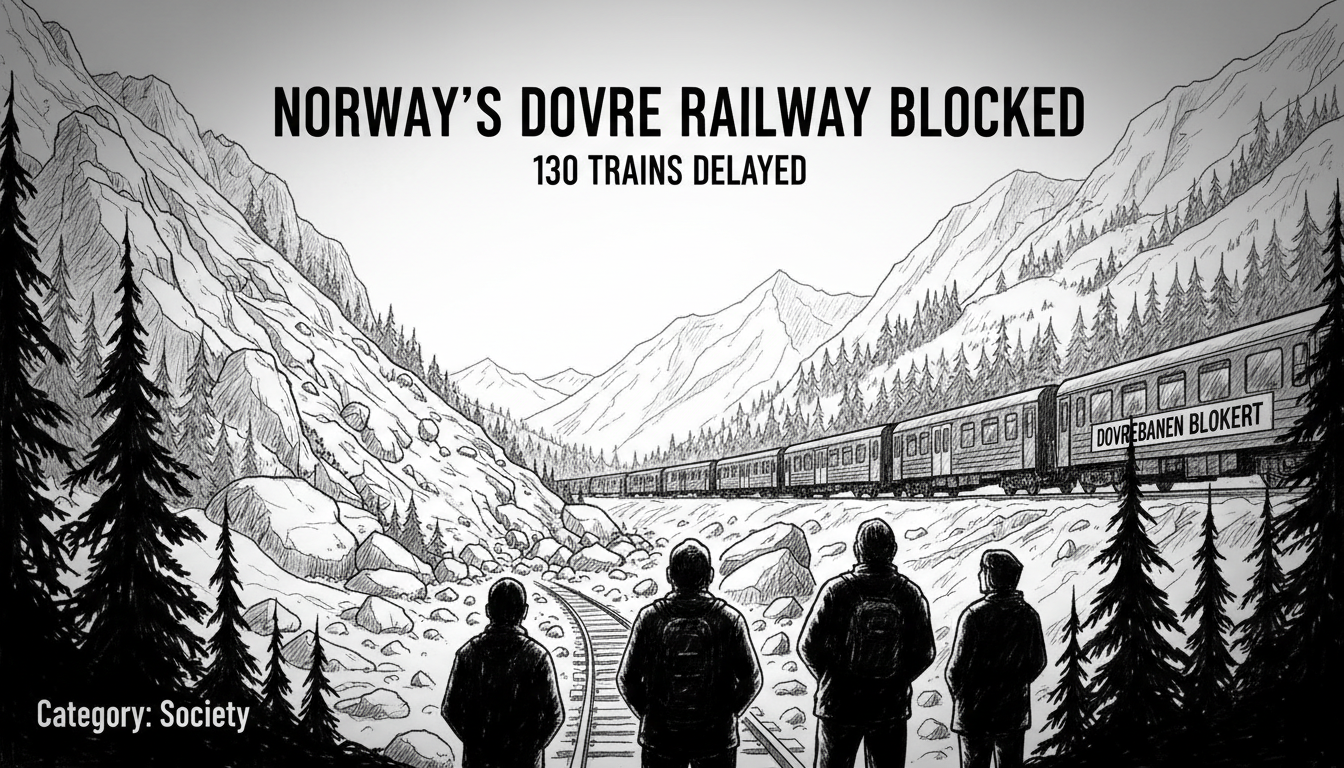
Norway's vital Dovre railway line, which carries over 5,000 daily passengers and critical freight between Oslo and Trondheim, faced severe disruption Sunday night after a freight train blocked the tracks at Tangen station. The incident, reported by infrastructure manager Bane Nor around 8:15 PM, halted traffic on the nation's central rail artery, creating a cascade of delays during a busy travel period. While the stranded train later moved under its own power, operator Vy warned passengers to expect significant schedule setbacks as services struggled to return to normal.
Immediate Impact and Passenger Frustration
The blockage at Tangen, a station in Stange municipality in central Innlandet county, created an immediate bottleneck. The Dovre Line is the primary north-south rail connection through Norway's interior, making any obstruction highly consequential. "Trains are running, but it may take some time before they are on schedule. You must therefore expect delays," Vy stated bluntly on its website. For travelers, this meant uncertain wait times and potential missed connections on a line where hourly departures are the norm. The disruption highlights the fragility of a single-track system where even a minor incident can have outsized effects on the national transport network.
The Critical Role of the Dovre Corridor
The Dovre Line is far more than a passenger route. It functions as an economic lifeline, transporting goods from the port of Trondheim to the capital region and beyond. Freight trains carry everything from seafood to industrial components, and delays ripple through supply chains. Professor Arne Nåvik, a transportation logistics expert at the Norwegian University of Science and Technology, emphasizes its strategic importance. "The Dovrebanen is the backbone of mainland Norway's rail freight. An unscheduled stop of several hours doesn't just delay one train; it disrupts carefully coordinated logistics across the entire network, affecting terminals in Oslo, Lillehammer, and Trondheim," Nåvik explained. The line's reliability is directly tied to regional economic efficiency.
Infrastructure Strain and Systemic Challenges
This incident occurs amid ongoing scrutiny of Norway's railway infrastructure capacity. Bane Nor manages over 4,000 kilometers of track, with key sections like the Dovre Line operating at near capacity. Single-track segments, aging signaling systems, and increased traffic volumes create a system vulnerable to delays. While the exact cause of Sunday's stoppage is under review, such events prompt questions about network resilience. "Our focus is swift incident resolution to restore safe operations," a Bane Nor spokesperson said. The agency's performance is measured by system punctuality, which faces pressure from both weather-related events and technical faults.
Comparative Reliability: Rail vs. Road Transport
The disruption invites comparison with Norway's other main transport artery: the E6 highway, which runs parallel to the railway for much of its route. While roads offer flexibility, they are increasingly congested and face their own closures due to weather and accidents. Rail is promoted as a stable, green alternative for both people and goods. However, incidents like the Tangen blockage challenge that narrative. A 2023 report by the Norwegian National Transport Plan highlighted that increasing rail's market share requires superior reliability. For many freight operators, predictability is as crucial as cost. This table illustrates the scale of transport along the corridor:
| Transport Mode | Estimated Daily Volume (Oslo-Trondheim Corridor) | Key Vulnerability |
|---|---|---|
| Dovre Railway (Passenger) | 5,000+ passengers | Single-track sections, signaling faults |
| Dovre Railway (Freight) | Dozens of freight trains | Network-wide scheduling cascade |
| E6 Highway | 10,000+ vehicles | Weather closures, congestion, accidents |
Economic Ripple Effects and the Freight Dilemma
The economic impact of a major line blockage extends beyond inconvenienced passengers. Norway's industrial and maritime sectors rely on just-in-time logistics. Fresh seafood exports, a time-sensitive commodity, often move by rail to airports or southern ports. Manufacturing components for the energy sector also use this route. A half-day delay can necessitate costly shifts to road transport, increasing emissions and road wear. "Every hour of delay on the rail network pushes more goods onto the E6," notes logistics analyst Heidi Fossum. "This undermines national climate goals and increases total societal transport costs. Investment in more passing loops and robust infrastructure isn't an expense; it's a buffer against these economic shocks."
Policy Response and Future Investment
The Norwegian government, through the Ministry of Transport, has pledged significant investment in rail modernization. The current National Transport Plan allocates billions of kroner to rail, with projects aimed at increasing capacity and resilience on lines like the Dovrebanen. Key proposals include constructing additional passing loops to reduce single-track bottlenecks and upgrading the signaling system to the European ERTMS standard. However, these projects face long timelines. In the interim, operators must manage with existing infrastructure. "The immediate solution is effective communication and contingency planning," says Vy's Head of Operations, Kari Anne Sande. "We work closely with Bane Nor to inform passengers and reorganize crew and rolling stock when delays occur."
A Look Ahead: Balancing Growth with Resilience
The Tangen incident serves as a microcosm of a broader national challenge. Norway aims to shift more passenger and freight transport onto rail to meet ambitious climate targets. Success depends on the network's ability to handle growth reliably. This requires continuous investment in maintenance, modernization, and capacity expansion. As traffic increases, the system's tolerance for minor faults decreases. The question for policymakers is whether investment pace matches the growing demands placed on this critical infrastructure. For now, passengers and freight operators on the Dovre Line continue their journeys, hoping the path ahead remains clear. The true test will be how quickly the system learns from each disruption to build a more resilient railway for Norway's future.