
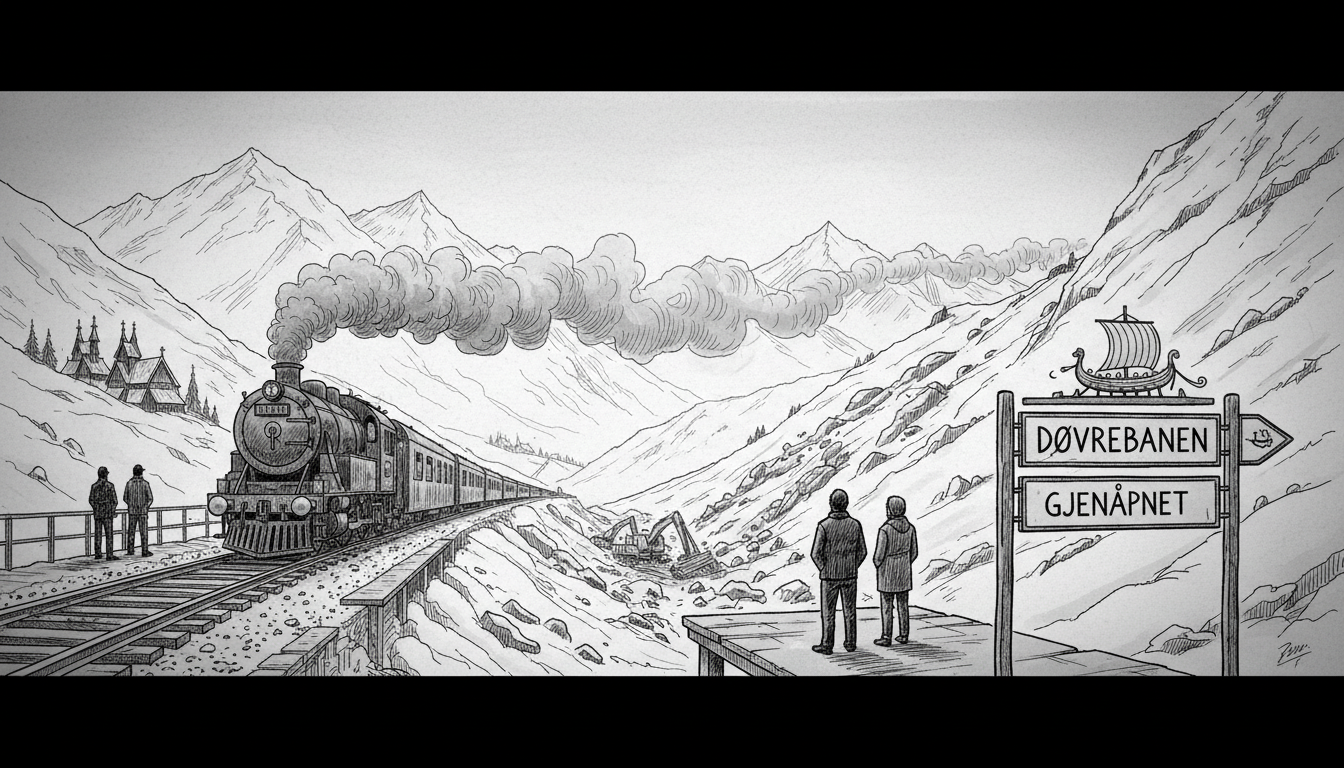
Norway's crucial Dovrebanen railway line has reopened after a landslide near Kvitfjell forced a precautionary closure. The landslide, which occurred early Monday morning in Ringebu municipality, blocked a local county road but did not directly impact the tracks. No injuries were reported. Anna Langhammer, a press officer for the national rail infrastructure manager Bane Nor, confirmed the reopening. "The Dovre Line is open. The railway was not hit by the landslide. Trains are running as normal. We closed it as a safety measure," she said. The incident highlights the persistent vulnerability of Norway's critical transport corridors to geohazards, a risk experts say is intensifying with climate change.
A Narrow Escape for a Critical Artery
The Dovrebanen is the main rail artery connecting Oslo with Trondheim, Norway's third-largest city. It carries long-distance passenger trains, regional commuter services, and a significant volume of freight. A prolonged closure would have immediate economic ripple effects, disrupting supply chains for industries in Central Norway and isolating communities. The landslide descended near the village of Losna, leading authorities to close the line between Losna and Ringebu stations as a precaution. While the rails were spared, the slide completely covered a local road, Fylkesvei 2540. Police estimate this road will remain closed for an extended period, forcing local traffic onto lengthy detours. The swift response from Bane Nor's maintenance teams, who assessed the slope stability and track integrity, allowed for a relatively quick reopening. This prevented the kind of multi-day disruption that can cost the logistics and tourism sectors millions of kroner.
Climate Change and the Growing Instability of Norway's Terrain
Geologists and infrastructure experts point to this event as a symptom of a larger, worrying trend. "What we are seeing is an increase in the frequency of slides and rockfalls, particularly in areas with quick clay or unstable slopes after periods of heavy rain or rapid snowmelt," explains Dr. Henrik Lervik, a geohazard researcher at the Norwegian Geotechnical Institute. "The warming climate is a key driver. We get more intense precipitation events, and permafrost thaw in mountainous areas is destabilizing slopes that have been frozen for millennia." The Dovrebanen traverses some of Norway's most challenging terrain, cutting through valleys and along mountainsides between Oslo and Trondheim. This makes it inherently exposed. Bane Nor has invested heavily in monitoring systems, including radar and laser scanning, to detect ground movement along high-risk sections. The precautionary closure at Kvitfjell was a direct result of such a risk-averse protocol. "The decision to close is never taken lightly, given the disruption it causes," says Langhammer. "But passenger and crew safety is absolute. When a geohazard event occurs nearby, we must verify the integrity of our infrastructure before resuming service."
The Economic Lifeline Running Through the Mountains
The economic significance of the Dovrebanen cannot be overstated. For the freight sector, it is a vital alternative to long-haul trucking on the E6 highway, helping to reduce carbon emissions and road wear. Companies in the Trøndelag region rely on it for just-in-time deliveries of components and for exporting goods southward. The tourism industry, especially around destinations like Lillehammer and the Dovre mountain plateau, depends on reliable rail connections for visitors. A single day of closure forces costly re-routing onto roads, increases congestion, and damages confidence in rail as a dependable mode of transport. The Norwegian National Rail Administration's long-term strategy includes "climate-proofing" key lines. This involves constructing more protective barriers, stabilizing slopes through engineering, and potentially re-routing the most vulnerable stretches of track—projects that run into billions of kroner. Each landslide, even a minor one like this, adds political and financial urgency to these plans. Members of the Storting's Transport Committee have repeatedly called for accelerated investment in infrastructure resilience, framing it as a national security issue.
A Close Call and a Persistent Warning
The incident at Kvitfjell ended as a close call, a minor disruption in the grand scheme. Traffic is flowing again, and the schedule is returning to normal. However, it serves as a persistent warning. The landscape of Norway, for all its beauty, is dynamic and increasingly unstable. As Dr. Lervik notes, "The ground is literally shifting beneath our critical infrastructure. We are in a race between the accelerating effects of climate change and our ability to adapt and reinforce our railways and roads." For Bane Nor, the work continues long after the tracks reopen. Engineers will conduct follow-up surveys of the slope near Kvitfjell, analyzing whether further protective measures are needed to guard against a future, more direct slide. For passengers and businesses, the event is a reminder of the fragility of the connections that bind the country together. The mountains that define Norway's identity also present one of its greatest logistical challenges—a challenge that is growing more formidable with each passing year. How Norway manages this balance between nature and infrastructure will determine the reliability of its transport network for decades to come.