
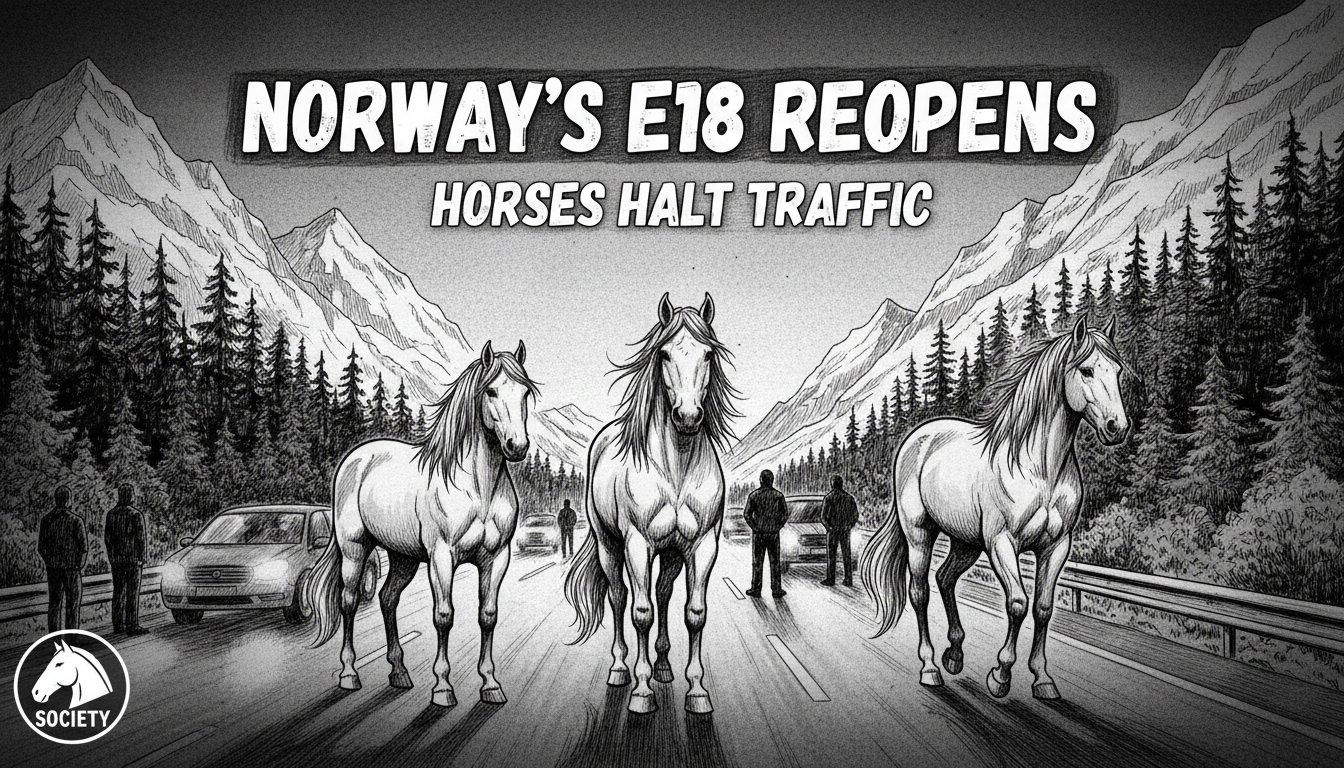
Norway's E18 highway was closed in both directions near Drammen Saturday morning after three loose horses were reported running in the southbound lanes. Police have now reopened the vital transport artery after the animals' owner regained control, ending a disruptive incident that highlights persistent rural-urban tensions on Norway's roads.
The closure occurred at Skoger, a district in Drammen municipality approximately 40 kilometers southwest of Oslo. The E18 serves as a critical corridor connecting the capital to major cities in the south and west, including Kristiansand and Stavanger. Any shutdown, even for a short period, causes immediate congestion on alternative routes through the densely populated Viken county.
Operational commander Inge Omli Landsrød confirmed the resolution. "The owner has control of the horses. The road is open again," Landsrød said in a statement. The National Road Traffic Centre was notified of the incident and its conclusion, allowing for updated traffic advisories to be issued to motorists.
A Recurring Hazard on Modern Highways
While the incident concluded without reported injuries or collisions, it underscores a recurring safety challenge. Loose livestock on high-speed roadways presents a severe danger. A collision between a vehicle and a large animal like a horse can be catastrophic, resulting in significant vehicle damage, serious human injury, and the death of the animal.
Animal control experts point to secure fencing and regular property maintenance as the primary defense. "Prevention is entirely about responsible ownership and infrastructure," says Lars Holen, a veterinary advisor with the Norwegian Food Safety Authority. "Modern fencing systems are highly effective, but they require inspection and upkeep. Especially after winter, ground frost and snow load can weaken posts and wires."
Norwegian law places clear responsibility on animal owners. The Animal Welfare Act mandates that owners keep animals in a manner that prevents them from posing a danger to traffic. Municipalities can issue fines for negligence, and owners can be held liable for damages and cleanup costs if their animals cause an accident.
Economic and Commuter Impact of Road Closures
The brief closure of the E18 near Drammen carries immediate economic consequences. The corridor is a key route for freight transport to and from the Port of Drammen, one of Norway's largest. Delays disrupt just-in-time logistics for industries and increase costs for haulage companies.
For commuters, the closure forces traffic onto smaller regional roads like the 282 and 283, which are not designed for sudden surges in volume. This leads to longer travel times, increased fuel consumption, and heightened frustration. In the greater Oslo metropolitan area, where traffic congestion is a perennial political issue, any incident on a main artery has a ripple effect across the network.
"These incidents, while often local, test the resilience of our entire transport system," notes traffic analyst Kari Nilsen. "They expose the lack of redundancy. When the E18 stops, there are very few equivalent alternatives, which is why we see congestion build so rapidly."
The Friction Between Farmland and Asphalt
The incident at Skoger is a microcosm of a broader national dynamic. Norway's highway network, particularly in the south and east, increasingly cuts through agricultural districts. The E18 itself winds through traditional farming areas as it bypasses towns like Drammen and Tønsberg.
This creates an interface where high-speed modern transport meets slower-paced rural life. While wildlife crossings like those for moose and deer are engineered into new road projects, the hazard of domesticated animals escaping onto the roadway remains a more localized, but frequent, concern.
Local police districts, especially in agricultural regions, routinely deal with reports of loose cows, sheep, and horses. The response typically involves locating the owner, securing the animals, and managing traffic until the situation is resolved. These operations divert police resources from other duties.
Policy Responses and Preventative Measures
In response to past incidents, some municipalities have strengthened local regulations on fencing near major roads. The national Public Roads Administration (Statens vegvesen) also considers existing agricultural activity when planning new road layouts or upgrades, sometimes funding improved fencing as part of a project's mitigation measures.
Technology offers additional solutions. Some farmers in high-risk areas use GPS trackers on valuable livestock, allowing for quicker location if animals break out. However, such technology is an added cost and is not widespread.
The most effective measure remains diligent animal husbandry. "There is no substitute for physically checking your fences and gates," Holen emphasizes. "It's a routine task, but it's the cornerstone of prevention. An owner knowing their animals are secure protects everyone—the animals, themselves, and motorists."
A Near Miss with Broader Implications
Saturday's incident ended as a near miss. No property was damaged, and no one was hurt. The horses were returned safely to their owner. For the motorists caught in the delay, it was an inconvenience. For the authorities, it was a resolved operational call.
Yet it serves as a pointed reminder. Norway's infrastructure is a complex system where human error, mechanical failure, or a broken fence can have disproportionate effects. The country continues to balance its modern economic needs with its pastoral landscapes and traditions.
As traffic flows again on the E18 past Skoger, the question lingers: How does a nation committed to both agricultural sustainability and efficient mobility minimize the points where these two priorities dangerously intersect? The answer lies not in grand solutions, but in the daily, unglamorous work of checking a fence line—a simple act that keeps horses in their fields and high-speed traffic moving safely on its way.