
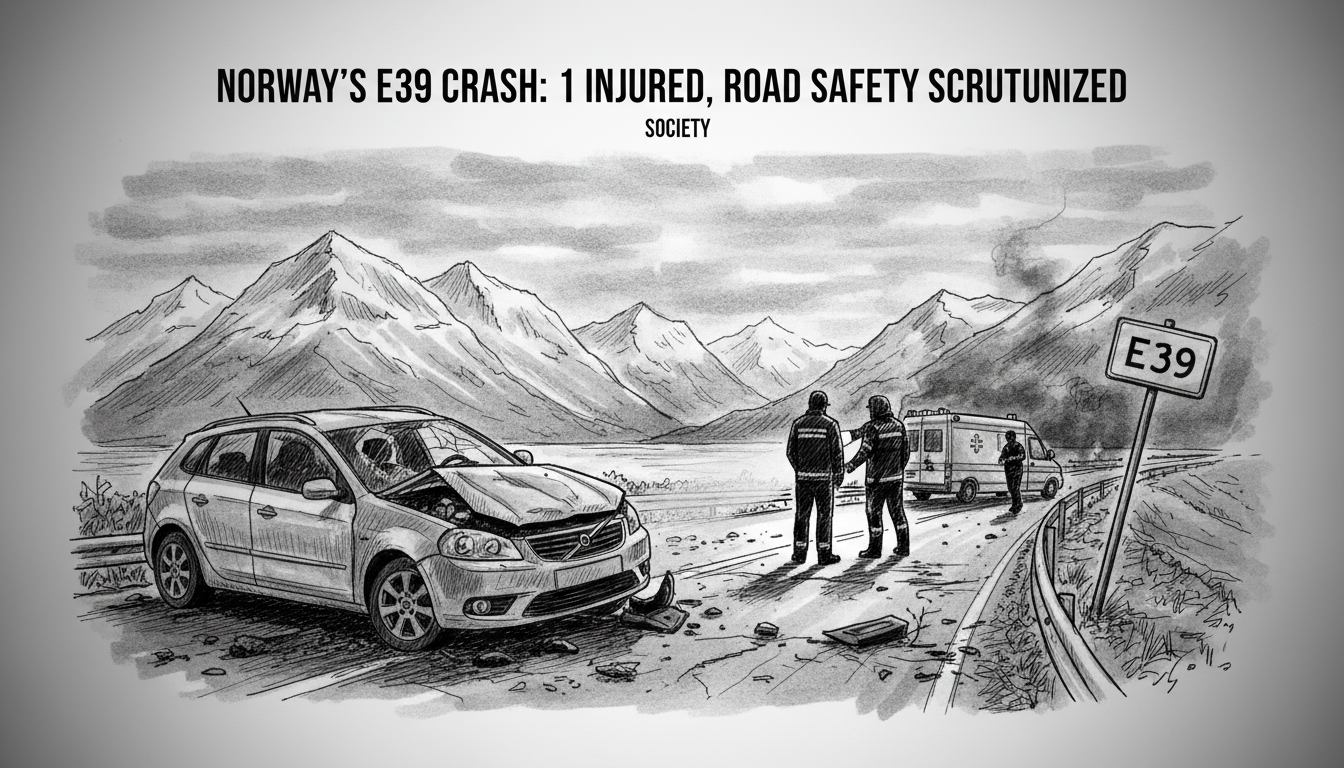
Norway road accident response swung into action Wednesday after a head-on collision on the coastal E39 highway near Vartdalstranda. Police confirmed one driver required ambulance transport to hospital for medical assessment following the crash. The incident, involving two cars, saw one vehicle cross into the oncoming lane before striking the side of another. Two other individuals were checked by paramedics at the scene. Both wrecked vehicles needed recovery, causing manual traffic direction along the vital route. The event has renewed scrutiny of safety along one of Scandinavia's most challenging and essential road corridors.
The Scene on a Critical Corridor
The accident occurred on a stretch of road flanked by the steep terrain of Møre og Romsdal county. The E39 here is a lifeline for communities and commerce, winding along Norway's fractured western coastline. Police reported traffic was moving despite the manual management required after the collision. Local authorities have not released the condition of the hospitalized driver. Initial reports indicate three people total were involved in the mid-morning incident. Emergency services responded promptly to the call, highlighting the constant readiness required for such events on this notorious route. The E39's 1,330-kilometer path from Trondheim to Kristiansand is infamous for its demanding driving conditions.
A Highway Forged by Geography
Norway's E39 is an engineering response to a formidable landscape. It connects cities and towns separated by deep fjords and rugged mountains, often via ferry crossings or ambitious tunnels. The route near Vartdalstranda is characteristic of this challenge. Drivers contend with variable weather, sharp curves, and changing road surfaces. Autumn and winter months introduce rain, snow, and ice, dramatically increasing risks. Road safety experts consistently point to routes like the E39 when discussing the need for defensive driving adapted to conditions. "The western coastline presents unique hazards," said a traffic safety researcher from the Institute of Transport Economics, who asked not to be named in breaking news coverage. "Driver awareness and vehicle preparedness are non-negotiable, especially as seasons change."
The Numbers Behind the Headlines
While Norway boasts one of the world's lowest road mortality rates per capita, each accident prompts serious evaluation. The country recorded 117 road fatalities in 2022, a number authorities work relentlessly to reduce. Møre og Romsdal county, home to the site of Wednesday's crash, consistently registers a higher-than-average share of accidents. This is attributed to its high traffic volume, tourist influx, and the intrinsically difficult nature of its road network. The table below outlines recent annual road fatality figures for Norway, providing context for the broader safety landscape.
| Year | Road Fatalities in Norway | Notable Trend |
|---|---|---|
| 2022 | 117 | Slight increase from pandemic lows |
| 2021 | 109 | Historically low year |
| 2020 | 104 | Impacted by reduced pandemic travel |
| 2019 | 110 | Pre-pandemic baseline |
These national statistics, however, offer little comfort at the scene of a specific crash. For the individuals involved and the communities that rely on the E39 daily, the focus is intensely local. Every closure or delay disrupts supply chains, commutes, and daily life, underscoring the highway's economic and social importance.
Infrastructure and Behavior: The Dual Solution
Improving safety on roads like the E39 is a two-pronged effort. The Norwegian Public Roads Administration continuously invests in upgrades—widening lanes, improving guardrails, and planning for future ferry-replacing tunnels like the ambitious E39 Coastal Route project. Yet infrastructure projects take years and billions of kroner. In the immediate term, experts emphasize the role of driver behavior. "Technology and road engineering have brought us far," the transport researcher noted. "But the final element is always the person behind the wheel. Adjusting speed for conditions, maintaining full attention, and ensuring your vehicle is equipped for Norwegian weather are critical actions every driver can take." This accident, now under police investigation, will be analyzed for factors including vehicle condition, driver action, and potential road surface issues.
The Human Cost Beyond the Statistics
Beyond the numbers and policy discussions lies the human impact of any collision. The driver taken to hospital represents a personal crisis for a family and a network of friends. The others assessed at the scene likely faced significant shock and trauma, even if physically unharmed. Such incidents serve as stark reminders for all road users. They also test the emergency response networks in rural counties, where resources can be stretched over large geographical areas. The effective response by police and ambulance services in this case demonstrates the system's functionality, even as it highlights the ever-present demand for it.
Looking Forward on a Road Prone to Peril
The E39 will remain Norway's main coastal artery for decades. As the government debates long-term infrastructure megaprojects, daily maintenance and safety campaigns continue. For now, the stretch at Vartdalstranda has cleared, and traffic flows normally again. But the questions raised by the collision linger. Is investment keeping pace with both traffic volume and climatic changes bringing more volatile weather? Are driver education programs sufficiently effective? This single accident on a Wednesday morning is a data point in Norway's ongoing effort to reconcile its breathtaking but treacherous geography with the need for safe, reliable mobility. The ultimate goal, as stated in Norway's National Transport Plan, is 'Vision Zero'—no fatalities or serious injuries on the roads. Each incident measures the distance left to travel toward that vision, on a highway where the journey is never simple.