
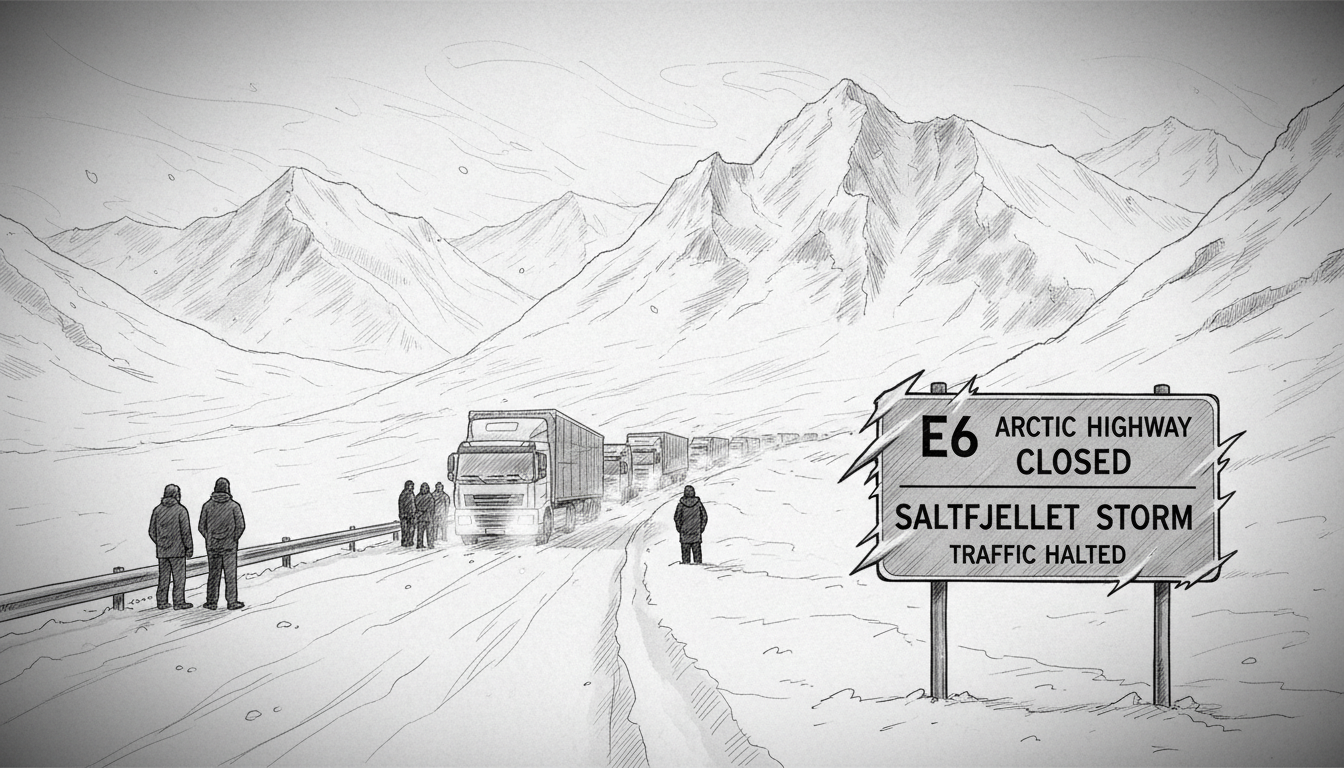
Norway's vital E6 highway is closed over the Saltfjellet mountain pass after a severe storm hit Nordland county. The national road authority announced the closure between the Bolna and Sørelva toll stations late Friday night, with no estimated time for reopening. This critical north-south artery, a lifeline for Arctic communities and freight, is immobilized by heavy snow and hurricane-force winds.
For travelers and truckers, the closure means immediate disruption and difficult decisions. Alternative routes add hundreds of kilometers to journeys between southern and northern Norway. The Polar Circle Center, a landmark tourist stop on the pass, sits empty. Local businesses that rely on steady traffic face lost revenue with every hour the road remains shut.
A Recurring Choke Point on Norway's Spine
The E6 over Saltfjellet is one of Norway's most notorious winter bottlenecks. Stretching 3,100 kilometers from the Swedish border near Oslo to Kirkenes in the far north, the E6 is the country's longitudinal spine. The section crossing the Saltfjellet mountain range, just south of the Arctic Circle, reaches an altitude of over 700 meters. It is exposed to weather systems from the Norwegian Sea, making it prone to rapid and extreme conditions.
"This is not an isolated incident; it's a seasonal reality," said Lars Moe, a transport analyst at the Nordland Research Institute. "The Saltfjellet pass can experience whiteout conditions and wind speeds exceeding 40 meters per second. When it closes, it doesn't just inconvenience a few motorists. It severs a primary supply chain for an entire region." Historical data shows this section is closed, on average, several times each winter, with closures lasting from a few hours to several days.
Economic Ripples from a Single Road Closure
The economic impact of an E6 Saltfjellet closure is immediate and multifaceted. Over 1,000 heavy goods vehicles use this route on a typical day, transporting everything from groceries to construction materials northward and fresh seafood southward. Perishable goods are particularly vulnerable. A 24-hour delay can mean significant financial loss for fisheries in Lofoten or Vesterålen waiting to get their products to European markets.
For the state-owned road administration, each closure triggers a costly and dangerous response. Snowplow crews, often working in perilous conditions, battle to clear the road. Their priority is safety, not speed. "Our crews are reporting near-zero visibility and heavy drifting," a road authority operations manager said in a briefing. "Reopening is a careful process. We must ensure the road is safe, not just clear of snow."
The detour for light vehicles involves taking the E12 and RV77 through Sweden, adding approximately 250 kilometers and three hours to a trip from Mo i Rana to Bodø. For heavy trucks, the permitted routes are even longer. This diversion increases fuel costs, wear and tear, and delivery times, a cost ultimately borne by consumers.
Infrastructure Challenges in a Changing Climate
The repeated closures of the E6 over Saltfjellet fuel an ongoing debate about Norway's northern infrastructure resilience. While tunnels and bridges have revolutionized coastal travel via the National Road 80 coastal highway, the inland E6 remains exposed. Proposals for a tunnel through Saltfjellet have circulated for decades, cited as a permanent solution to weather closures. However, the enormous cost—estimated in the billions of kroner—and environmental concerns have kept the project on the drawing board.
Climate change adds complexity to the equation. While winters may warm, extreme weather events, including intense snowfall and storms, are projected to increase in frequency and intensity in northern Norway. This suggests the vulnerability of high-altitude roads like the E6 over Saltfjellet may grow, not diminish. "We are facing a paradox," Moe explained. "A warmer Arctic can lead to more volatile weather. Investing in resilient infrastructure is no longer just about convenience; it's a long-term economic necessity for Northern Norway."
Politicians from northern constituencies consistently lobby for greater investment. "The E6 is our Main Street," said a member of the Storting's transport committee from Nordland. "When it closes, our communities are isolated. The government's National Transport Plan must prioritize solutions for Saltfjellet that match the road's national importance." The current plan includes funds for avalanche protection and improved weather monitoring but stops short of approving a full tunnel.
The Human Element of Arctic Isolation
Beyond economics and policy, the closure highlights the human reality of life in Norway's vast north. For residents of towns like Mo i Rana or Bodø, a trip to the nearest major city south of the pass, Trondheim, is already a long journey. A road closure can mean missed medical appointments, postponed family visits, and a tangible sense of isolation. It reinforces the geographical divide between north and south, a persistent theme in Norwegian domestic policy.
Tourists exploring the Arctic Circle region find their itineraries abruptly changed. The closure also affects emergency services and routine healthcare, as patient transfers between regional hospitals in Nordland and Trondheim rely on this route. Alternative transport is limited; air travel is expensive and weather-dependent, and coastal ferry services do not replicate the road's connectivity.
Looking Ahead: A Road in Waiting
As the storm continues to batter Saltfjellet, the waiting game continues. Meteorological reports suggest the worst winds may ease by Sunday morning, but significant snow accumulation remains a challenge. The road authority will not speculate on a reopening time, emphasizing that safety assessments are continuous.
This weekend's closure serves as another stark reminder of Norway's geographical challenges. The country's wealth is built on mastering its environment, from offshore oil platforms in the North Sea to mountain-hugging roads. Yet, at Saltfjellet, nature still dictates terms. Each closure renews questions about the balance between accepting seasonal disruptions and investing in monumental engineering to overcome them. For now, the mountain pass holds the key, and the traffic stands still.