
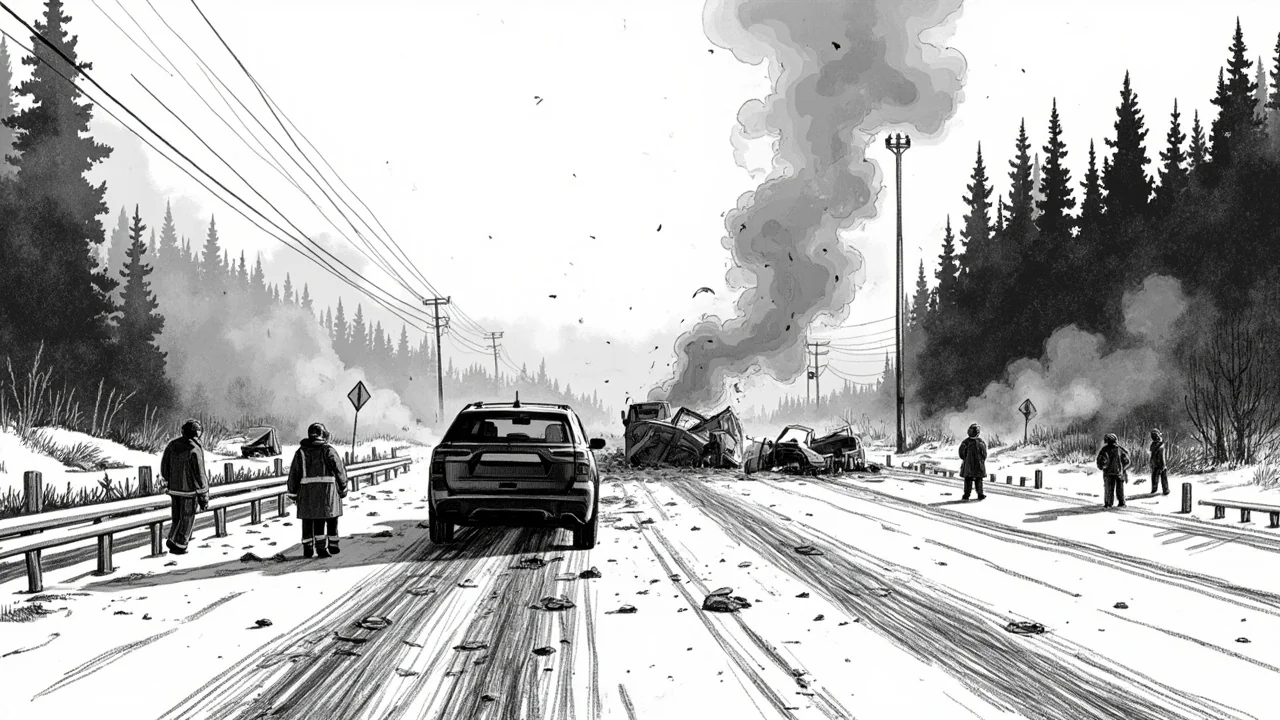
Norway's main E6 motorway saw a dramatic car fire north of Oslo Sunday morning, but police report no serious injuries. A driver in his twenties lost control on the icy road near Djupdalstoppen, crashing into a barrier before his vehicle caught fire and burned completely. The incident caused temporary disruption on the critical southbound artery connecting the capital to eastern regions.
Operational commander Rune Isaksen confirmed the driver was taken for a medical check as a precaution. "The fire is extinguished and the car is totally burned out," Isaksen stated. He noted that while road conditions were slippery, it was too early to definitively link ice to the crash cause. Police cleared the scene by 10:30 AM, restoring normal traffic flow on the strategically important route.
A Routine Emergency on a Critical Artery
The E6 motorway functions as Norway's national spine, running from the southern tip at Svinesund to Kirkenes near the Russian border. The stretch north of Oslo, where Sunday's fire occurred, handles heavy commuter and freight traffic daily. Incidents here trigger immediate response protocols from the Øst Police District, which covers the capital region. This fire, while severe for the vehicle involved, was resolved with textbook efficiency by Norwegian emergency standards.
No other vehicles were involved in the single-car accident. The driver's report of a skid preceding the impact aligns with police observations of glazed ice on the roadway. Winter road maintenance is a major public expenditure in Norway, with the Norwegian Public Roads Administration deploying thousands of plows and salt trucks. Yet sudden temperature shifts can create treacherous black ice patches, particularly on elevated sections like Djupdalstoppen.
The Anatomy of a Total Burn-Out
A car burning to total destruction, as described by police, indicates an intense, fuel-fed fire that likely consumed the entire passenger compartment and engine bay. Modern vehicles contain numerous flammable materials—plastics, upholstery, fluids—that can sustain a fierce blaze once ignited. Norwegian fire crews are trained to prioritize life safety over property; their rapid response ensured the driver escaped before the fire intensified.
The cause of ignition remains undetermined. Post-crash fires can start from electrical shorts, fuel line ruptures, or hot components contacting flammable debris. Forensic examination of a totally burned vehicle is challenging, often leaving the precise origin unconfirmed. The police investigation will focus on driver testimony, road conditions, and any mechanical factors preceding the crash.
Winter Roads and Norway's Accident Calculus
Norway maintains one of Europe's lowest road mortality rates despite its harsh climate. This success stems from a multi-faceted approach: rigorous vehicle safety standards, extensive driver education for winter conditions, and rapid emergency medical response. Sunday's incident underscores how this system functions—a serious crash occurred, but the human outcome was minimal.
Icy roads contribute to thousands of minor accidents annually in Norway, but fatal outcomes have decreased steadily. The Norwegian Public Roads Administration invests heavily in weather monitoring and anti-icing measures. Yet as this case shows, perfect safety remains elusive. The driver's age, in his twenties, places him in a statistical group with higher accident involvement rates, though police have not suggested any fault.
Infrastructure Resilience and Traffic Management
The swift clearance of the E6—within about an hour of the initial report—demonstrates Norway's capability to manage disruptions on vital infrastructure. Quick deployment of recovery vehicles and coordinated police action minimized economic impact. Delays on the E6 ripple through supply chains and affect businesses across the region, making rapid resolution a priority.
This incident occurred on a Sunday morning, limiting traffic volume. A similar event during weekday rush hour would have caused significant congestion. The Øst Police District's operations center manages such scenarios routinely, diverting traffic via alternative routes like the E16 when necessary. Their public communication, providing clear updates on road status, is a key component of maintaining public confidence during disruptions.
The Human Factor in Vehicle Safety
The driver's decision to seek a medical check, even without apparent serious injury, reflects prudent caution. Crash forces can cause internal injuries not immediately obvious. Norway's public health system facilitates such precautionary assessments without financial barrier to the individual. This safety net, combined with high seatbelt usage and advanced vehicle safety systems, forms the last line of defense when accidents occur.
Modern cars are designed with fire prevention in mind—fuel cut-off switches, protected wiring, and flame-retardant materials. A total burn-out suggests these systems were overwhelmed, possibly by a significant fuel leak or sustained initial flame. The vehicle make and model have not been disclosed, but all cars sold in Norway meet strict EU safety regulations that include fire resistance standards.
Looking Ahead: Prevention and Response
This event will likely enter statistics used by the Norwegian Public Roads Administration to evaluate high-risk road segments. The Djupdalstoppen area may receive scrutiny for winter maintenance schedules or potential improvements to barrier design. Each incident provides data points that inform Norway's continuous efforts to achieve "Vision Zero"—the goal of no road fatalities or serious injuries.
For the driver, the experience serves as a stark reminder of winter's hazards. For authorities, it validates existing response protocols. For the public, it's a brief news item highlighting the ever-present risks of mobility in a northern nation. The ultimate takeaway, however, is positive: a dramatic accident resulted in no loss of life, thanks to a combination of individual luck and systemic competence. As Norway's winter deepens, this balance between risk and resilience will be tested repeatedly on roads from Oslo to the Arctic Circle.