
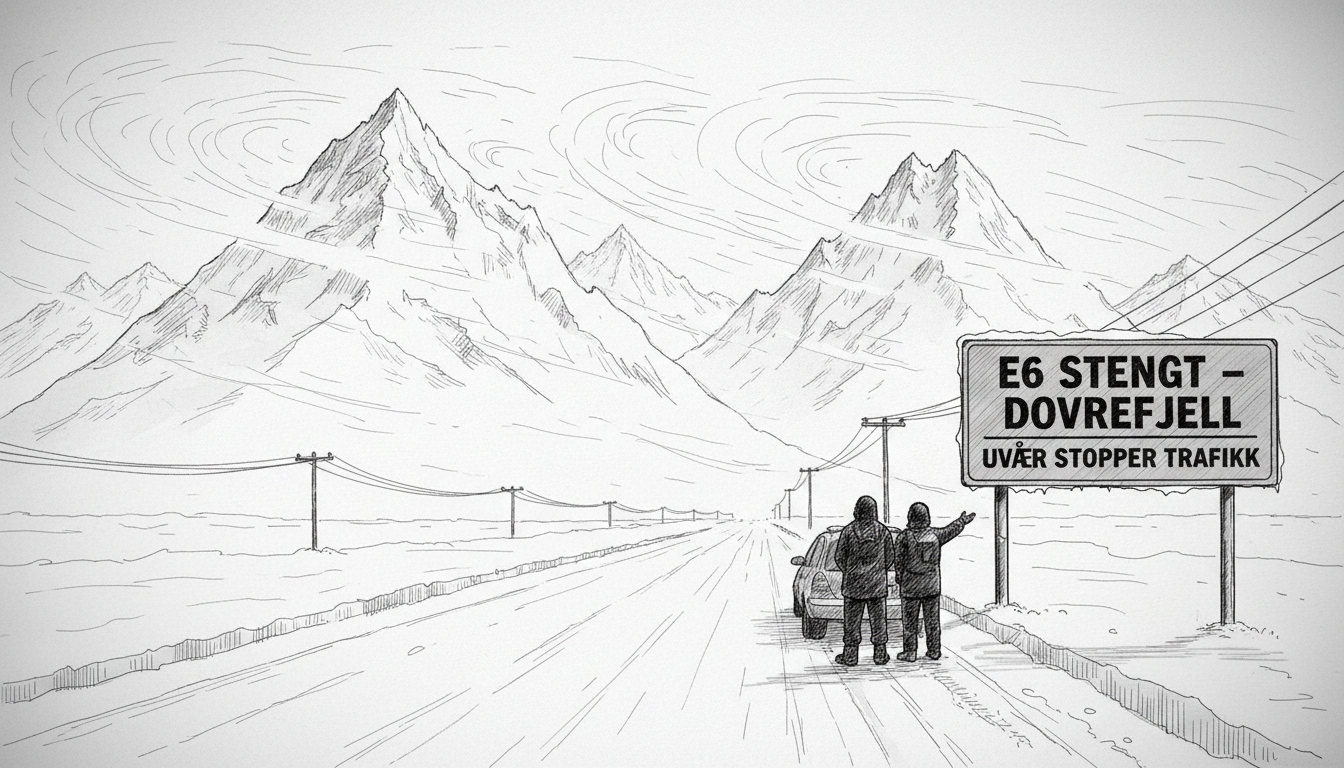
Norway's vital E6 highway has been closed over the Dovrefjell mountain range due to a severe winter storm, halting all north-south traffic. The closure between Dovre and Oppdal began Monday evening as heavy snow and strong winds created dangerous, near-zero visibility conditions. Traffic operator Tone Sorken at Vegtrafikksentralen Øst confirmed the road is unlikely to reopen before Tuesday morning, stranding freight and travelers on Norway's most important national artery.
"It's snowing heavily and blowing hard. There's a stiff gale on parts of the mountain," Sorken said in an update. She noted the wind is not expected to abate until early Tuesday, making a nighttime reopening impossible. The decision underscores the persistent vulnerability of Norway's critical infrastructure to the country's formidable winter climate, even on a modern, well-maintained highway.
A Critical Artery Severed
The E6 is Norway's national spine, running 3,088 kilometers from the southern border with Sweden at Svinesund all the way to Kirkenes in the Arctic Finnmark region. The section crossing the Dovrefjell plateau is its most notorious and weather-sensitive segment. This closure effectively severs the road connection between Northern and Southern Norway, forcing a detour of hundreds of kilometers for any vehicle attempting to bypass the mountain.
Dovrefjell National Park, which the highway traverses, is known for its extreme and rapidly changing weather. The mountain range acts as a barrier for weather systems, often creating localized blizzard conditions even when forecasts are mild for surrounding areas. The area is home to Europe's last wild reindeer herds, but for logistics companies and travelers, it represents a recurring bottleneck.
Economic and Logistical Ripple Effects
Every hour the E6 over Dovrefjell remains closed carries a significant economic cost. The highway is the primary route for freight transport between the major port of Trondheim and the population centers in Eastern and Southern Norway. Fresh produce, manufactured goods, and industrial components all move along this corridor. Alternative routes via RV 3 over Filefjell or the E16 over Valdres add considerable time, distance, and fuel consumption to journeys.
"A closure like this disrupts just-in-time supply chains immediately," explained Lars Moe, a transport logistics analyst based in Oslo. "For the freight industry, it's not just the delay on the mountain itself. It creates congestion on alternative routes and a backlog of goods that takes days to clear. The cost runs into millions of kroner per day." The impact is felt in grocery stores, construction sites, and factories awaiting deliveries from the other side of the mountain.
The Science of Mountain Road Management
Managing the E6 over Dovrefjell is a year-round, high-stakes operation for the Norwegian Public Roads Administration (Statens vegvesen). The Traffic Management Center East (Vegtrafikksentralen Øst) monitors the road via a network of weather stations, webcams, and sensors that measure wind speed, temperature, and pavement conditions. Decisions to close the road are not taken lightly and are based on strict safety protocols.
Wind is the primary culprit. When sustained winds exceed 25-30 meters per second (56-67 mph), the risk of trucks overturning or vehicles being blown off course becomes unacceptable. Combined with heavy snowfall, which reduces visibility to mere meters, the conditions become impossible for safe travel. Proactive closure is the standard policy to prevent motorists from becoming trapped in white-out conditions at 1,000 meters above sea level.
A Recurring Challenge and Long-Term Solutions
This is not an isolated incident. The E6 over Dovrefjell is closed multiple times each winter. The frequency has sparked ongoing political and engineering debates about long-term solutions. One major project, the planned Dovre Line railway doubling and modernization, aims to provide a more weather-resilient alternative for freight. However, that project is years from completion.
For the road itself, discussions have included ideas like building more extensive snow tunnels or wind fences in the most exposed sections. The harsh environment and the need to protect the pristine wilderness of Dovrefjell National Park make such projects exceptionally costly and complex. For now, the strategy remains one of advanced forecasting, efficient snow clearance, and timely closures to ensure safety.
The Human Element of the Closure
Behind the logistics data are stranded travelers. The closure often catches people mid-journey, leading to overnight stays in hotels in Dombås or Oppdal, the towns at either end of the closed section. Local businesses see a sudden, if unplanned, influx of guests. For residents of remote communities north of Dovrefjell, such closures are a regular part of winter life, requiring flexibility and planning.
Emergency services remain on high alert during such closures. While the road is closed to general traffic, responders must still be able to reach potential incidents. This requires close coordination between the traffic center, road maintenance contractors with specialized snowplows, and local police.
Looking Ahead: A Nation Defined by its Geography
The closure of the E6 over Dovrefjell is a stark reminder of a fundamental Norwegian reality. The country's economic unity and social cohesion are perpetually challenged by its dramatic geography. Mountains, fjords, and harsh weather dictate the terms of transportation and connectivity. While Norway leads in engineering and technology, from subsea tunnels to avalanche protection, nature still holds the ultimate veto power over movement.
As climate change alters weather patterns, the nature of these challenges may shift. Some studies suggest winters may become more volatile, with increased precipitation falling as rain at higher altitudes, leading to ice and new types of hazards. This places even greater importance on adaptive infrastructure and resilient planning.
For Tuesday morning, the focus is on the forecast. Traffic operators will await the contractor's assessment at dawn. The snowplows will begin their work in the twilight, clearing drifts that may be several meters high. The goal is to reopen the artery as soon as it is safe, reconnecting the country. But every Norwegian knows that on Dovrefjell, the mountain decides the schedule. The temporary silence on this stretch of asphalt, broken only by the howling wind, is a powerful testament to the enduring force of the natural world in one of Europe's most advanced nations.