
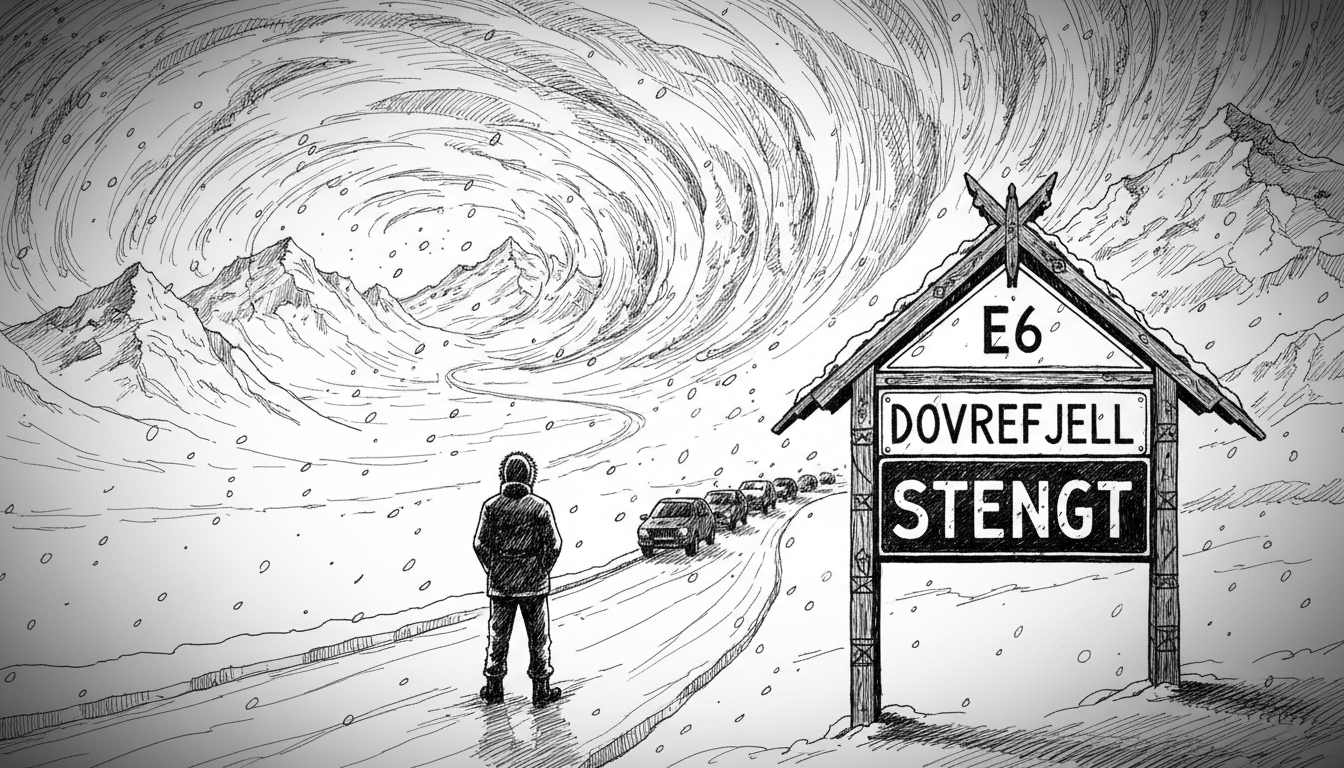
Norway's main E6 highway is closed over the Dovrefjell mountain range, severing the critical link between Oslo and Trondheim. The Norwegian Public Roads Administration shut the road between Dovre and Oppdal at 9 PM Monday due to severe weather, with no clear timeline for reopening. A yellow-level warning for heavy snowdrifts is in effect across northern and southern Finnmark, parts of Troms, all of Nordland, and northern mountain areas of Southern Norway, creating widespread travel disruption.
This closure highlights a persistent vulnerability in Scandinavia's longest road. The E6 stretches over 3,000 kilometers from Sweden's southern coast to Norway's Arctic frontier at Kirkenes. The Dovrefjell section, a high-altitude pass through a national park known for its wild reindeer, is a notorious choke point. When weather turns, this artery for people and goods simply stops flowing.
A Recurring Challenge for Norwegian Infrastructure
Road closures on Dovrefjell are not unusual, but each incident underscores the logistical tightrope Norway walks. The mountain range acts as a formidable barrier between the country's eastern and western regions. The national road authority must balance public safety with the economic and social need to keep the route open. Heavy snowfall combined with strong winds creates near-zero visibility and rapid snow accumulation, making passage impossible even for equipped vehicles.
"The decision to close is never taken lightly, but driver safety is paramount," a senior road administration official said in a statement. "Conditions on Dovrefjell can deteriorate from manageable to life-threatening in a very short time." The closure forces commercial traffic, tourists, and local residents onto lengthy detours, primarily using the E16 and RV15, which adds hours to journey times and increases fuel costs.
Economic Ripple Effects from Mountain Pass to Port
The economic impact of an E6 closure extends far beyond stranded motorists. Norway's supply chains, particularly for perishable goods and time-sensitive deliveries, rely on predictable transit along this corridor. Logistics companies face immediate penalties in delayed shipments and disrupted schedules. For businesses in Trondheim and Central Norway, a closed Dovrefjell means isolation from major distribution centers in the Oslo region.
Transport analysts point to the cumulative cost of these weather-induced stoppages. "Each major closure on the E6 represents a multi-million kroner disruption to the national economy," said Lars Jensen, a professor of transport logistics at the Norwegian University of Science and Technology. "It's not just the delay. It's the cascading effect on warehouse schedules, ferry connections, and just-in-time delivery systems that modern commerce depends on." The closure also tests Norway's much-discussed resilience, questioning the reliance on a single primary surface route for such a vital connection.
Climate and Geography: An Inescapable Reality
Dovrefjell-Sunndalsfjella National Park, covering 1,693 square kilometers, is a protected and pristine wilderness. The road that traverses it must coexist with an extreme environment. Climate data suggests weather patterns are becoming more volatile, with intense precipitation events increasing in frequency. This poses a long-term challenge for infrastructure planners. Engineering solutions like taller snow fences or more frequent avalanche control are costly and have limits against nature's force.
The situation contrasts with Norway's advanced maritime and energy sectors. The country can engineer floating offshore wind farms and subsea gas pipelines, but a mountain pass remains at the mercy of the weather. This paradox is not lost on policymakers. There is ongoing debate about investing in alternative transport modes for this corridor, such as improving rail capacity on the Dovre Line, which runs a parallel but less direct route. However, rail is also susceptible to extreme weather, and major infrastructure projects carry enormous price tags.
The Human Element: Stranded Travelers and Local Adaptation
Behind the logistics and economics are thousands of affected travelers. Tourist itineraries are upended, family visits postponed, and work commutes impossible. Local communities like Dovre and Oppdal become waypoints for the stranded, with hotels and cafes seeing an unplanned influx. For residents of these mountain communities, such closures are a part of life. They plan for them, keeping pantries stocked and schedules flexible.
"We watch the weather forecasts as closely as the road reports," said Kari Nilsen, who runs a guesthouse near the closed section. "When the E6 closes, we know some people will need a warm place to wait it out. It's a reminder that for all our technology, we still live in a place where nature has the final say." This local adaptability is a crucial, often overlooked, component of Norway's relationship with its demanding geography.
Looking Ahead: Resilience in the Face of Nature
The reopening of the E6 over Dovrefjell will come only after road crews have battled snowdrifts and winds have subsided. Each closure renews conversations about Norway's infrastructure priorities. Should the state invest in more robust all-weather protection for this key route, or does accepting seasonal closures and improving alternatives represent a more sustainable path? The debate touches on core values: connectivity, safety, economic efficiency, and environmental stewardship.
For now, the closed road serves as a stark reminder. Norway's wealth and modernity are built across a landscape that remains fundamentally untamed. The Dovrefjell pass, with its wild reindeer and sweeping vistas, is a national treasure. It is also a bottleneck that can halt a nation's main street. As climate uncertainty grows, finding a balance between conquering and accommodating this terrain will be one of Norway's defining challenges. The next time the clouds gather over the mountains, the country will be watching, waiting to see if the road stays open.