
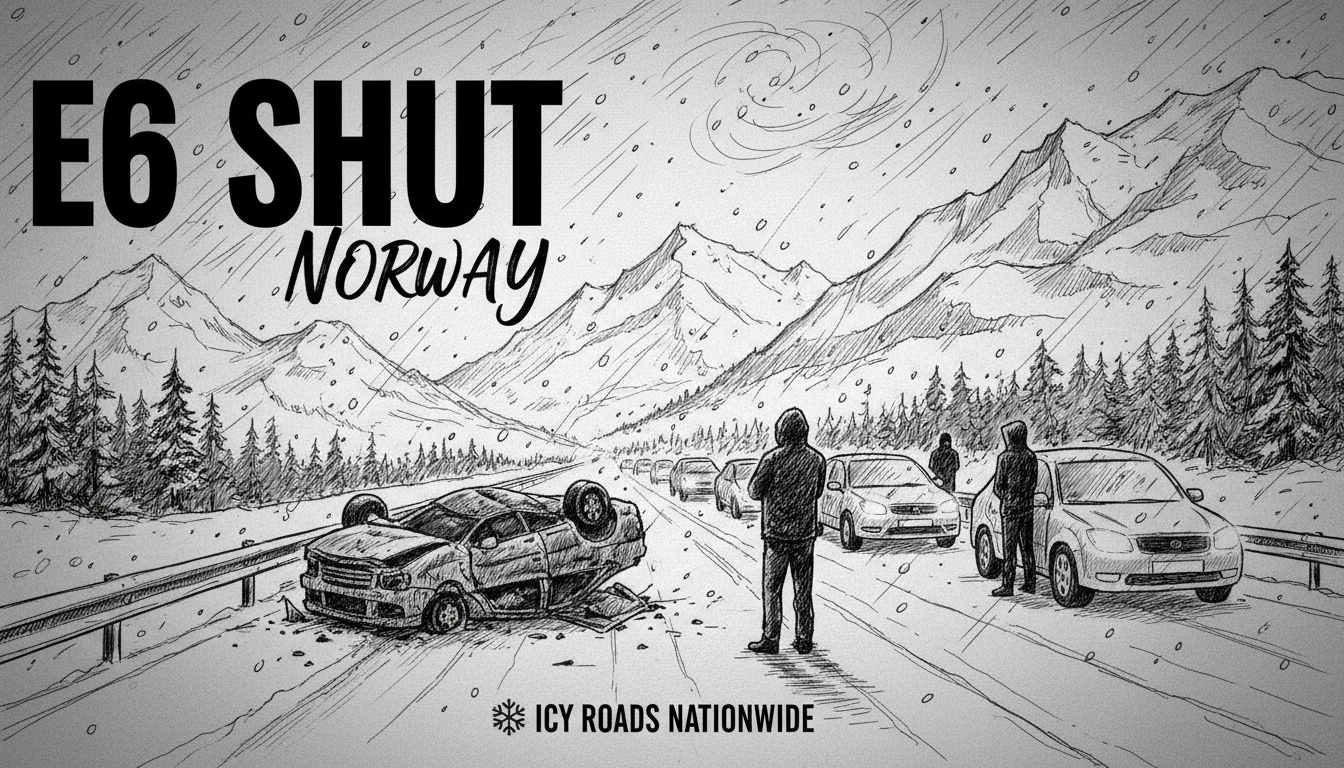
Norway's main E6 highway was closed northbound near Sarpsborg Sunday after a car lost control on ice and crashed into a guardrail. The incident, which left the driver unharmed, triggered a full closure from the Leikvoll junction, with traffic diverted via Gamle Kongevei until road crews could apply salt. Police across multiple districts reported treacherous conditions leading to several minor accidents, highlighting the sudden onset of winter hazards on Norwegian roads.
"The E6 is so slippery that it is being closed on-site until a contractor has been able to salt the road," said duty officer Jimmy Pettersen of the East Police District in a police log entry. He urged all motorists to adjust their speed to the conditions. The closure on this critical artery, which runs the length of the country, caused immediate local disruption. In a separate incident in Lillestrøm, another vehicle slid off the road into a ditch, resulting in minor injuries to the driver.
A Widespread Winter Hazard
The problems were not confined to the Oslo region. On the west coast, particularly in the Sunnhordland area encompassing Rosendal and Tysnes, police received numerous reports of extremely slippery roads. The simultaneous issues across geographically diverse regions—from the inland east to the coastal west—point to a broad weather system affecting southern Norway. These conditions serve as an annual reminder of the logistical and safety challenges posed by the country's climate, even on modern, well-maintained highways like the E6.
Norway's Public Roads Administration maintains a rigorous winter maintenance regime, but rapid changes in temperature and precipitation can outpace treatment efforts. Black ice, often invisible to drivers, forms quickly and poses the greatest danger. The crash on the E6 at Kalnes is a classic example of this phenomenon, where a loss of grip on an apparently clear road surface leads to immediate loss of vehicle control.
The Economic and Social Artery
The E6 is more than just a road; it is Norway's primary national transport corridor. Running over 3,100 kilometers from the Swedish border in the south to Kirkenes near the Russian border in the north, it connects every major region. A closure on any segment, especially one near key logistics hubs like Sarpsborg in the populous east, has ripple effects. Freight movement is delayed, commuters are stranded, and emergency service response times can be affected by the necessary detours.
This specific closure rerouted traffic onto Gamle Kongevei, the "Old King's Road." This detour illustrates a common Norwegian strategy: utilizing older, secondary networks when primary highways fail. However, these roads are often narrower, less straight, and pass through populated areas, increasing travel time and potential for localized congestion and new accidents. The economic cost of such closures, though brief, accumulates through lost productivity, increased fuel consumption from idling traffic, and strain on alternative routes.
Expert Analysis on Winter Readiness
Road safety experts consistently stress that technology and salting alone cannot prevent winter accidents. "The most critical safety feature in winter driving is the driver's adaptation," says a veteran traffic safety instructor with the Norwegian Council for Road Safety. "Modern cars with stability control and winter tires can create a false sense of security. When police report conditions so bad they close a major motorway, it underscores that the basic physics of friction have been overcome. Speed must be reduced significantly below the posted limit."
Norwegian authorities operate a tiered warning system, but its effectiveness relies on public vigilance. The police logs from Sunday show a direct, operational response: assess, close, treat, reopen. This protocol prioritizes absolute safety over traffic flow, a policy rooted in Norway's "Vision Zero" approach to road fatalities, which aims to eliminate serious injuries and deaths. A temporary closure is always preferable to a multi-vehicle pileup.
Furthermore, experts point to the challenge of "first ice" events early in the season. Drivers may be out of practice with winter driving techniques, and their vehicles may have only recently been fitted with winter tires, which need a short breaking-in period to achieve optimal grip. The incidents reported from Lillestrøm to Sunnhordland suggest many drivers were caught by surprise by the severity of the conditions.
The Human Factor in a Harsh Climate
Beyond the logistics and expert analysis, these events are a story of human adaptation to environment. Norway has one of the highest rates of winter tire use and driver training for cold conditions in the world. Yet, as Sunday proved, the environment can still assert itself powerfully. The driver who walked away unharmed from the E6 crash was fortunate; the outcome underscores the importance of safety systems like guardrails and crumple zones, which are designed to mitigate the consequences of a loss of control.
For residents in areas like Sarpsborg or Sunnhordland, such days require a change in routine and heightened awareness. Simple commutes become calculated risks, and plans are made with a glance at the weather app and road agency website. This is an ingrained part of Nordic life, a seasonal negotiation between mobility and the elements. The efficient response by police and road crews is a public service that enables this negotiation, minimizing danger until conditions improve.
A Look Ahead as Winter Sets In
The events of this Sunday are a precursor. As winter deepens, similar scenes will play out across Norway, particularly on mountain passes like the Filefjell or on coastal roads exposed to wet, freezing conditions. The key question for authorities is whether public messaging on adaptive driving is cutting through. For motorists, the lesson is clear: the legal right to use winter tires from November to Easter is a minimum requirement, not a guarantee of safety.
The reopening of the E6 after salting provided a quick resolution to this incident, but it leaves a broader consideration. With climate change potentially leading to more frequent freeze-thaw cycles and unpredictable winter weather, the demands on road maintenance budgets and driver alertness may increase. Norway's infrastructure is built for winter, but each season tests its resilience and the prudence of its people. The empty, closed lanes of the E6 near Kalnes served as a silent, powerful reminder that in the face of nature's icy grip, caution is the only sensible path forward.