
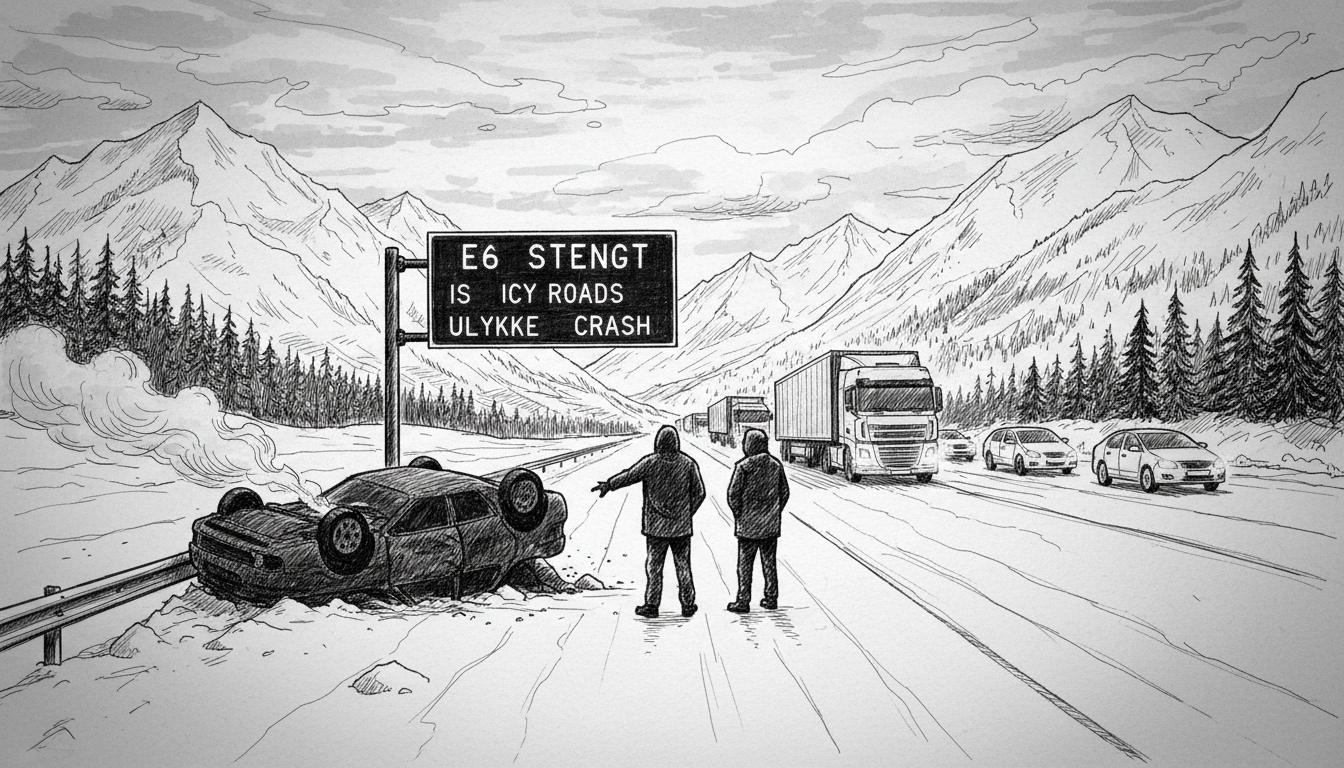
Norway's E6 highway was closed northbound near Sarpsborg on Tuesday after a car lost control on an icy stretch and collided with a guardrail. The incident, which left the vehicle stranded across the carriageway, forced police to shut the vital artery until road crews could complete salting operations. The driver was taken to hospital for a check-up, police confirmed, highlighting the severe material damage to the car but the absence of other vehicles involved.
This single-vehicle accident underscores a recurring winter crisis for Scandinavian transport. The E6, Norway's primary north-south corridor stretching over 3,000 kilometers, is a lifeline for freight and passenger travel. Its closure, even for a few hours, causes significant economic disruption and travel chaos. The decision by police to close the road entirely, rather than manage a partial blockage, points to the extreme hazard presented by the conditions.
A Recurring Winter Hazard
The closure occurred just north of Grålum, an area within Sarpsborg municipality in Viken county. Traffic was diverted via the Old King's Road (Gamle kongevei) while contractors worked to make the E6 safe again. Police Operations Manager Jimmy Pettersen said the driver was transported to hospital as a precaution. The vehicle remained in the roadway, awaiting recovery, blocking all northbound traffic.
This event is not an isolated one. Slippery road conditions are a dominant factor in Norwegian winter traffic incidents. While comprehensive 2024 statistics are still being compiled, data from previous years paints a stark picture. In a typical winter, icy or snowy conditions are a contributing factor in a substantial percentage of all traffic accidents. The Norwegian Public Roads Administration (Statens vegvesen) faces a constant battle against nature to keep routes like the E6 open.
The Economic Artery at a Standstill
The E6's function cannot be overstated. It connects the capital region of Oslo to key cities like Hamar, Trondheim, and Mo i Rana, ultimately reaching the northern reaches of Finnmark. For the freight industry, it is indispensable. Delays caused by weather-related closures ripple through supply chains, impacting everything from supermarket shelves to industrial production timelines. The cost is measured in millions of kroner for each major disruption.
"When the E6 closes, Norway's backbone fractures," said Lars Tennfjord, a transport analyst with the Institute of Transport Economics. "The immediate impact is on safety, which is paramount. But the secondary effect is a logistical headache that delays goods and increases costs for businesses and consumers alike. Alternative routes are often local roads ill-suited for heavy truck traffic, creating new bottlenecks."
Expert Analysis on Winter Road Safety
Road safety experts reiterate a consistent message during the winter months, one that drivers often hear but sometimes ignore. "The three pillars of winter driving in Norway are proper winter tires, adapted speed, and increased following distance," explained Kari Nilsen, a senior advisor at the Norwegian Council for Road Safety. "On a day like today near Sarpsborg, where black ice can form quickly, speed adaptation is critical. Modern cars give a false sense of security, but physics always wins on ice."
Nilsen emphasized that even all-wheel drive vehicles are not immune to losing control on glare ice. The incident on the E6, where the car struck the guardrail, is a classic result of a driver losing traction and being unable to correct the slide. The guardrail, or autovern, likely prevented a more serious outcome, such as the vehicle leaving the roadway entirely.
The Infrastructure and Response Challenge
The Norwegian Public Roads Administration operates a vast network of weather stations and uses forecast data to pre-emptively salt roads. However, predicting and treating every hazardous patch, especially during periods of fluctuating temperatures around freezing, is an immense challenge. The stretch of E6 near Sarpsborg is particularly notorious among truck drivers for its susceptibility to ice formation due to local geography and wind patterns.
Police face a difficult calculation when incidents occur. Keeping a road open with a partial blockage risks secondary collisions, especially in poor visibility or on ice. A full closure, while safer, maximizes disruption. In this case, the assessment by officers on scene that conditions were "so unsafe" mandated a full shutdown until professional salting could be completed. This protocol prioritizes human life over traffic flow, a principle deeply embedded in Norwegian road safety policy.
Looking Beyond the Immediate Closure
While the road has since reopened, the incident serves as an annual reminder of the vulnerabilities in a nation defined by its long, harsh winters. Investment in road maintenance is a perpetual political discussion, balancing budgets against safety. Some experts advocate for more aggressive use of brine solutions before storms and increased monitoring of high-risk zones like the E6 near Sarpsborg.
For the average Norwegian, the story is a routine winter headline. It prompts checks of tire tread depth, a second thought about departure times, and a resigned acceptance of the power of Nordic weather. Yet, each closure also sparks a debate about preparedness, responsibility, and the limits of infrastructure in the face of nature.
The driver involved in this crash will recover. The damaged car will be towed away. The salt will melt the ice. Traffic will flow again. But the fundamental tension between mobility and safety on Norway's icy roads remains, waiting for the next temperature drop, the next patch of black ice, and the next headline-making closure of the essential E6.