
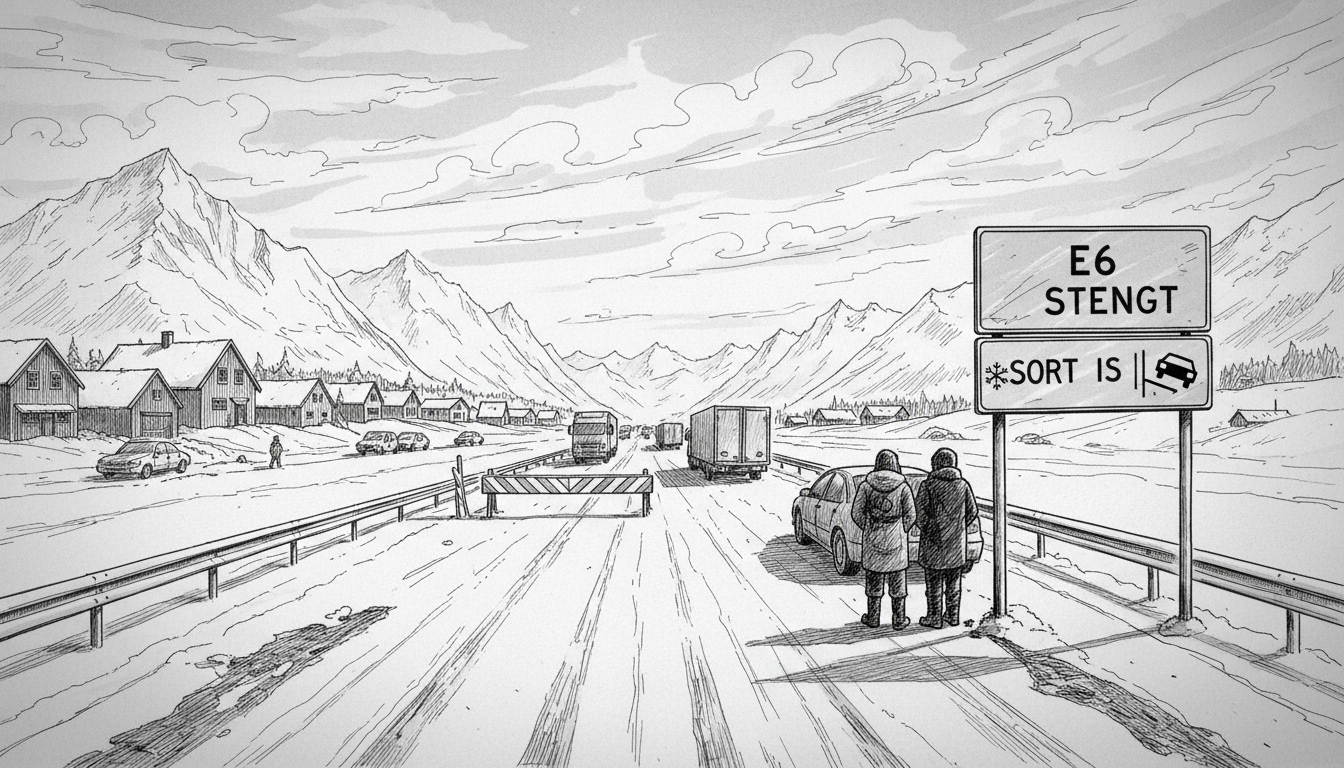
Norway's E6 highway was closed near Sarpsborg Sunday morning after a car spun out on treacherous black ice, forcing police to halt all traffic on the vital north-south artery. The incident, which occurred around 11 a.m., revealed dangerously slippery conditions on a section of road where morning sun and lingering shadow created a perfect storm for ice formation. Police redirected vehicles onto local roads until a salt truck could treat the surface, highlighting the persistent winter challenge for Scandinavia's most important road link.
"We are assessing the E6 to be so slippery that it is not justifiable to open for free movement again before the salt truck has been on site," the Eastern Police District stated in its log. The decision came after a single-vehicle accident served as an early warning. "There has been a car in the guardrail that spun around. No personal injury has been reported," said Operations Manager Andreas Paulsen. His team's immediate focus was on managing the resulting traffic queue and ensuring safety.
The Invisible Hazard on a Vital Corridor
Black ice, or "glattføre," is a notorious and often invisible winter hazard in Norway. It forms when moisture on the road surface freezes rapidly, creating a thin, transparent layer of ice that offers almost no traction. Traffic operator Barbro Evensen Venhagen from the Eastern Traffic Centre explained the specific conditions at Sarpsborg. "When the sun came out, it iced over, especially in the one lane where the shadow falls," she said. "It's just a bit unfortunate that it has to be right on the European road."
The closure affected a critical stretch of the E6, which runs over 3,000 kilometers from Trelleborg in southern Sweden to Kirkenes in northern Norway. In the Sarpsborg region, approximately 90 kilometers southeast of Oslo, the highway is a primary conduit for commuters, freight, and travel between the Norwegian capital and Sweden. Any disruption here causes immediate ripple effects, with delays quickly backing up onto alternative routes like the "gamlevegen til Solli" (old road to Solli) used during this incident.
A Widespread Winter Warning
The problem was not isolated to Østfold county. Simultaneously, traffic authorities on the opposite side of the country issued similar warnings. "People should be aware across the entire West Coast," said traffic operator Tina Fjelldavli at the Western Traffic Centre on Sunday morning. She reported slippery conditions "almost across the board," specifically naming the E134, E39, and E16 highways.
Fjelldavli emphasized the deceptive nature of the threat. "It's black ice, so it often doesn't look slippery, but because the road surface is cold and there's a clearing in the weather now, it becomes slippery." This combination—a cold roadbed followed by a break in cloud cover allowing rapid heat loss—is a classic recipe for black ice formation that catches even experienced drivers off guard.
The Machinery of Winter Road Management
Norway's response to such conditions is managed by the Norwegian Public Roads Administration (Statens vegvesen), which oversees the maintenance of the country's 54,703 kilometers of public roads. The system relies on a network of road weather stations, patrol reports, and public notifications to deploy resources like salt trucks and snowplows. The goal is proactive treatment, but rapidly changing microclimates, like the sun-and-shadow patch on the E6, can outpace even the best systems.
The salt truck dispatched to Sarpsborg uses a brine solution, often mixed with grit, to lower the freezing point of water on the asphalt. This treatment is a constant and costly necessity during the winter months. The economic impact of road closures, however, far exceeds the cost of maintenance. The E6 carries a significant portion of Norway's domestic and international freight; every hour of closure translates to delivery delays, logistical complications, and lost productivity.
Expert Analysis: Adaptation is Non-Negotiable
Road safety experts stress that technology and salt trucks are only part of the solution. The fundamental requirement is driver adaptation to conditions. "Black ice is the great equalizer," says Lars Tennebo, a former traffic safety instructor with the Norwegian Automobile Federation (NAF). "It doesn't matter if you drive a small car or a heavy truck; when you hit a patch with no friction, physics takes over. The authorities can and do their part, but the final safety margin is determined by the driver's speed, awareness, and preparedness."
Tennebo points to the Sarpsborg incident as a textbook case. "A single vehicle loses control, and that is the canary in the coal mine. It tells the police that the entire section is hazardous. The responsible decision is to close it, as they did, to prevent a mass collision. Drivers should view such closures not as an inconvenience, but as a necessary protection."
He recommends that during transitional weather in spring and autumn, drivers must be particularly vigilant in the early morning and late evening on exposed roads, bridges, and shaded forest stretches. Reducing speed, increasing following distance, and avoiding sudden steering or braking maneuvers are critical.
The Bigger Picture: Climate and Infrastructure
This minor closure on a Sunday morning is a microcosm of Norway's enduring relationship with its climate. The country's geography—with its fjords, mountains, and long latitudes—creates countless microclimates where road conditions can change within kilometers. Maintaining all-weather reliability on key routes like the E6 is a national priority with direct implications for safety, economic cohesion, and northern community connectivity.
Investments in more weather-resilient road surfaces, improved forecasting sensors, and automated treatment systems are ongoing. Yet, as Sunday's events proved, the battle against ice is a persistent, low-tech struggle in many respects, ultimately decided by the timely arrival of a salt truck and the patience of motorists.
The E6 at Sarpsborg reopened shortly after treatment. The traffic queue was dissolved, and the flow of vehicles and commerce resumed. But the warning from the West Coast remained in effect, a reminder that across Norway, winter's grip loosens slowly and unpredictably. For road authorities and drivers alike, the lesson is perennial: in the Nordic winter, complacency is the most dangerous condition of all.