
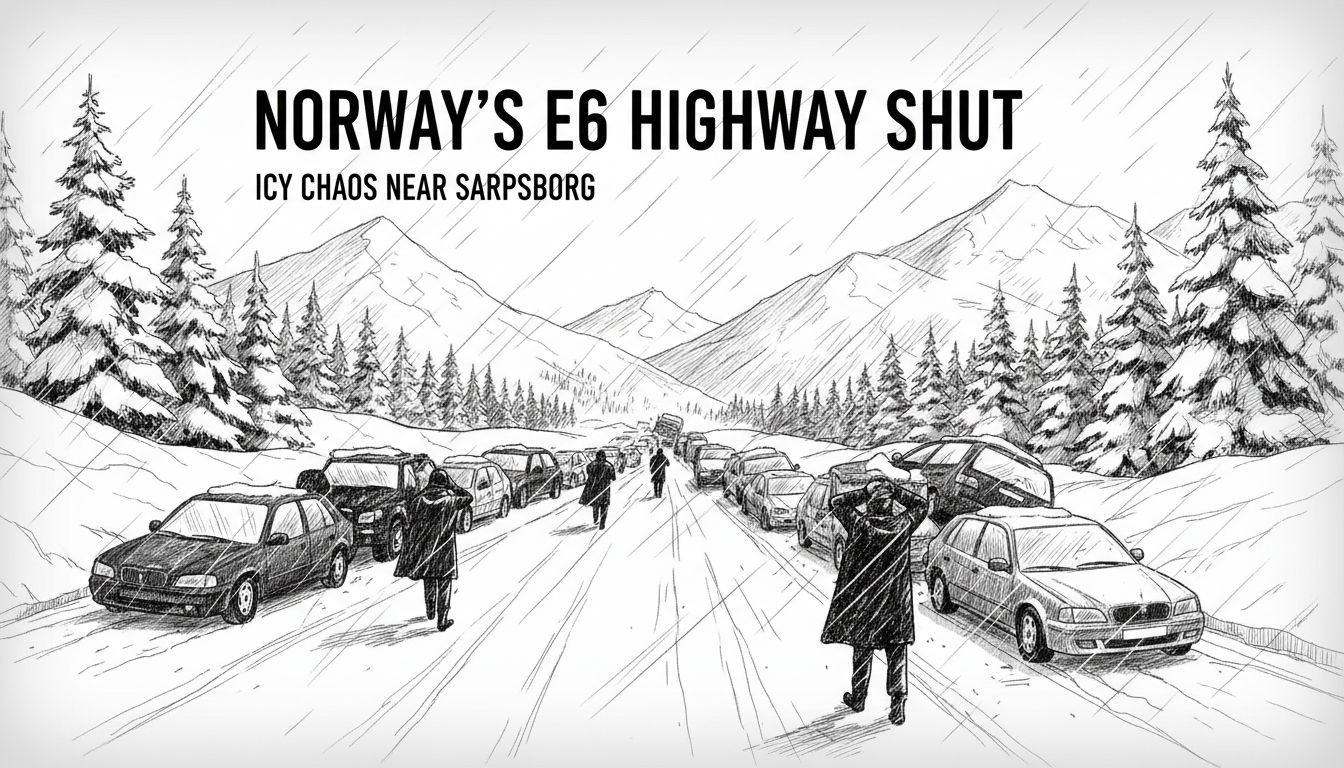
Norway's crucial E6 highway was closed near Sarpsborg Sunday morning after treacherous black ice made the road impassable. Police shut the major artery after a car spun out in an autovern, or crash barrier, highlighting the sudden danger that emerged with morning sunlight and freezing temperatures.
"The patrol assesses the E6 to be so slippery that it is not justifiable to open for free traffic again until the salt truck has been on site," the East Police District stated. Traffic was diverted onto the old road to Solli as authorities worked to clear a growing queue of vehicles. The incident underscores the persistent challenge of maintaining Scandinavia's longest road during volatile spring weather.
A Sudden Freeze on a Major Artery
The closure struck a critical section of Norway's national transport network. The E6 runs over 3,000 kilometers from the Swedish border at Svinesund to Kirkenes in the far north, serving as the backbone for freight and personal travel. The Sarpsborg area, about 90 kilometers southeast of Oslo, is a key junction near the Swedish border.
Mission leader Andreas Paulsen confirmed the closure was prompted by a specific incident. "There has been a car in the autovern that spun around. No personal injury has been reported," he said. His team's immediate focus was on managing the fallout. "We are working to resolve the queue as quickly as possible."
The problem was not heavy snow, but a more insidious condition: black ice. Traffic operator Barbro Evensen Venhagen at the East Traffic Centre explained the phenomenon. "When the sun came, it iced over, especially in the one lane where the shadow falls. It's just a bit unfortunate that it has to be right on the European road," she said. A salt truck was dispatched to the scene around 11 a.m. to treat the roadway.
A Wider Warning for Western Norway
While the E6 closure captured attention, authorities issued a broader alert for challenging conditions across Western Norway. The region's complex terrain of fjords and mountains creates microclimates where road conditions can change rapidly.
"One should be aware of the entire Westland," said traffic operator Tina Fjelldavli at the West Traffic Centre Sunday morning. She reported notifications of slippery roads "almost across the board," specifically mentioning the E134, E49, and E16 highways.
Her warning was explicit about the hidden danger. "People should drive carefully. It is a black road, so it may not look slippery, but because it is a cold road surface and a clearing in the weather now, it becomes slippery." This combination—a cold roadbed followed by a weather clearing that allows moisture to freeze—is a classic recipe for black ice, which is nearly invisible to drivers.
The Constant Battle for Winter Road Safety
Sunday's incidents are not isolated. They represent an annual struggle for Norwegian road authorities. In 2022, 107 people died in road traffic accidents in Norway. While this number is low by international standards, it fuels the national Road Safety Vision, which aims to eliminate fatalities and serious injuries.
Maintaining the E6, especially its southern sections carrying high volumes of international freight, is a top priority. The strategy involves a combination of proactive salting, mechanical clearing, and public warnings. Traffic centres like those in the east and west monitor weather forecasts and road sensor data around the clock, deploying resources preemptively when conditions are predicted to deteriorate.
Yet, as the Sarpsborg closure shows, nature can outpace the response. Spring is a particularly tricky season. Fluctuating temperatures around the freezing point, combined with increased sunlight that melts snow by day only for it to refreeze at night, create persistent ice risks. Shaded areas under bridges or on north-facing slopes, like the one described on the E6, can remain icy long after other sections have cleared.
Expert Advice for Navigating Norwegian Winters
Road safety experts consistently emphasize that infrastructure and official responses are only one part of the safety equation. Driver behavior is critical. The mandatory use of winter tires with studs or approved friction tires from November to April is the first line of defense. However, tires alone are not enough.
Experts stress three key adjustments for conditions like those seen Sunday: reduced speed, dramatically increased following distance, and heightened situational awareness. On black ice, braking distances can multiply tenfold. A following distance that is safe on dry asphalt becomes dangerously insufficient on an icy patch.
Drivers are also advised to pay attention to subtle clues, like a lack of spray from other vehicles' tires (indicating a dry-looking road might actually be frozen) or a sudden, unexplained quietness in tire noise. Authorities recommend using the official road condition websites and apps before traveling, as conditions can vary significantly over short distances.
The Economic and Social Ripple Effects
A closure of the E6 is not just a traffic inconvenience; it has tangible economic and social costs. As the main freight corridor from continental Europe into Central and Northern Norway, any disruption delays goods and increases transport expenses. For commuters and travelers, detours like the one onto the "gamlevei" or old road to Solli add time, fuel consumption, and stress.
These events also test the resilience of Norway's transport planning. They highlight the dependency on a single, linear route through difficult terrain in the south. While rail and sea offer alternatives for some freight, road transport remains dominant for many sectors. Incidents like this fuel ongoing debates about infrastructure investment, the need for more resilient alternative routes, and the balance between mobility and safety.
A Look Ahead as Seasons Shift
The Sarpsborg closure serves as a late-season reminder of winter's grip. As climate patterns shift, the nature of these challenges may evolve. Milder winters could lead to more frequent freeze-thaw cycles, precisely the condition that creates black ice, rather than consistent cold and stable snow cover.
This places a premium on adaptive road maintenance and public communication. The work of traffic operators like Fjelldavli and Venhagen, interpreting weather data and driver reports to issue timely warnings, becomes even more crucial. Their message remains simple and vital: conditions can change in an instant, and caution is the only constant requirement for safe travel on Norway's majestic but demanding roads.
The E6 reopened after salting, but the warning stands. Norway's breathtaking landscapes come with logistical challenges etched into every mountain pass and fjord-side curve. The nation's relationship with its environment is one of respect and adaptation, a daily negotiation between the need for connection and the power of nature—a negotiation that, on a sunny Sunday morning near Sarpsborg, required closing the country's most important highway.