
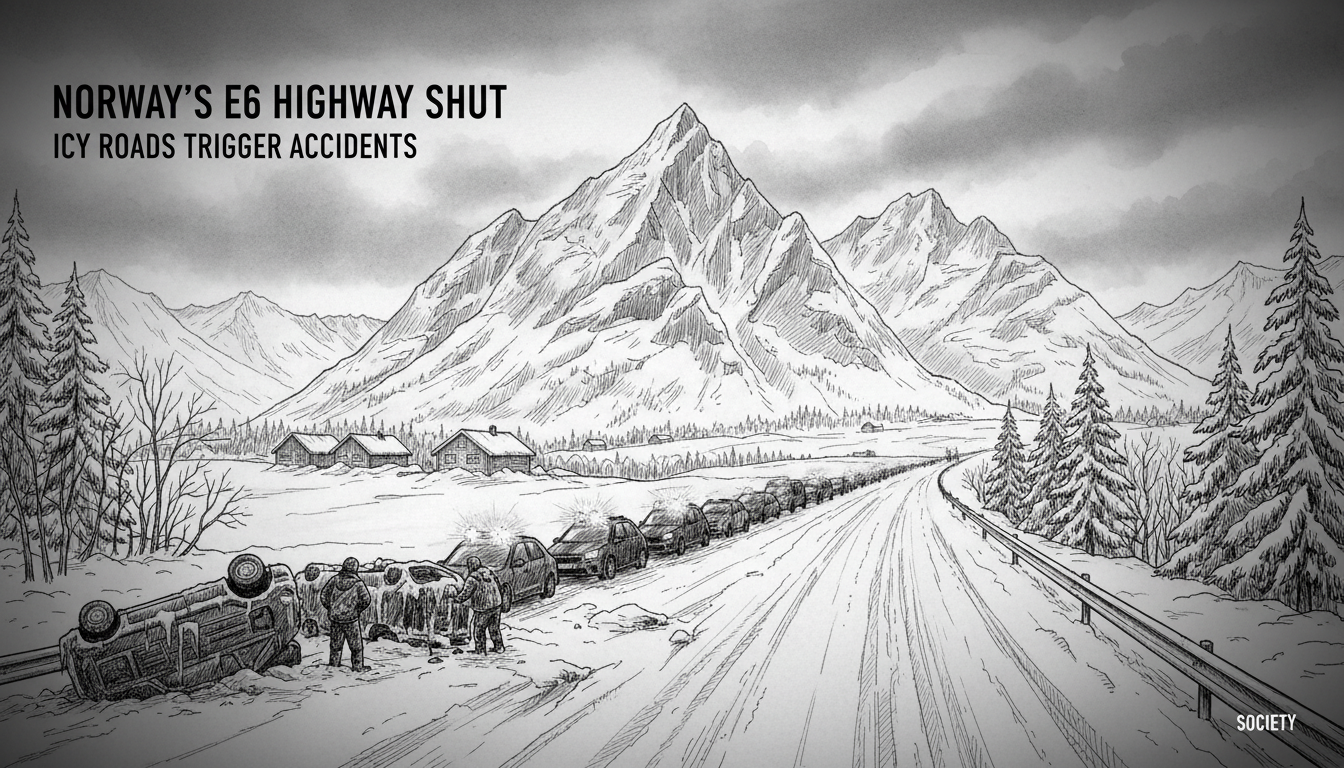
Norway road conditions turned treacherous on Sunday, forcing the closure of a key section of the E6 highway near Sarpsborg and causing multiple accidents across the country. A car lost control on the icy surface at Kalnes, crashing into a guardrail and prompting police to shut the northbound lanes. The driver emerged unharmed, but the incident highlighted the sudden dangers posed by the season's unpredictable weather.
"The E6 is so slippery that it is being closed on site until a contractor has been able to apply grit," said duty officer Jimmy Pettersen of the East Police District in a police log statement. Authorities blocked the road from the Leikvoll intersection, diverting traffic via Gamle Kongevei until treatment could be completed. In a separate incident in Lillestrøm, a car skidded off the road into a ditch, resulting in minor injuries to the driver.
A Nationwide Hazard Emerges
The problems were not confined to the Oslo region. On the country's western coast, the Vestlandet area reported extremely slippery conditions, with a high number of incidents logged in the Sunnhordland region, particularly around Rosendal and Tysnes. These widespread reports signal a classic Norwegian early-winter scenario: rapid temperature shifts creating a thin, nearly invisible layer of ice known as "glattis" on road surfaces. This phenomenon is a perennial challenge for Norway's transportation network and a leading cause of accidents during the transitional seasons.
Police across affected districts issued uniform warnings, urging motorists to exercise extreme caution. "Road users traveling in traffic are asked to adjust their speed according to the conditions," Pettersen's statement concluded. The call for adapted driving is a standard but critical message from Norwegian authorities, emphasizing that vehicle technology and winter tires are not substitutes for driver judgment when faced with black ice.
The Economic Artery of the E6
The closure of the E6, even for a limited stretch and duration, carries disproportionate significance. As Norway's primary north-south highway, the E6 functions as the country's logistical backbone. It connects the capital region of Oslo to major cities like Hamar, Trondheim, and ultimately stretches to Kirkenes near the Russian border. It is essential for freight transport, daily commutes, and regional mobility.
A shutdown at Kalnes, just south of the city of Sarpsborg in Østfold county, creates immediate ripple effects. The designated diversion via Gamle Kongevei is a local road incapable of handling the typical volume of E6 traffic efficiently. This leads to congestion, delays for commercial goods vehicles, and increased frustration for travelers. For businesses relying on just-in-time logistics, such disruptions have a tangible financial cost. While this incident was resolved relatively quickly, it serves as a stark reminder of the nation's vulnerability to weather-related infrastructure failures.
Expert Analysis on Winter Readiness
Road safety experts in Norway consistently stress a multi-layered approach to combating icy road dangers. The legal requirement for winter tires (M+S or studded) within specific seasonal dates is the first line of defense. However, as Sunday's accidents prove, compliant equipment is not foolproof. "Winter tires provide essential grip, but they are not magic," explains a traffic safety consultant familiar with Norwegian conditions. "The most critical factor is the driver's behavior—reducing speed, increasing following distance, and avoiding sudden maneuvers. On 'glattis,' even a slight steering correction or brake application at normal speeds can lead to a loss of control."
The Norwegian Public Roads Administration (Statens vegvesen) operates an extensive network of weather stations and uses forecasting to preemptively treat roads. However, the sheer scale of the road network and the speed at which ice can form, particularly on exposed highway bridges and shaded stretches, means reactive closures are sometimes unavoidable. The decision to close the E6, rather than just issue a warning, indicates police assessed the immediate risk as unacceptably high for continued traffic flow.
A Recurring Seasonal Challenge
This event is not an anomaly but part of a recurring pattern. Norway's geography, with its coastal humidity, inland cold, and frequent temperature fluctuations around the freezing point, creates perfect conditions for slippery roads from late autumn through early spring. The first major cold snap of the season often catches some drivers off guard, leading to a spike in accidents. It serves as an annual wake-up call for motorists to re-acquaint themselves with winter driving techniques.
Local police logs and news reports from early winter regularly feature near-identical entries: "glatte veier" (slippery roads), "skidd ut" (skidded off), and "mindre ulykker" (minor accidents). The response protocol is also well-established: police secure the scene, road authorities are dispatched to apply salt or gravel, and traffic is diverted until the surface is rendered safe. The system is efficient, but it is repeatedly tested by the weather.
The Human Factor in Traffic Safety
Beyond the infrastructure and warnings lies the unpredictable element of human behavior. Despite widespread awareness campaigns, some drivers consistently fail to adapt their speed to the conditions. The minor accident on the E6, where the driver was fortunate to escape injury, could have been far more severe with different circumstances—oncoming traffic, a different point of impact, or higher speeds.
The incident in Lillestrøm, resulting in light injuries, underscores that even at low speeds in urban areas, the consequences can be real. These events prompt authorities to reiterate the fundamentals: ensure your vehicle is properly equipped for winter, plan for extra travel time, and stay informed about road condition reports through official apps and websites. In Norway, respecting winter is not just a suggestion; it is a necessary skill for safe mobility.
Looking Ahead: Resilience and Adaptation
As climate change introduces greater weather volatility, the challenge of managing road safety may intensify. Warmer winters could lead to more frequent cycles of freezing and thawing, increasing the incidence of icy patches. This places a greater onus on road maintenance planning and driver vigilance. Investments in more resilient road surfaces and advanced weather monitoring technology will be part of the long-term solution.
For now, the closure of the E6 near Sarpsborg is a contained event, a temporary inconvenience resolved by gritting trucks and police work. But it is also a potent symbol. It represents the ongoing negotiation between a modern, mobile society and the formidable natural forces that shape the Norwegian landscape. The road has reopened, traffic is flowing again, but the underlying message remains: in Norway, winter commands respect from every person behind the wheel. Will this season's first major ice event be the reminder drivers need to slow down, or merely the first of many similar police logs to come?