
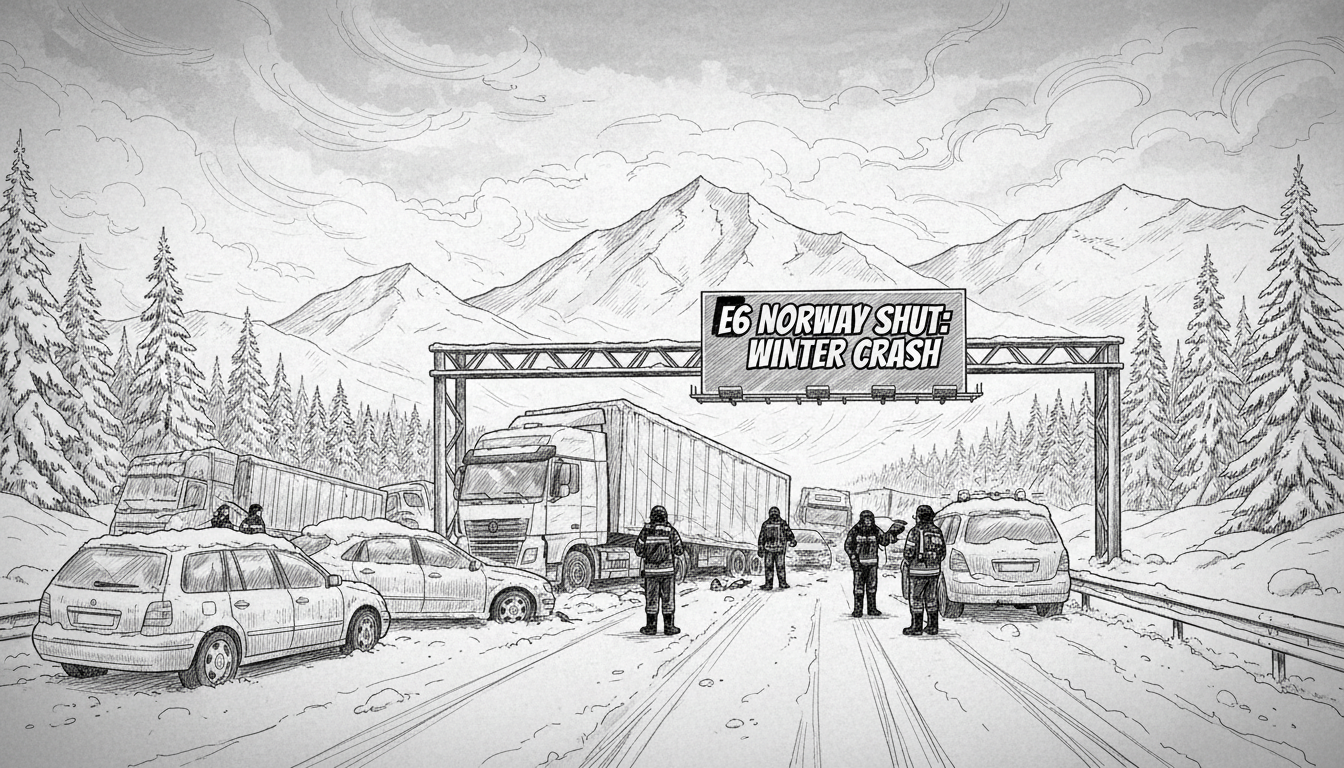
Norway's E6 highway northbound is closed near Sarpsborg after a single-vehicle crash exposed treacherous black ice conditions. Police have shut the vital artery at the Leikvoll interchange, redirecting all traffic onto the older Gamle Kongevei. The decision follows a collision where a car lost control and struck a guardrail, blocking the roadway with significant damage.
The driver was transported to a local hospital for evaluation, according to police operations leader Jimmy Pettersen. No other vehicles were involved in the incident. Authorities are keeping the E6 closed until road maintenance crews can complete salting operations, deeming current driving conditions too unsafe for traffic.
This closure disrupts a critical transport corridor linking Oslo to the southeastern counties and onward to Sweden. The E6 serves as Norway's national spine, handling heavy commuter and freight traffic. Even a temporary shutdown near a populated hub like Sarpsborg causes immediate logistical headaches and delays.
A Recurring Winter Hazard on Norway's Main Artery
Black ice, known as "glattis" in Norwegian, is a perennial and deadly challenge on the country's roads. It forms when moisture freezes on the road surface, creating a nearly invisible, glassy layer of ice. Conditions are particularly prone during early morning hours or when temperatures hover around freezing after precipitation.
"The police assessment to close the road is a preventative safety measure," said a senior traffic engineer with the Norwegian Public Roads Administration, who spoke on background. "When you have a confirmed incident like this, it indicates a widespread road condition problem. Keeping the road open risks a cascade of further accidents."
This stretch of the E6 near Grålum, just north of Sarpsborg, experiences high traffic volumes. The sudden closure at Leikvoll forces northbound traffic onto secondary roads not designed for such capacity. Gamle Kongevei, or the Old King's Road, is a narrower, slower route that will see significant congestion during the closure.
The Economic and Social Ripple Effect
Highway closures on this scale have impacts beyond simple inconvenience. The E6 is a major freight route for goods moving between Oslo and the key port of Gothenburg in Sweden. Delays increase logistics costs and can disrupt just-in-time supply chains for industries in the region.
Local commuters from towns like Fredrikstad and Moss who work in or around Sarpsborg face extended and unpredictable travel times. School buses and public transport are also rerouted, creating a domino effect of schedule disruptions. The economic cost of such closures, in lost productivity and increased fuel consumption, runs into millions of kroner per hour during peak periods.
Norway invests heavily in winter road maintenance, with a fleet of over 500 plows and salting vehicles deployed nationwide. However, black ice can form rapidly and unpredictably, sometimes outpacing the response of maintenance crews. The decision to close a road is never taken lightly, balancing the risk of accidents against the major disruption caused.
Expert Analysis on Driver Preparedness and Infrastructure
Road safety organizations consistently stress adaptation to conditions. "The first frosts and icy patches catch many drivers out," explained Dr. Lena Holm, a researcher at the Institute of Transport Economics. "People may not have switched to winter tires yet, or they are driving at summer speeds. Black ice requires extreme caution, significantly reduced speed, and gentle maneuvers with steering, brakes, and accelerator."
Modern vehicles with stability control systems can help, but they cannot override physics on sheer ice. The most critical factor remains driver behavior. Police reports from previous winters show a spike in single-vehicle accidents during conditions exactly like those reported near Sarpsborg.
Infrastructure also plays a role. This section of the E6, while modern, is in a relatively open area exposed to wind and temperature shifts. Experts note that bridges and shaded sections freeze first, but black ice can form anywhere when conditions align. Continuous monitoring via road weather stations helps, but localized microclimates can create dangerous spots without warning.
A Broader Look at Norway's Winter Road Challenge
Today's incident is not isolated. Each winter, similar closures affect the E6, the E18 along the south coast, and mountain passes like the E16 over Filefjell. These events trigger a well-rehearsed response from police, road authorities, and tow companies. The protocol prioritizes safety, then clearance, then reopening.
The process involves securing the accident site, recovering the damaged vehicle, and then treating the road surface. Salting, or "strøing," uses sodium chloride or brine to lower the freezing point of water on the road. It is effective but requires time to work, especially if ice has already firmly bonded to the asphalt.
For travelers, the advice is clear during winter months. Always check the Norwegian Public Roads Administration's website or app (175.no) for real-time traffic and road condition information before departure. Allow extra travel time, ensure your vehicle is equipped with proper winter tires, and be prepared for sudden changes in conditions.
The Path Forward: Response and Reopening
As of the latest updates, contractors are on scene working to salt the affected northbound lanes of the E6. Police will inspect the road surface before reopening it to traffic. The timeline depends on how quickly the de-icing agents break down the existing black ice layer.
The damaged vehicle will be removed by a recovery truck. Police may also conduct a standard investigation into the cause of the initial crash, though single-vehicle accidents on ice are often classified as "force majeure" due to road conditions.
This event serves as an annual reminder of the power of nature in Nordic climates. Norway builds and maintains some of the world's most resilient infrastructure, yet it remains at the mercy of winter's whims. The swift closure of the E6 today was a proactive, if disruptive, decision aimed at preventing a more serious multi-car collision.
When the highway reopens, drivers will be cautioned to proceed with care. The underlying message is one of respect for the environment. In Norway, the battle between mobility and winter is a constant negotiation, where safety must always claim the right of way. How society balances this need for movement with inherent natural risk defines the Scandinavian approach to winter survival.