
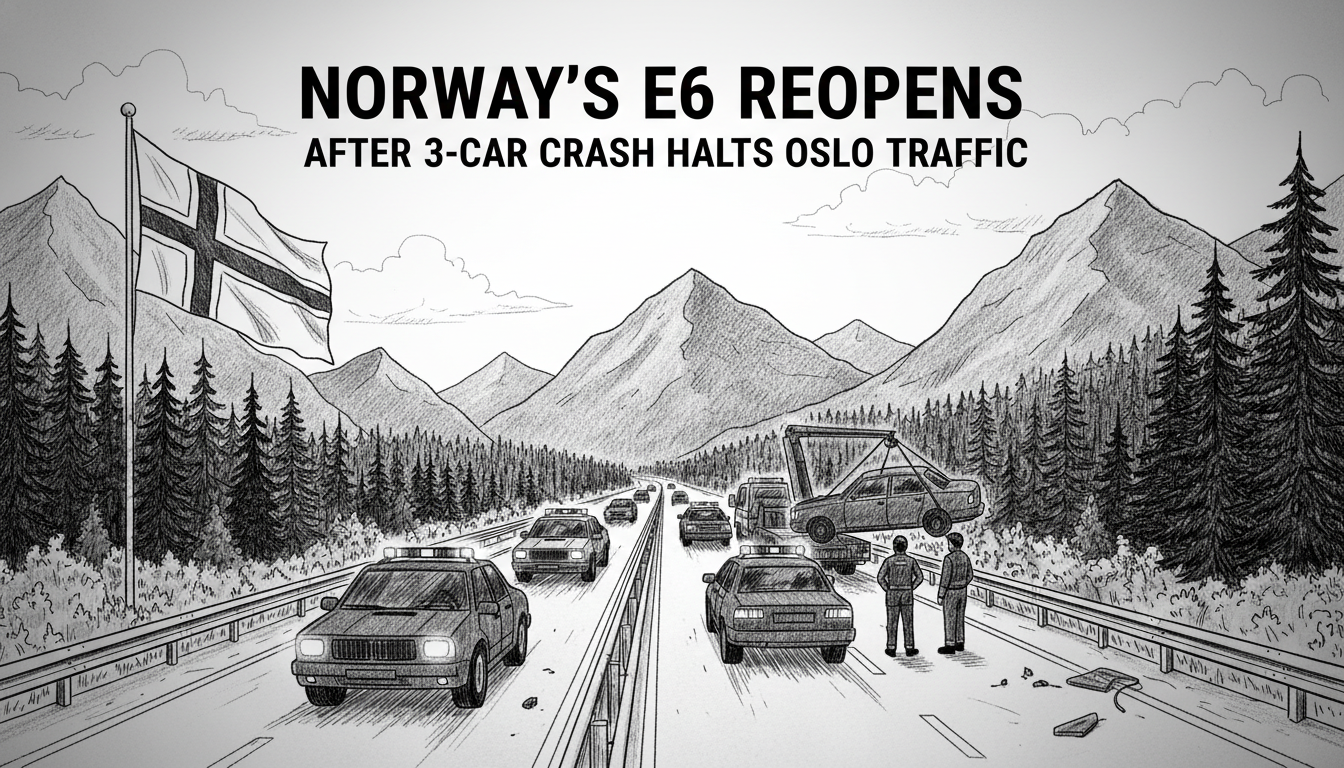
Norway's vital E6 highway has reopened after a three-vehicle crash near the Helsfyr interchange in Oslo forced a complete closure of the major artery. Police confirmed the southbound lanes reopened at 14:05, restoring traffic flow on a road critical for national commerce and commuter movement. The incident, suspected to be a rear-end collision, caused significant disruption during a busy afternoon period, diverting traffic through the Ekeberg tunnel and Svartdalen.
For over an hour, one of Scandinavia's busiest transport corridors was paralyzed. The closure highlighted the fragility of Oslo's road network at key choke points. Helsfyr, where the E6, E18, and Ring 3 intersect, is notorious among transport planners for its congestion. "When the E6 stops at Helsfyr, the ripple effect is immediate and widespread," said traffic analyst Lars Mikkelsen. "It's not just an Oslo problem. It disrupts the flow of goods and people along the entire southern coast."
A Critical Artery Paralyzed
The E6 is more than just a city highway. It is Norway's national spine, running 3,140 kilometers from the Russian border in the north to the Swedish border in the south. The section through Oslo's eastern precincts handles over 100,000 vehicles daily. It connects the capital to major cities like Moss, Drammen, and ultimately Gothenburg in Sweden. A closure here has direct economic consequences, delaying freight from the port of Oslo and stranding commuters from the populous eastern suburbs.
Police have not released details on injuries but confirmed all drivers were conscious and speaking with emergency responders. The focus of the investigation is on the sequence of the collision. "Our initial assessment points to a rear-end impact as the primary cause," a police operations manager said in a statement. "This underscores the perennial issue of insufficient following distance, especially in variable traffic conditions near major junctions."
The Helsfyr Bottleneck: A Known Challenge
The incident spotlights a long-standing infrastructure dilemma for Norwegian authorities. Helsfyr sits at the convergence of three major highways, funneling immense traffic volumes into a confined space. Urban development in the Østensjø district has increased local traffic, while the E6's role as a national transit route has grown. This creates a volatile mix of high-speed through traffic and vehicles entering or exiting the network.
"Helsfyr is a textbook case of 1960s road planning meeting 21st-century traffic demands," explained Mikkelsen. "The geometry of the interchange, combined with peak-hour volume, creates a high-risk environment for sudden slowdowns. When traffic decelerates rapidly, the risk of multi-vehicle pileups increases significantly." Transport analysts note that similar incidents occur several times a year at this location, though full closures are less common.
Economic and Commuter Impact
While the closure lasted roughly 90 minutes, the economic toll extends beyond the stoppage time. The Norwegian Road Federation estimates that a major highway closure in the Oslo region costs the economy several million kroner per hour in lost productivity and delayed logistics. For commuters, the alternative route via the Ekeberg tunnel and Svartdalen added an estimated 30 to 45 minutes to journey times, affecting thousands of drivers.
The timing of the crash, in the early afternoon, also impacted freight movement. Many logistics companies schedule southbound deliveries from Oslo's distribution centers in the post-lunch period. "Any unplanned closure on the E6 creates a backlog that takes hours to clear," said a spokesperson for a major transport firm. "It's not just about the delay during the closure. It's about the knock-on effect for the rest of the operational day."
Safety and Infrastructure Debates
This incident will likely reignite debates in the Storting about road safety funding and infrastructure resilience. The government's National Transport Plan has allocated funds for gradual improvements along the E6 corridor, but major redesigns of interchanges like Helsfyr are complex and costly. Proposals often clash with urban density goals and environmental concerns in the capital.
Opposition politicians have previously called for accelerated investment in accident black spots. "This is not an isolated event," said Conservative Party transport spokesperson, Marius Arion. "We have known about the risks at key junctions like Helsfyr for years. Today's crash is a reminder that we need to prioritize concrete safety upgrades, not just long-term planning documents." The ruling Labour-led coalition points to ongoing projects, like the new E6 Ramstadsletta section, as evidence of commitment but acknowledges urban interchanges present unique challenges.
Looking Ahead: Technology and Behavior
Beyond concrete and asphalt, experts see technology and driver education as critical tools. Intelligent Transport Systems (ITS), including variable message signs and queue warning systems, are being rolled out on the E6. These systems can alert drivers to sudden slowdowns ahead, potentially preventing chain-reaction collisions.
However, technology alone is insufficient. "The fundamental issue in many rear-end collisions is driver behavior," stated a senior instructor from the Norwegian Public Roads Administration's traffic safety division. "Maintaining a safe distance, adjusting speed to conditions, and avoiding distractions are the most effective safety features any vehicle has. This is especially true on high-volume, high-speed routes like the E6 where conditions change rapidly."
As traffic returned to normal on Tuesday afternoon, the scene at Helsfyr served as a brief but stark reminder of the interconnectedness of Norway's transport network. A single collision at a key node can disrupt national flow. The reopening marked the end of an incident, but the broader conversation about securing the reliability of Norway's most important highway continues. With ever-increasing traffic volumes and national ambitions for zero traffic fatalities, the pressure to find solutions for bottlenecks like Helsfyr will only intensify. The question for policymakers is whether today's disruption will translate into accelerated action or become just another statistic in Oslo's long history of traffic congestion.