
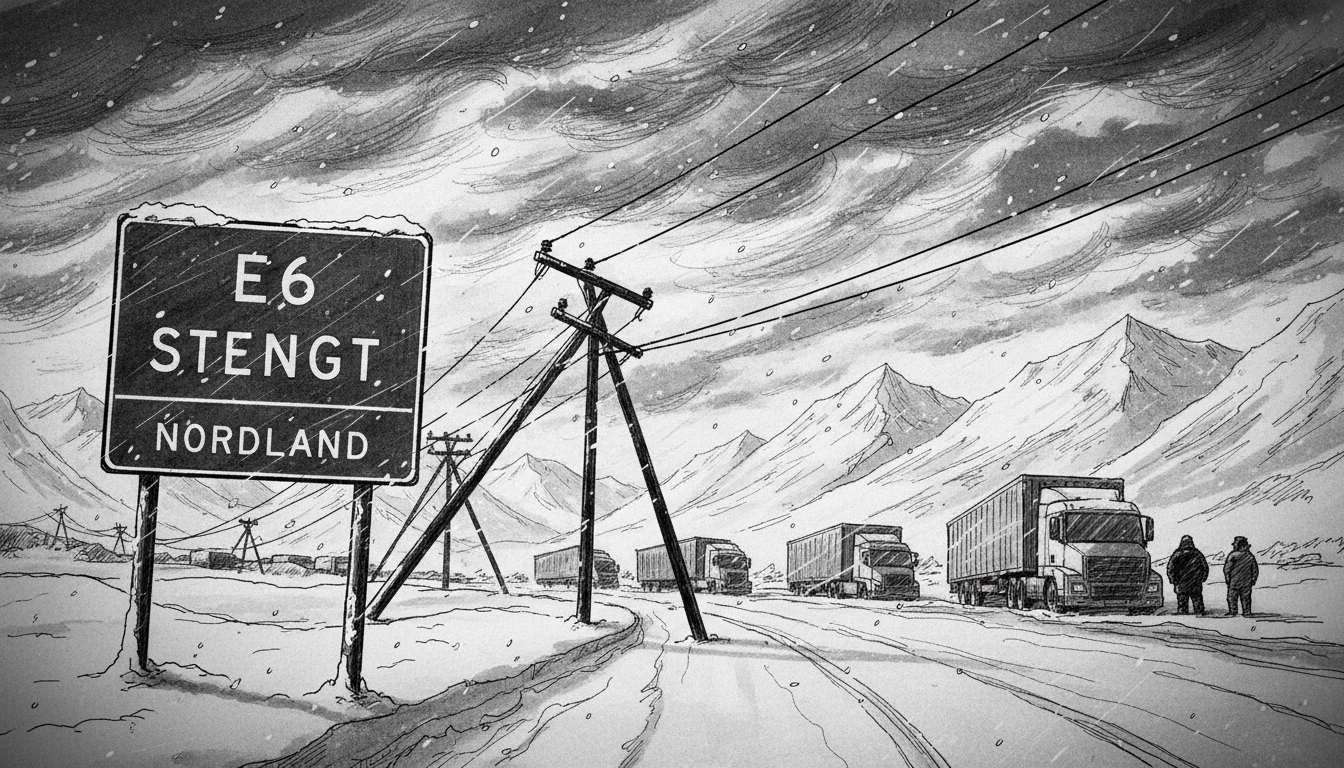
Norway's vital E6 highway is blocked and northern communities are grappling with disrupted communications after severe weather triggered a major accident and widespread infrastructure damage. A truck overturned at Sagpollen in Hamarøy municipality, Nordland, closing the crucial north-south artery. Simultaneously, 125 mobile base stations failed and power outages persisted overnight, isolating residents across the vast county. The dual crises expose the profound vulnerability of Norway's northern infrastructure to winter's harsh conditions.
Emergency services reported the truck driver was conscious and walking after other motorists assisted him at the scene. "The vehicle hit a rock wall, spun onto its roof, and landed back on its wheels," said operations manager Kai Henrik Eriksen. The closure of the E6 at this location creates a significant logistical bottleneck. This road is the main transport corridor for goods and people along Norway's long coastline, and alternative routes in the mountainous region are scarce and often less secure.
A Region Isolated by Failed Networks
As night fell on Saturday, the situation extended beyond the blocked road. Telecommunications provider Telenor confirmed that approximately 125 of its 700 base stations in Nordland county were out of service. This represents a major reduction in mobile network capacity, critically hampering communication in a region characterized by small, scattered communities. The outages hinder residents from reporting emergencies, checking on vulnerable neighbors, or receiving updates from authorities. Combined with ongoing power failures, it creates a dangerous information blackout.
Experts argue this incident is not an anomaly but a symptom of a systemic challenge. "Northern Norway's infrastructure is perpetually tested by extreme weather, long distances, and complex terrain," says Lars Måsø, a professor of Arctic technology. "A single event like a storm or an accident can have cascading effects, knocking out power, communications, and transport in one sweep. Resilience isn't just about stronger pylons; it's about redundant systems and recognizing that these networks are lifelines."
The Economic Artery of the North
The E6 highway is more than just a road; it is the economic spine of Northern Norway. Its closure disrupts the supply chain for everything from groceries to industrial parts. Trucking companies face costly delays, and perishable goods risk being lost. For local businesses in towns like Hamarøy and nearby Narvik, such interruptions can mean significant financial losses. The road also serves as the primary evacuation route during emergencies, making its availability a matter of public safety.
This vulnerability raises persistent questions about infrastructure investment priorities. While the Norwegian government has allocated substantial funds to major projects like the Coastal Highway (E39 ferry-free route), maintaining and securing existing arteries in the north competes with other national needs. The incident at Sagpollen will likely reignite debates in the Storting about whether current spending matches the acute climate and geographic challenges faced by northern counties.
Climate Change and Increasing Instability
The accident occurred during a period of difficult weather, a factor becoming increasingly volatile due to climate change. Nordland experiences rapid shifts between rain, snow, ice, and high winds, creating treacherous driving conditions. Warmer winters lead to more freeze-thaw cycles, which damage road surfaces and increase rockfall hazards. These changing patterns demand adaptive strategies from the Norwegian Public Roads Administration.
"We are planning with a new set of parameters," a senior engineer from the administration recently told a transport conference. "The historical data we used for building and maintaining roads is less reliable. We need more real-time monitoring, better weather forecasting integration, and designs that account for wetter snow and stronger gusts." This proactive approach is crucial for a highway like the E6, where a closure has national ramifications.
The Human Toll of Disconnection
Beyond the economic and logistical analyses, the blackouts underscore a human reality. For elderly or medically vulnerable individuals in remote areas, losing phone and internet connection is not an inconvenience—it's a threat. It severs their link to emergency medical services, family support, and information. Community response plans in many northern municipalities rely on neighbors checking on each other, but this becomes vastly more difficult when mobile networks fail.
The persistence of power outages hours after the initial incident also points to challenges in grid resilience. While Norway's hydropower-dominated system is robust, the distribution network—the final lines to homes—is exposed to falling trees, heavy snow loads, and strong winds. Quick restoration is complicated by the same conditions that cause the damage and the vast distances technicians must travel.
A Call for Coordinated Resilience
The concurrent road closure, power outage, and telecoms failure demonstrate a lack of systemic coordination. Critical infrastructure sectors—transport, energy, communications—are often managed separately, yet their failures are interdependent. A parliamentary report last year recommended establishing a cross-sectoral "Northern Infrastructure Resilience Taskforce," but it has yet to be formed.
As crews work to clear the E6 and restore services, the events of this weekend will be recorded as another stark reminder. Norway's wealth and technological prowess are tested at their limits beyond the Arctic Circle. Building a resilient north requires viewing roads, power lines, and data cables not as isolated utilities, but as an integrated lifeline that must withstand the increasing fury of northern winters. The question for policymakers in Oslo is whether the political will exists to fund that vision, or if communities in Nordland will continue to weather these storms isolated and in the dark.