
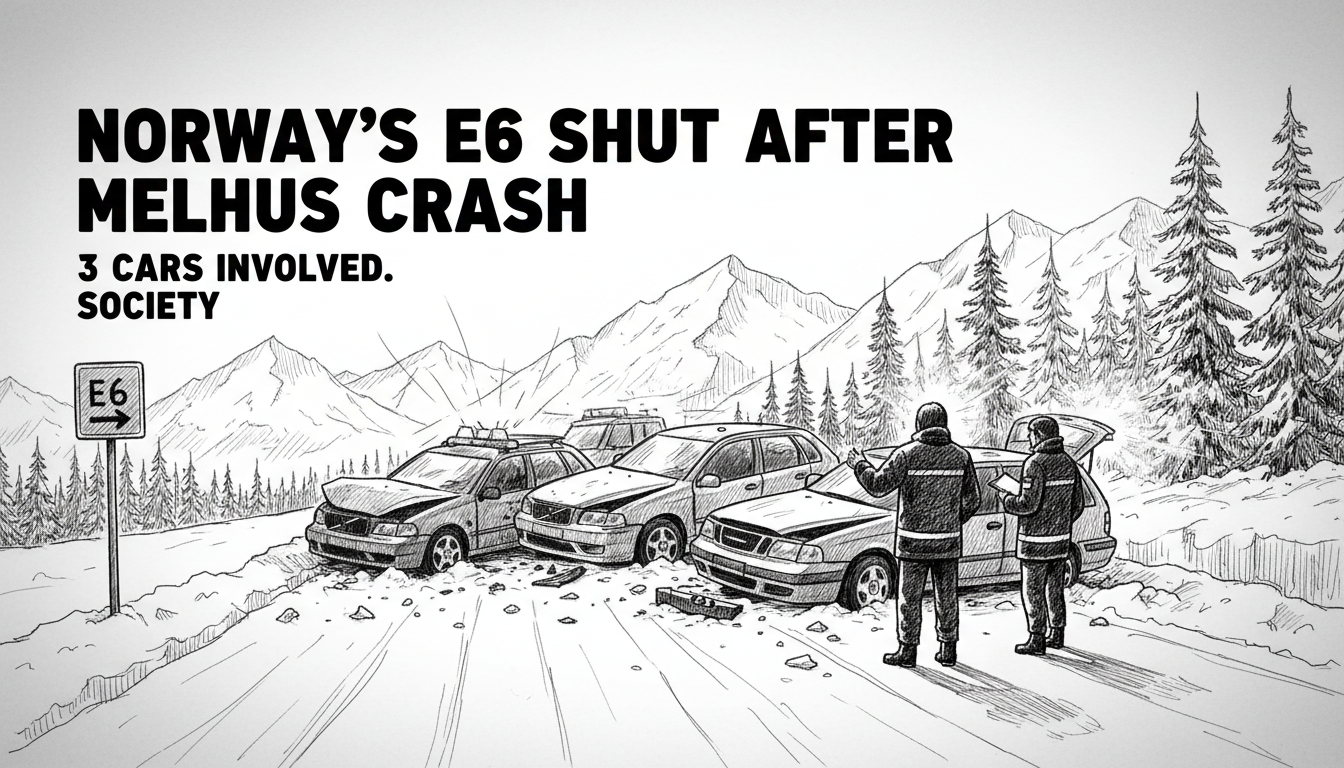
Norway's vital E6 highway is closed south of Ler in Melhus municipality following a serious multi-vehicle collision involving three cars. Police confirmed one vehicle is blocking the roadway, halting all traffic on the crucial north-south artery. Authorities report all individuals involved were conscious and responsive at the scene, but the closure creates immediate disruptions for commuters and freight transport across central Norway.
The accident occurred during the afternoon on a stretch of road familiar to thousands of daily travelers. The E6 functions as Norway's national spine, connecting its southern regions to the northern counties through Trøndelag. A closure at Ler, just south of Trondheim, effectively severs the primary route between Norway's third-largest city and Oslo to the south. Local police have mobilized to manage traffic flow and initiate an investigation into the crash's cause.
A Major Artery Severed
The economic and logistical impact of an E6 closure is immediate and significant. This highway is not just a commuter route; it is a critical corridor for the transport of goods. Everything from fresh food deliveries to construction materials and consumer products moves along this road. Industry analysts estimate that a prolonged closure can cost the regional economy millions of kroner per hour in delayed shipments and lost productivity. Alternative routes, primarily county roads like the Fv 30 or the longer coastal E39, are slower, less capable of handling heavy truck traffic, and become congested quickly.
“Every minute the E6 is closed, the ripple effects grow,” said Lars Fjelldal, a transport logistics analyst based in Trondheim. “We are talking about supply chains for entire regions being disrupted. Supermarkets, factories, and ports all operate on tight schedules. An accident like this demonstrates how dependent our modern economy is on a single, uninterrupted transport line.” The closure forces freight companies to recalculate routes, adding hours to journey times and increasing fuel costs, expenses often passed down the supply chain.
Safety on Norway's Busiest Road
The incident near Melhus brings the perennial issue of traffic safety on the E6 back into sharp focus. While Norway boasts some of the world's safest roads, high-speed highways like the E6 present unique challenges. The stretch near Trondheim combines high traffic volumes, including a large number of heavy goods vehicles, with variable weather conditions that can change rapidly. Fog, rain, and early darkness during autumn and winter months contribute to hazardous driving conditions.
Traffic safety experts point to a combination of factors that can lead to multi-vehicle pile-ups. “On a road like the E6, traffic density is high, and speeds are consistently at or above the limit,” explained Kari Nilsen, a researcher at the Institute of Transport Economics. “This means stopping distances are long, and driver reaction time is critical. A single mistake, a moment of inattention, or an unexpected obstacle can trigger a chain reaction. This is why maintaining safe following distances and adapting speed to conditions are not just recommendations—they are essential survival strategies on this road.”
Police investigations following such accidents typically examine vehicle condition, driver behavior, road surface conditions, and weather data. The goal is to determine whether preventable factors like speeding, tailgating, or distracted driving played a role.
The Human and Community Impact
Beyond the traffic maps showing long red lines of congestion, real people are affected. Commuters face unexpected hours added to their journey home, missing family dinners or childcare pickups. Travelers headed to the airport for flights find themselves in a race against time on unfamiliar backroads. Local businesses in Melhus and neighboring communities along the diversion routes may see an unexpected influx of stopped motorists seeking fuel, food, or a pause from the gridlock.
For emergency services, the closure creates a complex operational challenge. Police, fire, and ambulance crews must navigate around the closure to reach other incidents in the area, potentially delaying response times. The closure itself requires a significant police presence to secure the accident scene for investigation and to manage traffic diversions safely. This draws resources away from other duties across the Trøndelag police district.
The drivers directly involved, while reported to be conscious, now face the aftermath: dealing with insurance, potential injuries, vehicle repair or replacement, and the psychological impact of a serious collision. Norwegian law provides strong support for accident victims, but the personal disruption is immense.
Historical Context and Infrastructure Pressure
This is not an isolated incident for the E6. The highway has seen repeated accidents and closures, particularly in the Trondheim region, where traffic volumes exceed the capacity of some segments. The stretch between Melhus and Trondheim is a known bottleneck. These recurring incidents fuel ongoing political debates about highway expansion, the construction of alternative routes, and investment in rail freight to relieve pressure on the road network.
The National Transport Plan, debated hotly in the Storting, consistently grapples with funding for E6 improvements. Proposals for additional lanes, better separation of opposing traffic, and more resilient routing around geographic choke points are perennial topics. Critics argue that reactive measures following accidents are insufficient. They call for proactive, long-term investment to upgrade what is essentially the country's main logistical artery to modern safety and capacity standards.
“The E6 is the backbone of Norwegian land transport,” said Storting representative Mia Johansen, who sits on the transport committee. “When it fails, the whole body feels it. We need to have a serious discussion about making this backbone stronger and more reliable. That means dedicated funding in the state budget, not just promises in a transport plan.”
Looking Ahead: Reopening and Resilience
As recovery operations continue at the Ler site, the primary focus for authorities is to clear the wreckage, complete the necessary on-scene investigation, and reopen the road as swiftly and safely as possible. Norwegian Public Roads Administration (Statens vegvesen) crews are on standby to assist once police release the scene. Their job will include any necessary repairs to guardrails, road surfaces, or signage damaged in the collision.
The incident serves as a stark reminder of the fragility of interconnected transport systems. For Norway, a long, mountainous country with a concentrated population, the resilience of the E6 is a matter of national economic security. Each closure prompts a renewed evaluation of contingency plans, the robustness of alternative routes, and the long-term strategy for the nation's most important highway. The journey to a safer, more reliable E6 continues, but for now, the focus remains on clearing the lane, healing the human impacts, and getting traffic moving once more.