
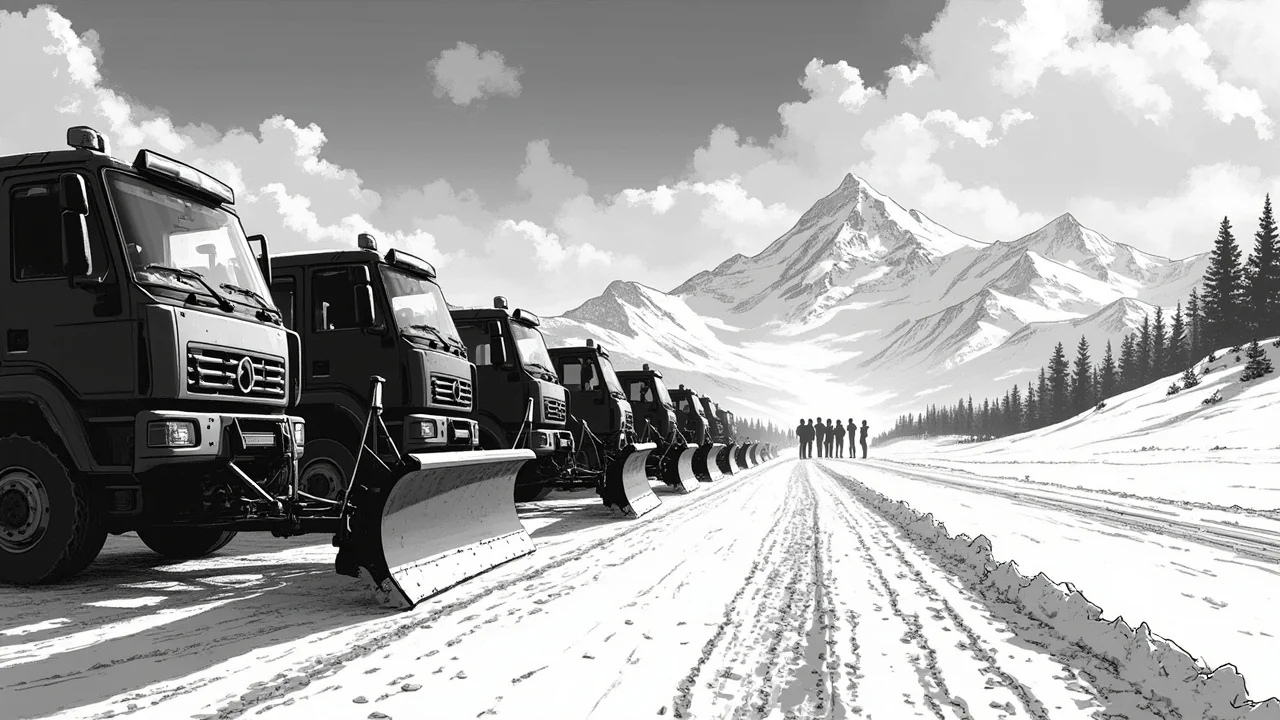
Norway's transport agency is pushing for electric snowplows, but industry leaders warn the plan could leave roads unplowed and small businesses bankrupt. The Norwegian Public Roads Administration (Statens vegvesen) is testing battery-powered vehicles for winter clearance, aiming to cut emissions from its heavy fleet. This initiative faces fierce resistance from contractors who say the technology is impractical for harsh Nordic winters.
Industry Calls Proposal 'Nonsense'
"The project is just nonsense," said Kjell Olafsrud, market director for Norway's Truck Owners' Federation (NLF). "We have diesel and gas vehicles that can drive for hour after hour and have the power they need." Olafsrud's blunt critique underscores a deep rift between the government's green ambitions and the operational reality of keeping Scandinavia's most demanding mountain passes open. His association represents the private contractors responsible for much of Norway's winter road maintenance.
Olafsrud emphasizes his group supports electrification in principle. "We are for electrification, but you have to start where it makes sense," he stated. He argues that forcing untested technology onto small plowing businesses introduces unacceptable risk during critical winter operations. Many of his members fear being mandated to buy expensive, single-purpose equipment they cannot afford and would not use outside the snow season.
A Question of Practicality and Power
The core technical objection centers on endurance and infrastructure. Electric snowplows require immense battery capacity to operate the heavy plow blade and operate for extended shifts in sub-zero temperatures. Jørn Evensen, a regional chief for the Machine Contractors' Federation (MEF), pointed to a test on the Dovrefjell plateau two years ago. A specially procured vehicle, far more powerful than commercial models, could run for up to ten hours. It then required a ten-hour charging period.
"There are only two possibilities if electric snowplows are to be introduced," Evensen concluded. "Either it must stop snowing, or you must have two vehicles." This downtime is a critical flaw for emergency response. Winter road maintenance is not a convenience; it is a vital public safety service. Prolonged charging breaks could delay clearing after a major storm, stranding motorists and disrupting supply chains.
The Government's Green Push
The Public Roads Administration sees the pilots differently. It states the electric plow trialed since last January on the Hardangervidda mountain plateau has served as an "extra resource." The agency is under significant political pressure to decarbonize all public sectors. Norway, a major oil and gas exporter, has aggressive domestic climate targets. Transport is a key focus, with generous incentives already making electric cars dominant in new passenger vehicle sales.
Extending this success to heavy-duty, specialized vehicles like snowplows is a logical next step for policymakers. The tests on Dovrefjell and Hardangervidda, two of Norway's most iconic and challenging winter landscapes, are meant to prove the concept in extreme conditions. Success there would provide a powerful symbol of technological transition.
Threat to Small Contractors and Winter Preparedness
Beyond technology, the financial impact alarms the industry. Norway's winter maintenance relies on a network of small, often family-run, contracting firms. Olafsrud warns that mandating expensive electric plows could be "the final nail in the coffin for many small entrepreneurs." The high upfront cost of a dedicated electric plow truck, potentially requiring duplicate vehicles to maintain coverage, is prohibitive without significant subsidies.
Evensen raises a more existential concern: national preparedness. "Operation and maintenance in winter is critical. We are dependent on safe roads," he said. Introducing vehicles with limited range and long recharge times could compromise the reliability of the winter road network. In a country where mountain passes like the E6 over Dovre or the RV7 over Hardangervidda are critical transport arteries, any reduction in plowing capacity has immediate economic and safety consequences.
The Infrastructure Gap
A significant, unaddressed challenge is charging infrastructure. Diesel trucks can be refueled quickly anywhere. A fleet of electric plows would need a network of high-power charging stations along remote mountain routes and at depots. Building this grid in sparsely populated areas is costly. Furthermore, the electricity demand of several large vehicles charging simultaneously could strain local power supplies, especially during peak winter consumption periods.
The industry's skepticism suggests a disconnect between pilot projects and mass deployment. The specialized vehicle used in the Dovrefjell test, as Evensen noted, is not commercially available. Moving from a one-off prototype to a reliable, affordable fleet available to hundreds of contractors is a vast leap.
Analysis: A Clash of Visions
This conflict represents a classic tension in the green transition: the push for technological solutions versus practical, experience-based operational knowledge. The government views electric snowplows through the lens of climate policy and long-term innovation. The contractors view them through the lens of immediate reliability, cost, and the sheer physical challenge of Norwegian winters.
Norway's success with passenger EVs does not guarantee a smooth transition for heavy machinery. The duty cycle of a snowplow—continuous high-power operation in extreme cold—is arguably the most difficult use case for battery technology. Battery performance degrades in low temperatures, and running heating cabins and powerful hydraulics drains capacity rapidly.
A more pragmatic path, often suggested by industry, is to prioritize electrification in areas where it currently works better. This includes urban routes with shorter distances and depot-based vehicles like buses. For long-haul, high-power applications like snow clearing, alternative green fuels like biogas or hydrogen may offer a more practical medium-term solution.
The Road Ahead
The Public Roads Administration has not announced a firm timeline for mandating electric plows. The current pilots are likely to continue. The political direction, however, is clear: all public procurement must increasingly favor zero-emission options. The coming years will see intense negotiation between the state and its contractors over costs, timelines, and technical specifications.
The outcome will set a precedent for the electrification of other specialized heavy vehicles across the Nordic region. Can Norway's famed winter road network remain one of the world's most reliable while going fully electric? The plowing contractors, who face the blizzards directly, are betting the answer is 'not yet.' Their warning is stark: moving too fast could mean choosing between green ideals and open roads.