
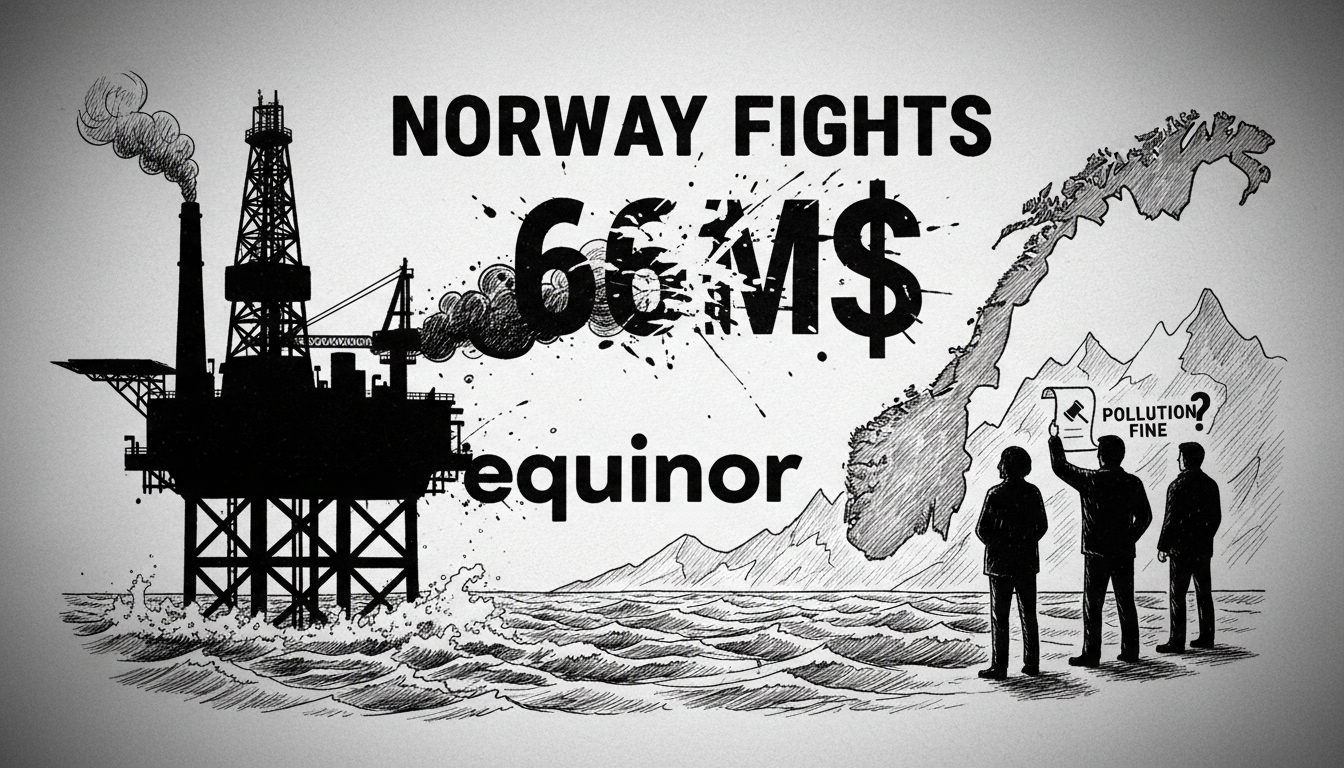
Norway's state energy giant Equinor is contesting a 720 million kroner ($66 million) fine from the country's economic crime unit for alleged decades-long environmental violations. The Norwegian National Authority for Investigation and Prosecution of Economic and Environmental Crime (Økokrim) issued the penalty for breaches of the Pollution Act, claiming the company failed in its duty of responsible maintenance at a facility. Equinor's Group Director for Legal Affairs, Siv Helen Rygh Torstensen, stated the company disputes the core allegations. "We dispute that the company has not fulfilled its duty of responsible maintenance of the facility over several decades and that the company has saved expenses on inadequate maintenance," Torstensen said.
This legal battle places Norway's largest company and a pillar of its national wealth directly against the state's environmental enforcers. The case strikes at the heart of Norway's dual identity as a global energy exporter and a champion of stringent environmental standards. A fine of this magnitude, while significant, represents a fraction of Equinor's quarterly profits, which totaled $2.67 billion in the first quarter of 2024. The principle at stake, however, carries far greater weight for the company's operational philosophy and its social license to operate in Norwegian waters.
A Clash Over Maintenance and Responsibility
The specific facility involved has not been publicly named by Økokrim, a common practice during ongoing investigations. The charge centers on the legal concept of "forsvarlig vedlikehold" or "responsible maintenance" as mandated by Norway's Pollution Act. This law requires industrial operators, particularly in the offshore sector, to implement and document a systematic maintenance program to prevent accidental emissions and ensure long-term facility integrity.
Økokrim's position suggests prosecutors have evidence that Equinor's maintenance protocols at this site were insufficient over a period spanning "several decades." The agency also alleges this was a cost-saving measure. For an industry where maintenance budgets run into the billions annually, even marginal reductions can translate into substantial sums. Equinor's forceful rejection indicates it has internal audits, maintenance logs, and inspection records it believes contradict the prosecutors' narrative.
"The burden of proof in these cases is high, and Økokrim will need to demonstrate a clear, documented link between specific maintenance decisions and an increased pollution risk," said Lars H. Birkeland, a professor of environmental law at the University of Oslo. "Equinor's defense will likely hinge on showing that its practices, even if imperfect, met the regulatory standard of 'responsible' care at the time."
The Stakes for Norway's Crown Jewel
Equinor is not just any company in Norway. The state owns 67% of its shares, and its taxes and dividends have funded the world's largest sovereign wealth fund, now valued at over $1.6 trillion. The company is a symbol of national engineering prowess and the economic engine that transformed modern Norway. A criminal conviction for environmental negligence would be a profound embarrassment. It could influence ongoing political debates about the future of oil and gas exploration in the Arctic Barents Sea and near the Lofoten islands.
Furthermore, the case arrives as Equinor seeks to rebrand itself as a leader in the energy transition. The company is investing heavily in offshore wind, hydrogen, and carbon capture and storage (CCS). A high-profile conviction for historical pollution violations could undermine its green credentials and provide ammunition to critics who argue its environmental commitments are superficial.
"The reputational damage often outweighs the financial penalty in these scenarios," noted Karina Standal, a research fellow specializing in energy ethics at the University of Bergen. "For a state-owned company, it's also about public trust. Voters and politicians will be asking: Is our national champion cutting corners on environmental safety to boost profits? That's a dangerous question for Equinor."
Økokrim's Growing Muscle in the Energy Sector
This case signals Økokrim's increasing willingness to pursue large, complex environmental cases against powerful industrial players. Historically, environmental violations in the offshore sector were often handled administratively by the Norwegian Offshore Directorate with fines. A criminal investigation by Økokrim represents a more severe escalation.
The 720 million kroner fine itself is noteworthy. While Norway has strict laws, penalties of this size for environmental crimes are rare. It suggests prosecutors view the alleged failures as systemic and serious. The fine also includes an element of "inndragning," or confiscation, which is meant to claw back economic benefits gained from the unlawful activity—in this case, alleged savings from deferred maintenance.
Legal experts point to the 2020 conviction of another major operator, Aker BP, for similar Pollution Act violations related to maintenance on the Ula field as a potential precedent. In that case, the company was fined 45 million kroner after admitting guilt. Equinor's decision to fight, rather than settle, sets the stage for a much larger legal showdown.
The Road Ahead in the Courtroom
The process will now move through the Norwegian legal system. Økokrim, having issued the fine, will formalize its charges. Equinor will present its formal defense. The case will likely involve detailed technical testimony from engineers, environmental scientists, and cost analysts. Thousands of pages of maintenance records, internal emails, and audit reports may be entered as evidence.
The court's decision will hinge on interpreting the technical standards of "responsible maintenance" and applying them to specific historical actions. It will also need to assess whether any identified shortcomings were deliberate cost-saving measures or reflected the evolving standards of best practice in the industry.
A trial could take years. Both sides have immense resources, but also significant incentives to reach a settlement before a final, public verdict is delivered. For Equinor, a settlement might involve a reduced fine and an admission of lesser faults without a criminal conviction. For Økokrim, a settlement that ensures a large penalty and enforceable commitments to improved practices could also be seen as a victory.
A Test of Regulatory Resolve
Beyond the courtroom, this case is a test for the Norwegian state's regulatory framework. Can it effectively police the very industry that funds it? The Ministry of Petroleum and Energy sets policy to maximize resource extraction, while the Norwegian Offshore Directorate and now Økokrim enforce safety and environmental rules. This inherent tension is now on full display.
The outcome will send a clear signal to the entire offshore industry operating in the Norwegian Continental Shelf, from mature fields in the North Sea to new developments in the Arctic. It will clarify the legal and financial risks associated with maintenance planning. A strong stance by Økokrim could lead to increased compliance spending across the sector, potentially impacting project economics.
For the public, the case underscores the ongoing environmental cost of fossil fuel extraction, even in a nation with a green reputation. Norway's fjords and mountains are pristine, but its offshore installations operate under constant pressure from harsh seas and aging infrastructure. Ensuring they do not become sources of pollution is a perpetual challenge.
Equinor's fight against this fine is more than a legal dispute; it is a defining moment for corporate accountability in Norway's most important industry. The verdict, whether delivered by a judge or forged in a settlement, will resonate through the halls of the Storting in Oslo, the boardrooms of Stavanger, and the remote control rooms overseeing platforms in the stormy North Sea. It will answer a fundamental question: When the state both owns the company and prosecutes it, who ultimately sets the standard for responsible conduct?