
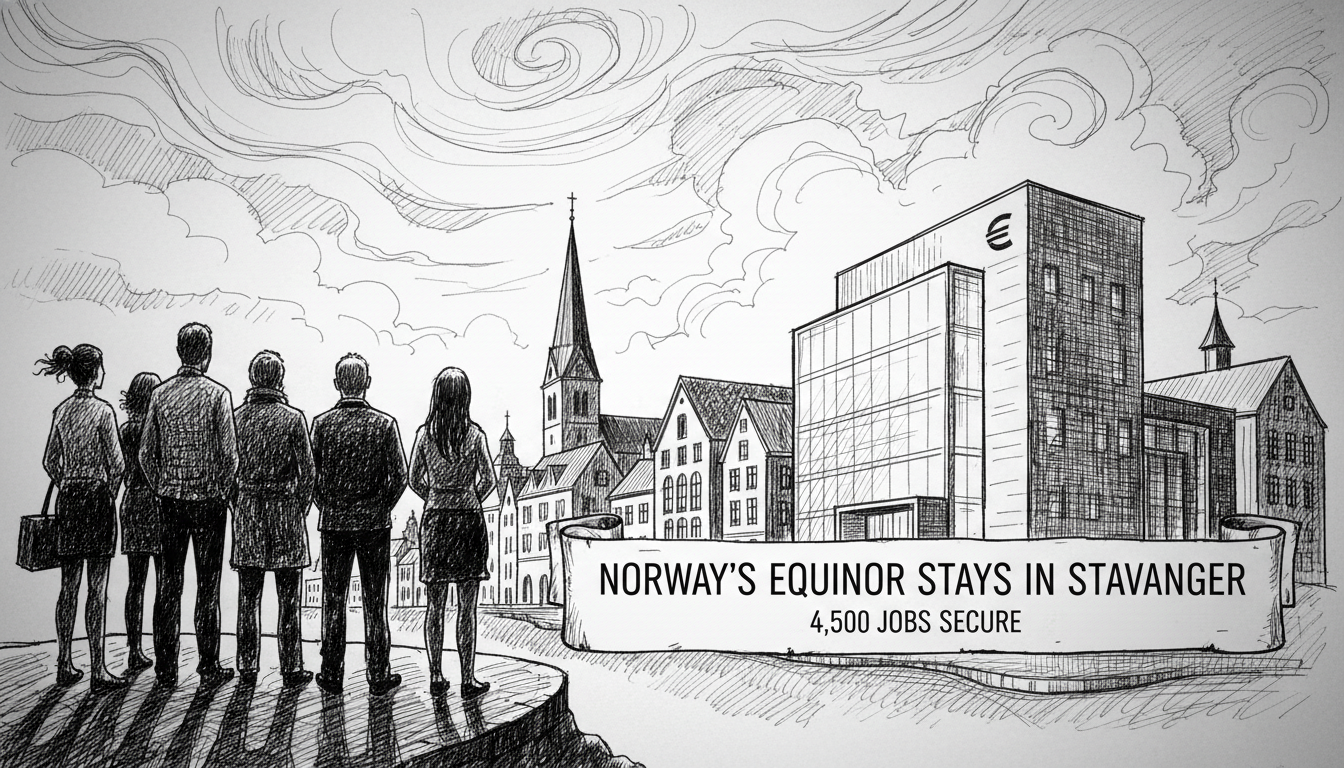
Norway's state energy giant Equinor has confirmed its global headquarters will remain at Forus in Stavanger, ending years of speculation about a potential relocation. The company announced a major upgrade to its existing complex, securing the future of approximately 4,500 regional jobs and reinforcing Stavanger's status as the nation's oil capital. CEO Anders Opedal stated the location is "non-negotiable," delivering a powerful vote of confidence in the southwestern Norwegian region as the company navigates the energy transition.
A Strategic Anchor in the Energy Capital
The decision to invest in and modernize the Forus headquarters, first occupied in 1979, carries significant symbolic and economic weight. It signals a long-term commitment to the Stavanger region at a time when Norway's oil and gas future is under intense scrutiny. For Stavanger municipality and Rogaland county, the announcement provides stability for a local economy deeply intertwined with the fortunes of the energy sector. The planned upgrades to the building are seen not just as a refurbishment, but as an investment in the future operational heart of Equinor, even as it expands into renewables.
"The headquarters have been at Forus since we moved out here in 1979. It will remain here. That the headquarters should be in Stavanger is non-negotiable," Opedal said in a statement. This unambiguous language is aimed at both employees and the local community, assuring them of Equinor's enduring presence. The move preemptively counters any political or internal debate about centralizing functions closer to government in Oslo, nearly 550 kilometers to the east.
Economic Ripples Across the Rogaland Region
With around 4,500 employees in the region, Equinor is far more than just an office tenant in Stavanger. It is the cornerstone of a vast ecosystem of supply companies, service providers, and research institutions. The Norwegian Petroleum Museum, the University of Stavanger's energy faculties, and clusters of engineering and offshore technology firms all draw their purpose from the industry's central node remaining in place. Analysts suggest that for every direct job at Equinor's headquarters, several more are supported in the local supply chain.
"This decision is a relief for the entire business community in Western Norway," said an industry analyst who requested anonymity due to corporate client relationships. "It removes a cloud of uncertainty. Upgrading the physical headquarters suggests Equinor is preparing it to be a modern, efficient hub for decades to come, capable of managing both legacy oil and gas assets and new energy ventures." The investment in the building itself will also generate significant construction and engineering contracts for local firms.
Navigating the Political and Energy Transition
The announcement arrives amid a complex political landscape. Norway remains one of the world's largest oil and gas exporters, and the taxes and revenues from this sector fund its generous welfare state and massive sovereign wealth fund. However, the country is under international pressure to accelerate its transition away from fossil fuels. Equinor itself is investing billions in offshore wind, hydrogen, and carbon capture, with major projects underway in the UK, US, and Europe.
Keeping the headquarters in Stavanger, the historical center of fossil fuel expertise, while pivoting the company's portfolio, is a delicate balancing act. It suggests Equinor believes the deep engineering, geological, and maritime project management expertise concentrated in Stavanger is transferable to new energy technologies. The decision can be interpreted as a bet that this knowledge cluster, built over 50 years, is its greatest asset for the future, not a relic of the past.
Politically, the move is likely welcomed across the spectrum in Rogaland. It secures high-value jobs and economic activity. For the national government, Equinor's majority owner, it represents stability and a continued geographic distribution of economic power beyond the capital region of Oslo. It also tacitly acknowledges the continued centrality of oil and gas revenues for the foreseeable future, even as transition plans advance.
The Forus Complex: From Past to Future
The Forus headquarters has been the operational brain of Norway's oil adventure since the late 1970s. From here, engineers have managed the development of iconic North Sea fields like Statfjord and Gullfaks, and more recently, complex projects in the harsh environments of the Barents Sea. The building has witnessed the transformation of Statoil from a state-directed instrument into the listed, international energy major Equinor.
The planned upgrades are expected to focus on sustainability, digital infrastructure, and flexible workspaces. This modernization is essential to attract and retain talent in a competitive global market. The goal is to create a headquarters that reflects a forward-looking energy company, not one anchored solely in its 20th-century origins. The physical renovation mirrors the corporate transformation underway.
Expert Analysis: A Signal to the Market
Energy policy experts see the decision as a multi-faceted signal. "First, it's a signal of commitment to Norway's continental shelf operations, which still have decades of production ahead," said Dr. Karen Oline, a senior researcher at the Nordic Institute for Energy Studies. "Second, it's a signal to the Stavanger region that it must continue to evolve as an energy cluster, not just an oil cluster. The expertise here in offshore operations is uniquely valuable for floating wind and other marine renewables."
She further notes that the choice avoids a politically contentious and economically disruptive relocation process. "Moving 4,500 jobs would have been a logistical nightmare and a political disaster for any government in Oslo. This decision provides continuity. It allows Equinor to focus its internal change management on the energy transition itself, rather than a distracting and divisive office move."
The Road Ahead for Stavanger and Equinor
The confirmation solidifies Stavanger's position but does not eliminate its challenges. The city and region must now double down on efforts to diversify its energy competence. The University of Stavanger and local colleges will play a critical role in broadening curricula. The local business community must continue to adapt, ensuring that companies serving the oil sector can also compete for contracts in offshore wind and carbon capture.
For Equinor, the upgraded Forus headquarters will be the command center for its dual-track strategy: maximizing value from oil and gas to fund the transition, while growing a profitable renewable energy portfolio. All major strategic decisions, from sanctioning new offshore projects in the Norwegian Sea to final investment decisions on giant wind farms off the US East Coast, will flow from this location.
The ultimate question is whether this historic oil capital can successfully rebrand itself as a capital for broader energy solutions. Equinor's commitment provides a stable foundation for that transformation. The company, and by extension Norway, is betting that the skills forged in the harsh environment of the North Sea are precisely what the world needs to build a new energy future. The decision to stay put in Stavanger is a declaration that the past and future of Norwegian energy are not in different places, but in the same hands, at the same address.