
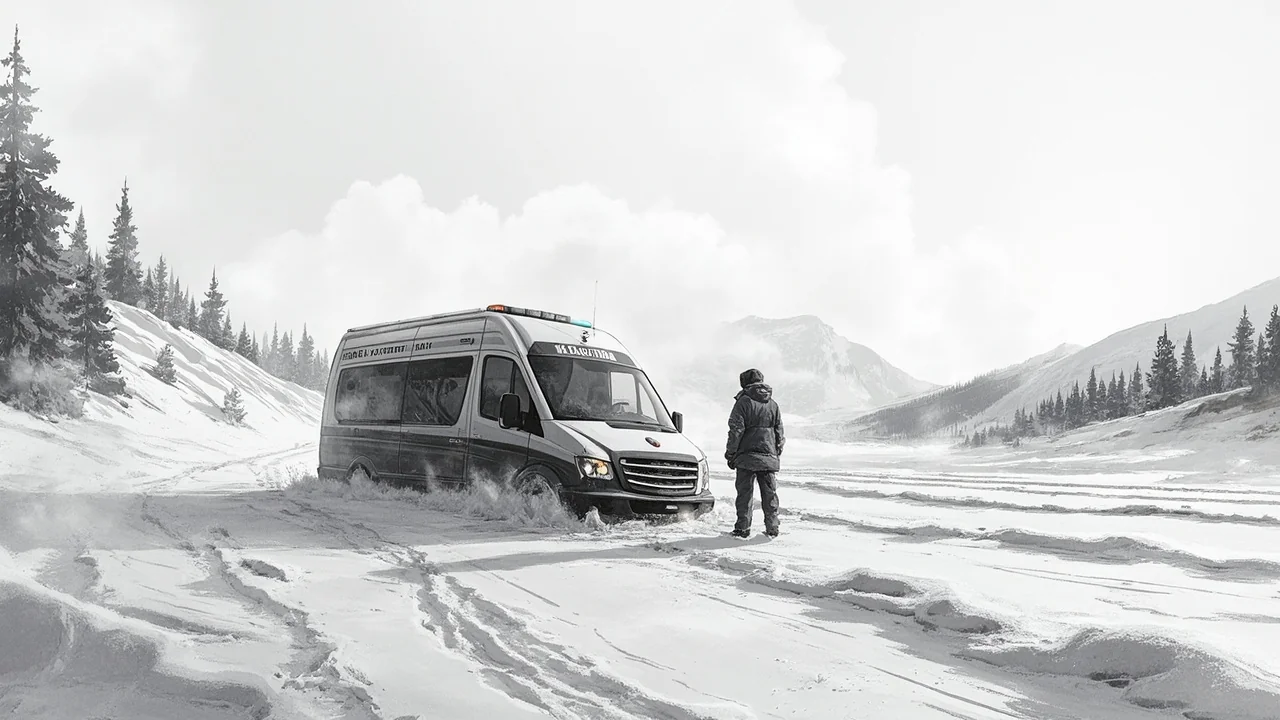
Norway's ambitious green transport policy faced a critical test when an electric patient taxi ran out of power in -15°C Arctic conditions. Mikkel Eriksen was being driven home to Alta after an emergency hospital stay in Hammerfest on January 2nd. The 150-kilometer journey turned dangerous halfway across the exposed Sennalandet mountain pass. The driver, navigating strong winds, watched the battery plummet from 69% to 3% before the vehicle stopped completely. They were stranded 25 kilometers from Eriksen's home in the heart of a Norwegian winter.
A Chilling Reality on the Mountain Pass
Eriksen, still weak from his hospital treatment, had fallen asleep in the back seat. He woke to a cold cabin and the car moving very slowly. 'I looked at the dashboard and discovered the car only had 3 percent power left,' Eriksen said. 'Then the driver said: "looks like we're not getting to Alta."' The explanation was a powerful headwind over the mountain, which drastically increased energy consumption. Eriksen found this surprising. 'This is the most weather-exposed mountain crossing I know of,' he noted. Sennalandet is notorious for severe weather, often requiring convoy driving or closing entirely in winter. The pair was now stuck in Finnmark at -15°C.
Improvised Footwear and a Frigid Wait
The situation was compounded by Eriksen's lack of proper clothing. Rushed to the hospital acutely, he had left without his shoes. Hospital staff had improvised, giving him plastic bags and non-slip socks as footwear. 'I didn't have any shoes on! I couldn't just start walking home. It was freezing cold outside, so I got irritated,' Eriksen explained. The driver assured him he had taxi insurance and called the company. However, the solution was not a replacement taxi, but a tow truck with a wait time of one hour and forty minutes. Faced with dropping temperatures inside the powerless vehicle, Eriksen made a decision. 'Then I thought: I'm not planning to die in this car, in this cold.' He called his wife, Frøydis Nilsen, who immediately got in her car and drove from Alta to rescue him.
The Policy Behind the Power Failure
This incident highlights the tension between Norway's rapid green transition and practical safety in extreme environments. The taxi was operating under strict national guidelines. 'We must just follow the guidelines from Pasientreiser,' said Jan Inge Johnsen, traffic manager at Hammerfest Taxi. The requirement from the national patient transport service is clear: all new taxis transporting patients must have zero emissions. The Northern Norway Regional Health Authority (Helse Nord) has been a key driver for this rule, which was fully implemented from autumn 2025. The policy aims to reduce the carbon footprint of the health sector, a significant contributor to transport emissions. Johnsen emphasized he was commenting on general principles, not the specific case.
Expert Analysis: When Green Goals Meet Arctic Reality
Technology and logistics experts point to a gap in planning. 'This is a classic case of a one-size-fits-all policy meeting a non-one-size-fits-all geography,' says Lars Holm, a transport researcher specializing in Northern conditions. 'The energy consumption of an electric vehicle in -15°C with a strong headwind can be double or triple the normal rate. Heating the cabin alone is a massive drain.' He notes that while the policy is well-intentioned, its execution requires nuanced local adaptations. For critical services like patient transport on remote Arctic routes, factors like mandatory charging stops, mandatory minimum charge levels at departure for mountain passes, or even hybrid exceptions for certain routes need consideration. The incident raises questions about risk assessment and driver training for EV operators in extreme conditions.
A National Conversation on Practical Electrification
Norway is a world leader in electric vehicle adoption, with over 90% of new cars sold being electric. This success story is now encountering edge cases. The patient taxi stranding is not an isolated event, but part of a broader discussion about electrifying all parts of society. Other sectors, like freight and emergency services, are watching closely. The challenge is balancing unwavering climate goals with unwavering reliability for essential services. Can technology and infrastructure catch up with policy ambition in the most demanding regions? Battery performance in cold weather is improving, but remains a physical limitation. Fast-charging infrastructure on remote routes like the E6 through Sennalandet is also critical. Was there a working charger the driver could have used? The source material suggests the driver chose not to charge, a decision that underlines the need for strict, weather-aware operational protocols.
The Human Cost of Systemic Transition
Beyond the policy debate, the story underscores a human cost. Mikkel Eriksen was a vulnerable patient relying on a state-coordinated service for a safe journey home. The failure eroded trust. His wife had to undertake an unexpected and potentially hazardous rescue drive. The psychological stress of being stranded in extreme cold after a hospital stay is significant. This incident demonstrates that the transition to a green economy must be human-centric, especially in welfare services. Safety and reliability cannot be secondary to emission targets. The conversation now turns to how the system can be hardened. Options include real-time weather integration into dispatch software, mandatory safety margins for battery charge on long trips, and clearer contingency plans when EVs are incapacitated.
Looking Ahead: A Nordic Model Under Pressure
Norway's model is often cited as the blueprint for the electric future. This real-world test in Finnmark shows that even the most advanced models require continuous refinement. The solution likely lies in a combination of better technology, smarter regulations, and enhanced operational discipline. Health authorities and transport providers must collaborate on dynamic guidelines that account for temperature, wind, and route topography. The Norwegian Public Roads Administration could play a role in designating 'extreme condition corridors' with special requirements. As other Nordic countries and regions with similar climates, like Canada and Alaska, push their own electrification agendas, the lessons from this stranded taxi will resonate far beyond the Sennalandet mountain pass. The ultimate question remains: How can a nation stay on the cutting edge of green technology while ensuring no patient is ever left in the cold?