
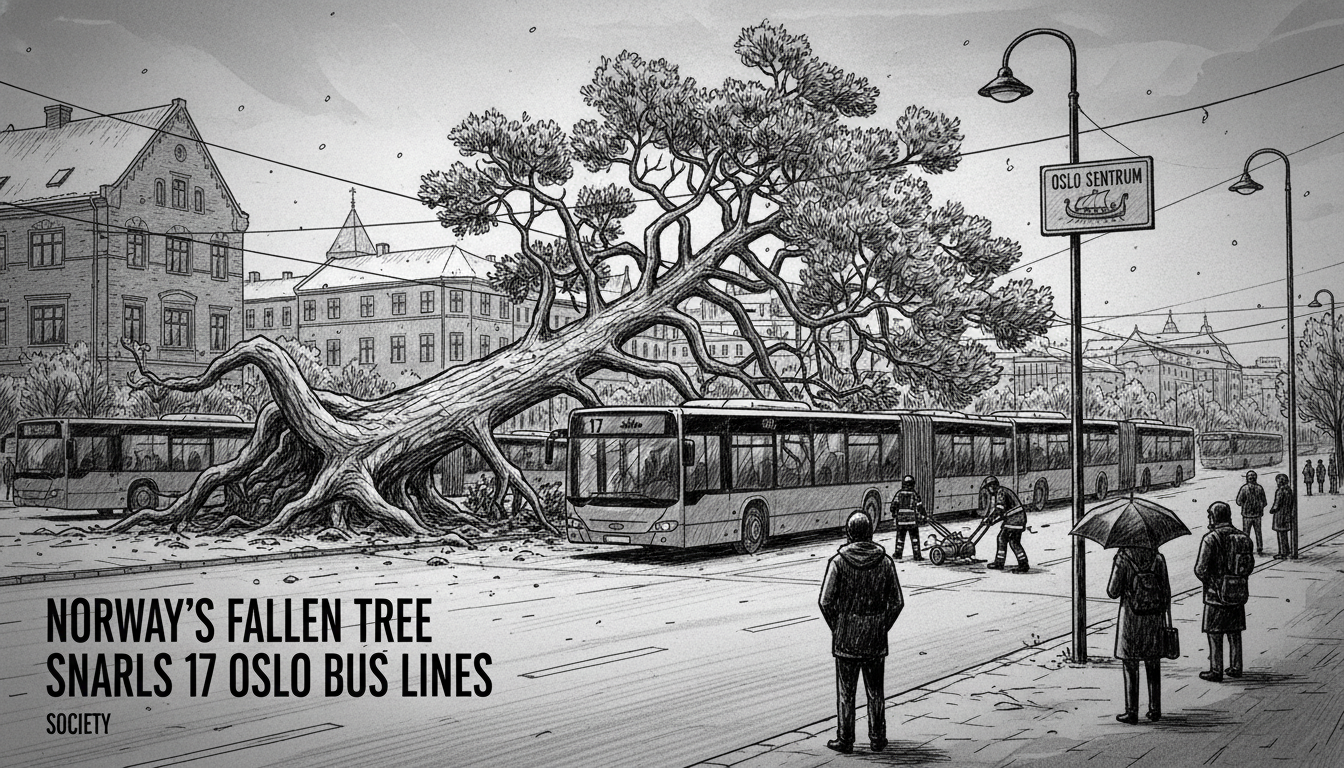
Norway's capital faced significant public transport disruption Monday afternoon after a single tree fell onto a major roadway in the south of the city. The incident on Ljabruveien in the Nordstrand district forced extensive detours and delays across seventeen key bus lines, impacting thousands of evening commuters.
Ruter, Oslo's public transport authority, confirmed the disruptions. "There is some rerouting and delays on a number of bus routes because of this," said press officer Øystein Dahl Johansen. The fire department was dispatched to clear the obstruction, but not before creating a ripple effect across the network.
The affected lines serve critical east-west and north-south corridors connecting central Oslo to suburban areas like Nordstrand, Søndre Nordstrand, and Mortensrud. Key routes include the high-frequency lines 73 and 74, express services like the 74X and 80E, and local connectors such as the 580 and 585. This cluster of delays highlights the vulnerability of a spoke in the city's transit web.
The Ripple Effect on Oslo's South
A fallen tree may seem a minor incident, but on a busy Oslo weekday, its impact is magnified. Nordstrand functions as a major transit hub for the city's southeastern boroughs. Ljabruveien is a key artery feeding traffic from these residential areas toward the city center and Ring 3, the capital's inner beltway.
The immediate consequence was a chain reaction of detours. Buses could not pass the blocked section, forcing drivers to find alternative paths through local residential streets not designed for high-volume bus traffic. This leads to slower travel times, bunching of buses, and gaps in service further down the line. For the commuter, a promised 15-minute journey can easily double.
Ruter's real-time travel apps and electronic signage at stops would have flashed warning symbols for the seventeen lines. The authority's communication strategy in such events is tested, relying on digital platforms to inform passengers of alternative travel options, which may include neighboring bus lines, the T-bane (metro), or local trains.
A Test for Public Transport Reliability
This event is a stark reminder of the complex challenges facing modern public transport systems. Oslo has invested heavily in making its city center nearly car-free and promoting transit, cycling, and walking. The success of this policy depends entirely on the perceived reliability of the alternatives.
"Single points of failure, like one blocked road, reveal the tight integration and therefore the fragility of a network," notes Lars Eriksen, a transportation analyst based in Oslo. "Ruter plans for major disruptions like track work or large accidents, but day-to-day resilience against minor events is equally important for user trust. The speed of response and clarity of communication are what passengers remember."
Norway's harsh weather, from heavy snow and ice to autumn storms, makes trees and branches falling onto roads and power lines a recurring seasonal hazard. Each event is a live drill for the emergency response coordination between Ruter, the municipal traffic agency, and the fire department. The goal is to restore normalcy within the hour, not the evening.
The Broader Context of Oslo's Transit Ambitions
To understand the significance of such a disruption, one must consider Oslo's broader transit landscape. Ruter oversees all bus, tram, metro, ferry, and local train services in the metropolitan area. It is a publicly owned entity answerable to Oslo and Viken county municipalities, with a mandate to provide efficient, green transportation.
The city is in the midst of a massive transit expansion. New T-bane lines are under construction, the tram network is being extended, and the bus fleet is rapidly electrifying. Oslo now boasts one of the world's largest all-electric bus fleets. This push is central to the city's goal of reducing direct greenhouse gas emissions by 95% by 2030.
However, physical infrastructure—the roads and rails—remains susceptible to simple physical obstacles. An electric bus stuck in a detour is just as delayed as a diesel one. The incident underscores that the green transition requires not just new vehicles, but also resilient and redundant infrastructure. Investing in tree maintenance along key transit corridors may become a higher priority as the city doubles down on its car-free vision.
Passenger Experience and System Accountability
For the affected passenger, the calculus is personal. Delays mean missed appointments, late dinners, rearranged childcare pickups, and frustration. In a city where monthly transit passes represent a significant household expense, expectations for smooth service are high.
Ruter compensates passengers for significant delays under certain conditions, but a widespread, sub-hour disruption like this typically falls outside such schemes. The social contract, instead, is based on the system's overall reliability. Frequent, small disruptions can erode confidence as much as a single large crisis.
This event will likely be logged internally as a minor operational incident. The key performance indicators monitored will be the clearance time and the restoration of normal service schedules. The data feeds into long-term planning, informing decisions about where to invest in infrastructure hardening or where to design alternative routing plans for critical corridors.
Resilience in the Face of Simple Obstacles
As the Oslo fire department likely cleared the tree from Ljabruveien within a few hours, normal service resumed. The aftermath offers a moment for reflection. Cities that commit to a public transport-first model must also commit to protecting the pathways that make it function.
This involves continuous investment not only in flashy new metro lines but in the mundane: drainage to prevent road flooding, stable slopes to prevent landslides, and, yes, arboriculture to manage roadside trees. In the Norwegian context, where nature is always at the doorstep, designing transport networks that can withstand its occasional intrusions is part of the job.
The fallen tree on Nordstrand is more than a Monday inconvenience. It is a case study in urban vulnerability and a test of responsive governance. As Oslo continues its ambitious journey toward a greener, denser, car-light future, ensuring its transit backbone can withstand the literal winds of change will be fundamental. The true measure of success is not that disruptions never happen, but how quickly and effectively the city bounces back when they do.