
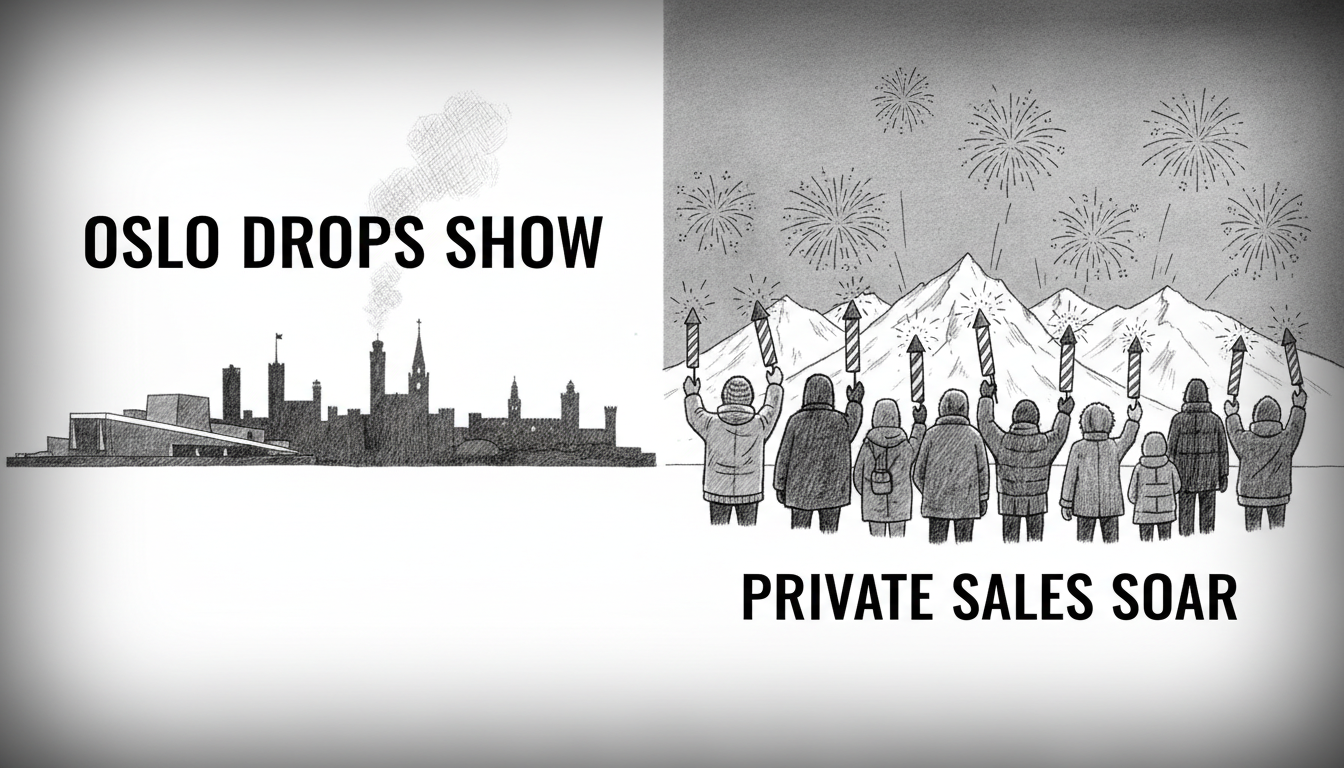
Norway's New Year's Eve fireworks tradition faces a critical test in Oslo this year. The city government has canceled its official display after a costly and widely mocked light show in 2022. A high-profile crowdfunding campaign to replace it has also collapsed. Yet, despite the lack of a central public spectacle, retailers report strong sales, setting the stage for a fragmented, privately-funded celebration across the capital.
This situation highlights a growing national debate. Municipalities are balancing cherished traditions against tightening budgets, environmental concerns, and public safety. The result is an uncoordinated patchwork of approaches. Some cities maintain their displays, others have switched to alternative shows, and a few, like Oslo, have stepped back entirely, leaving the festivities to private citizens and businesses.
The Spectacular Failure That Changed Everything
Oslo's retreat stems directly from a public relations disaster on New Year's Eve 2022. After a multi-year hiatus for traditional fireworks, the city invested nearly two million Norwegian kroner in a "modern," pyro-free laser light show centered at City Hall. Officials, believing the show would be best viewed from a distance, actively discouraged residents from gathering at the venue.
This advice proved misguided. For many who attempted to watch from hills and rooftops across Oslo, the display was barely visible—reduced to faint streaks in the sky. Social media backlash was swift and severe, with one typical comment branding it "the most ridiculous light show I've ever seen." The event became a symbol of wasteful spending and poor execution, severely damaging public trust in the municipality's ability to host a successful celebration.
A Crowdfunding Campaign Fizzles Out
In the wake of the official cancellation, a private initiative emerged to fill the void. A crowdfunding campaign was launched on the popular Norwegian platform Spleis, aiming to collect 490,000 kroner by December 30 to finance a large, professional fireworks display. The campaign gained notable backers, including Pyroteknikk, which contributed 40,000 kroner, and comedian Sigrid Bonde Tusvik, who donated 30,000 kroner. Tusvik had previously criticized the 2022 municipal show as "a total crisis."
Despite this early momentum, the campaign failed to capture the broader public's financial support. By late December, it had raised just under 95,000 kroner, forcing organizers to cancel their plans. The failure demonstrates the challenge of mobilizing sufficient private funds for a public good, even in a wealthy city passionate about its traditions.
Private Enterprise Steps Into the Void
While the large-scale crowdfunding effort stalled, other private actors are moving forward. Mustad Eiendom, a property development company, has announced it will host a fireworks display at midnight in the Lilleaker area of western Oslo. This corporate-sponsored event represents one model for how celebrations might evolve—funded by businesses for local communities or as a branding exercise.
More broadly, the absence of a public show does not signal a decline in the tradition. Anders Sture, managing director of Svea Fyrverkerier AS, one of the Nordic region's largest fireworks suppliers, reports that sales in Oslo are proceeding at a brisk pace. This suggests that the desire for personal fireworks remains strong, potentially leading to a more diffuse and less controlled celebration across the city's neighborhoods.
A National Patchwork of Policies
Oslo's situation is not isolated but reflects a broader national trend of reevaluation. Other major cities are taking divergent paths. Bergen, Stavanger, Kristiansand, and Tromsø have all decided to maintain their traditional municipal fireworks displays for now. Their continued investment underscores the cultural weight of the tradition, particularly as a shared communal experience.
However, many smaller municipalities, facing similar budget pressures as Oslo, have canceled their shows. The national conversation increasingly includes arguments about noise pollution, the impact on wildlife and pets, air quality, and the risk of accidents. These concerns have led some places to experiment with drone light shows or synchronized laser displays, though Oslo's experience serves as a cautionary tale for that approach.
Expert Analysis: Tradition in Transition
Cultural analysts see this moment as a significant transition point. "The centralized, municipal New Year's fireworks display has long been a powerful symbol of communal celebration and a shared fresh start," says Dr. Ingrid Moe, a sociologist at the University of Oslo who studies public rituals. "What we are witnessing now is a fragmentation of that experience. The tradition isn't disappearing; it's privatizing and decentralizing. The social and visual experience shifts from a single, collective moment to hundreds of smaller, private ones."
This shift, she notes, carries implications. It reduces the carbon footprint and safety risks associated with a single massive launch but potentially increases scattered local pollution and hazards. It also changes the social dynamic from a city-wide gathering to backyard or neighborhood events, which can feel less inclusive for those without access to private spaces or groups.
From a policy perspective, the dilemma is complex. "Municipalities are caught between public expectation and fiscal responsibility," explains Lars Holten, a public administration researcher. "After a high-profile failure like Oslo's laser show, the political risk of trying again is immense. Withdrawing public funding and encouraging private or corporate sponsorship becomes the path of least resistance, even if it leads to a less equitable celebration."
The Environmental and Safety Equation
The debate is further complicated by growing environmental awareness. Traditional fireworks release particulate matter and metals into the atmosphere. While the annual emissions are minor compared to year-round industrial sources, they represent a highly visible and symbolic form of pollution. The Norwegian Society for the Conservation of Nature has repeatedly called for restrictions on consumer fireworks, citing environmental and animal welfare concerns.
Safety remains a paramount issue. Every year, New Year's celebrations result in emergency room visits across Norway due to fireworks-related injuries. A decentralized, private celebration arguably makes uniform safety messaging and oversight more challenging for authorities than a single, professionally managed public event.
Looking Ahead: The Future of the Norwegian New Year
The coming New Year's Eve in Oslo will serve as a live experiment. Will the city feel emptier without a central focal point? Or will the proliferation of private displays create a unique, if chaotic, charm? The success of corporate-sponsored displays like Mustad Eiendom's will be closely watched by other businesses and city councils.
The long-term solution may lie in hybrid models. Some experts suggest municipalities could act as facilitators and regulators rather than sole funders—creating safe, designated public launch zones, coordinating private sponsorships for a central show, or subsidizing eco-friendlier pyrotechnics. The core challenge is preserving the magic and communal spirit of the tradition while adapting to contemporary economic and environmental realities.
As midnight approaches on December 31st, the skies over Oslo will still light up. The explosions will echo across the fjord. But the source of the spectacle, and who pays for it, has fundamentally changed. The failure of a laser show and a crowdfunding campaign has inadvertently sparked a wider conversation about how a modern society celebrates together, and who holds the spark.