
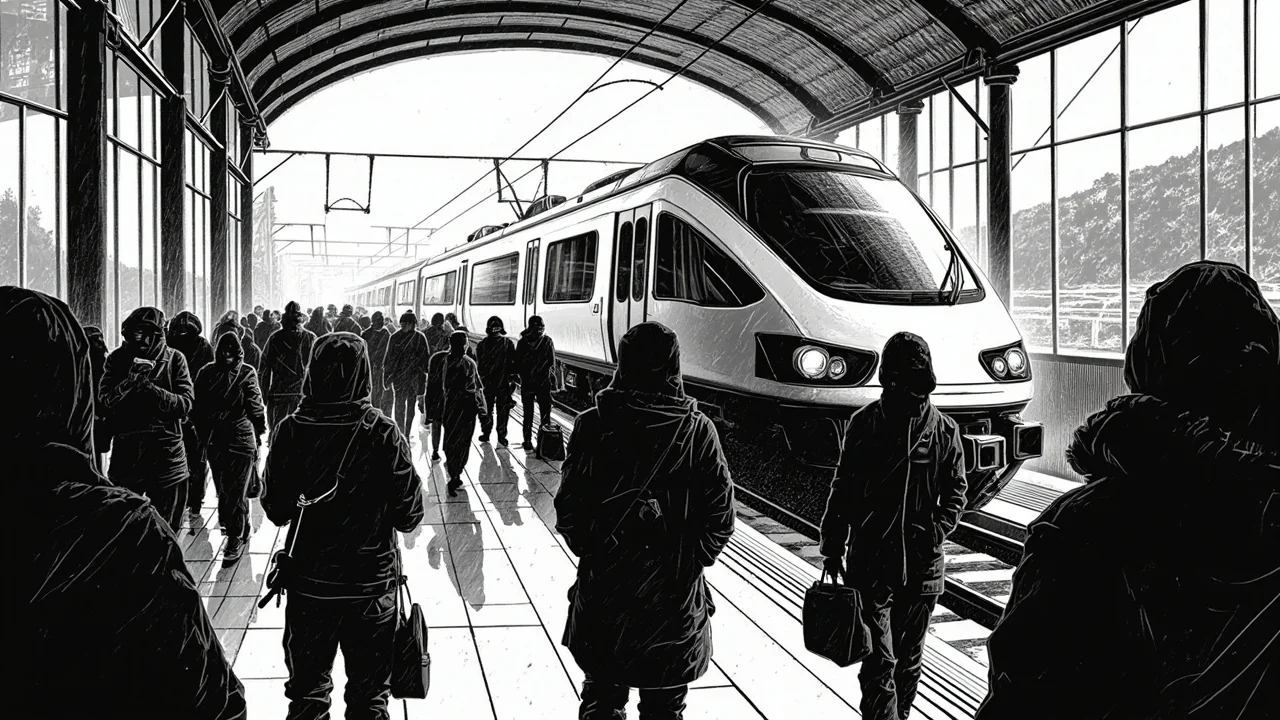
Norway's vital Gardermoen Line, the rail artery connecting Oslo to its main international airport, faces major disruptions after a technical fault crippled key tracks at Lillestrøm station. The failure on tracks 1 and 2 has created a bottleneck, causing what a Bane Nor spokesperson described as "extensive delays for some trains" that are "piling up." The Airport Express Train has suspended its non-stop services, halving the number of trains passing through the critical junction each hour. This incident exposes the fragility of a key piece of national infrastructure relied upon by thousands of daily commuters, business travelers, and tourists.
A Single Point of Failure
The disruption stems from a faulty track switch, or points mechanism, at Lillestrøm station, a major hub northeast of Oslo. While six of the station's eight tracks remain operational, the failure affects the two primary tracks used by the main line. This has forced all trains to funnel through the remaining tracks, creating a queue that backs up across the network. "There must be expected delays until further notice," said Harry Korslund, press officer for the state-owned rail infrastructure manager Bane Nor. "There are fewer tracks to run on, and then it piles up a bit with trains." The technical teams have been dispatched, but the root cause and full scope of the repair work remain unclear.
The most immediate and visible impact is on the Flytoget Airport Express. To manage the congestion, it has canceled all direct, non-stop services between Oslo Central Station and Oslo Airport Gardermoen. This strategic decision reduces the frequency of trains passing through the Lillestrøm bottleneck from six to just three per hour. While this may help prevent total gridlock, it significantly reduces capacity on what is marketed as a premium, high-frequency service. For travelers with tight flight connections, the uncertainty is palpable.
The Ripple Effect Across the Network
The delays are not confined to the airport line. The Gardermoen Line is a mixed-traffic corridor, carrying regional commuter trains, long-distance services to cities like Lillehammer, and freight. A fault at a central node like Lillestrøm sends shockwaves across this entire system. Korslund confirmed that the delays are "in some cases substantial for the rest of the traffic." Commuters from towns along the Romerike region east of Oslo face extended journey times into the capital. The economic cost mounts with each hour of delay, factoring in lost productivity, missed meetings, and logistical headaches for businesses.
This incident highlights a critical challenge for Norway's rail network: resilience. The country has invested heavily in its railways, but complex, high-utilization systems are vulnerable to single points of failure. The Gardermoen Line, in particular, is a victim of its own success. Since its opening ahead of the 1998 Winter Olympics, it has become an indispensable link, with passenger numbers consistently high. Its reliability is taken for granted until a switch fails, revealing the tight margins on which the schedule operates.
Infrastructure Under Scrutiny
Norway's political parties, particularly those focused on transport and regional development, will be watching the response closely. The center-left government, led by Prime Minister Jonas Gahr Støre, has championed rail as a cornerstone of green transition policy, aiming to shift passenger and freight traffic from road to rail. Incidents like this undermine public confidence in that strategy. Critics will ask if maintenance budgets are sufficient and if the network's design has adequate redundancy.
Bane Nor's performance in resolving the issue will be scrutinized. The agency manages over 4,000 kilometers of track and faces constant pressure from weather, wear, and increasing traffic. Its communication during this disruption is a key test. Providing accurate, timely information to passengers via apps, station displays, and announcements is as crucial as the physical repair. The silent information screens at Lillestrøm station, noted in initial reports, tell their own story of passenger frustration.
A Broader Transport Policy Context
This disruption arrives amid a national debate about Norway's transport future. The government is pushing for a significant increase in rail investment in the next National Transport Plan. Proponents argue that a robust, electrified rail network is essential for meeting climate targets and connecting regions. Opponents question the cost-effectiveness, especially for low-density areas. A high-profile failure on the country's flagship airport link provides ammunition for those who doubt the state's capacity to manage complex infrastructure projects reliably.
Furthermore, the incident puts a spotlight on the eastern corridor's capacity constraints. Discussions about a potential new high-speed line, the "InterCity" project, or additional tracks on existing routes, often cite reliability as a key driver. Today's delays offer a concrete example of the systemic risk. It is no longer a theoretical discussion about future capacity but a present-day reality of canceled trains and stranded passengers.
The Human and Economic Toll
Beyond the statistics and policy debates, the disruption has a human face. The business traveler missing a crucial client meeting, the family racing to catch a long-planned vacation flight, the shift worker facing a disciplinary mark for lateness—all bear the cost. The Airport Express, with its premium fare, sells itself on predictability. That promise is broken today. The reputational damage to Norway as a efficient, modern nation, particularly for first-time visitors experiencing this chaos upon arrival or departure, is harder to quantify but real.
The Norwegian economy, especially in the Oslo region, functions on punctuality. The just-in-time culture extends to its workforce. Unplanned rail disruptions impose a stealth tax on economic activity. While the direct cost of the repair may be contained, the indirect costs—lost hours, stress, alternative transport expenses—are distributed across thousands of individuals and companies. For a nation heavily invested in its public transport ethos, it is a sobering moment.
Looking Down the Track
As technicians work to diagnose and fix the fault at Lillestrøm, questions will linger. Was this a random component failure, or a sign of deferred maintenance? How quickly can normal service resume, and what interim measures can better protect passengers? The incident serves as a stark reminder that the transition to a low-emission, rail-centric transport system requires not just grand visions and large budgets, but also excellence in daily operation and maintenance. Norway's rail network is not just competing with cars and planes; it is competing with the public's expectation of reliability. Today, on the Gardermoen Line, that trust has been derailed. The path to restoring it begins with a single switch, but the journey involves a fundamental commitment to resilience that must run through every kilometer of track.