
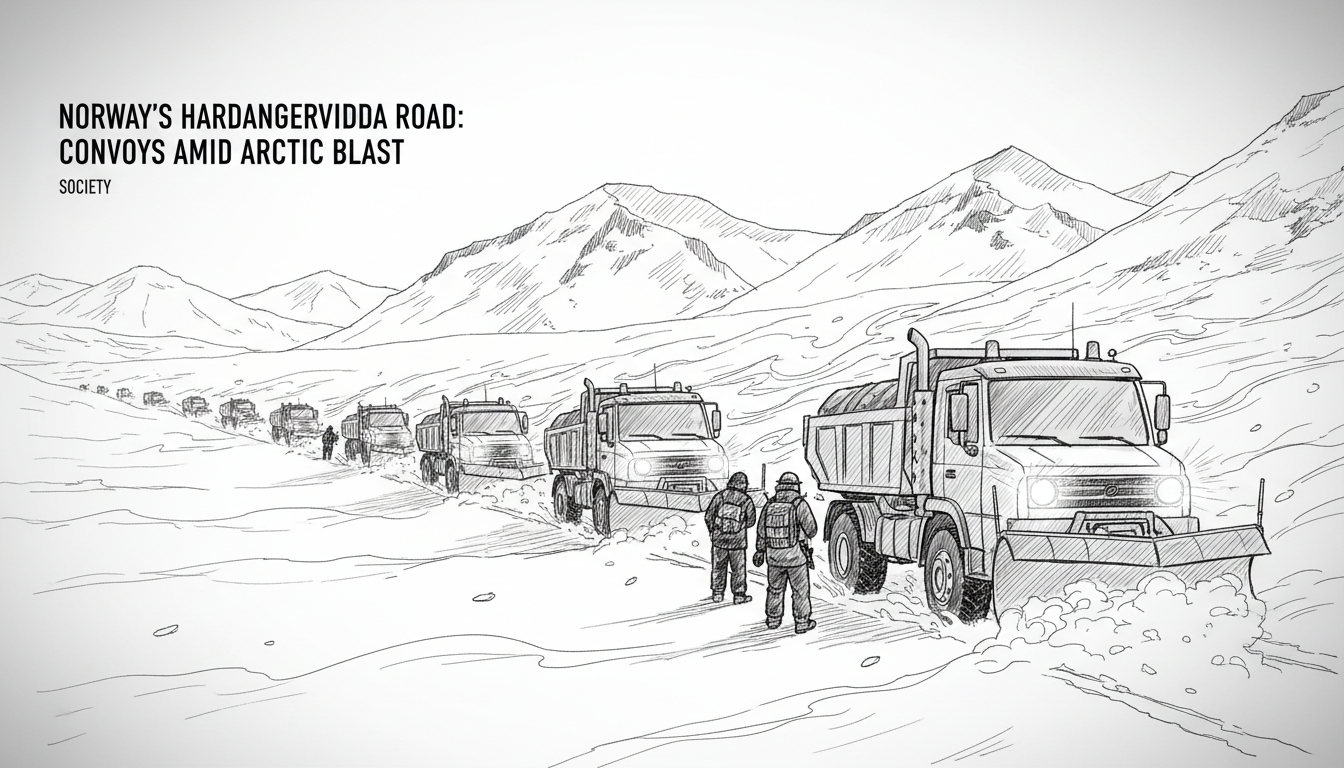
Norway's Riksvei 7 over the Hardangervidda plateau was placed under mandatory convoy driving early Saturday morning. The decision, implemented just after 3 a.m., mandates that all vehicles—from passenger cars to heavy trucks—must travel in supervised columns between the Leiro and Haugastøl checkpoints. This measure, known as 'kolonnekjøring,' is a critical safety protocol activated when fierce Arctic weather renders independent travel across the exposed mountain pass too dangerous.
For the drivers caught in the early hours, it meant waiting at the closed barriers for a snowplow to lead the way. They faced a journey through near-zero visibility, with winds powerful enough to push vehicles off the road. This stretch of highway is a vital artery connecting Eastern and Western Norway, making its closure or restriction a significant logistical event that disrupts commerce, travel, and daily life across a wide region.
The Unforgiving Geography of Hardangervidda
The Hardangervidda mountain plateau is Europe's largest high-altitude plateau, a vast, treeless expanse where weather systems collide with little obstruction. Riksvei 7 traverses this wilderness at an elevation where conditions can deteriorate from clear to catastrophic within minutes. The specific 60-kilometer segment between Leiro in Eidfjord municipality and Haugastøl in Hol municipality is notoriously vulnerable.
Meteorologists describe this area as a funnel for polar winds sweeping down from the Arctic. When these winds meet moisture from the Norwegian Sea, the result is intense snowfall and blinding ground blizzards. The road itself, while well-maintained, offers no natural windbreaks. This creates a phenomenon where snow does not just fall; it is whipped across the asphalt in dense, horizontal sheets, obliterating visibility and creating massive drifts.
"This is not a typical mountain pass," explains Lars Fjelldal, a senior advisor with the Norwegian Public Roads Administration (NPRA). "The Hardangervidda's sheer scale and exposure mean we are dealing with a different order of weather events. Wind speeds there can be double what we see in more sheltered mountain areas. Our decision to implement convoy driving is never taken lightly, but it is a necessary tool to prevent accidents and save lives."
The Mechanics of Survival: How Kolonnekjøring Works
Kolonnekjøring is a precisely coordinated operation that transforms a dangerous free-for-all into a disciplined, safe procession. When the NPRA makes the call, barriers descend at designated points, often with several kilometers of queue forming rapidly. Drivers are instructed to wait, with updates provided via electronic signs and the official road traffic website, Vegvesen.no.
A heavy-duty snowplow, often a massive Volvo or Scania unit with a reinforced blade and wing, takes the lead. It clears a single lane through fresh accumulations and drifts. Vehicles then follow in a tight line behind it, each driver mandated to maintain a constant, safe distance from the taillights of the vehicle ahead—the only reliable guide in a white void. Passing is strictly forbidden. The convoy moves at a slow, steady pace dictated by the plow operator's assessment of conditions, typically between 20 and 40 kilometers per hour.
For the snowplow drivers, this is a high-stakes job requiring immense concentration. "You are responsible for dozens of people behind you," says Kari Nilsen, a veteran plow operator with over fifteen winters on the Hardangervidda route. "The pressure is constant. You are watching the wind, feeling the drift build against the blade, and monitoring the line of headlights in your mirrors. The goal is to provide a moving sanctuary through the storm."
The system's effectiveness is proven. While accidents can still occur during convoy driving, they are typically minor fender-benders from following too closely. The catastrophic, weather-related multi-vehicle pile-ups seen in other regions are virtually absent on Norwegian mountain passes when the convoy system is active.
Economic and Social Ripple Effects
The closure of Riksvei 7 to free travel creates immediate logistical challenges. This road is a primary route for freight moving between the port of Bergen and the industrial and population centers of Eastern Norway. A prolonged period of convoy driving, or a full closure, delays everything from fresh seafood to manufactured goods.
Per Strand, a logistics manager for a major transport firm, outlines the impact. "When Hardangervidda is on convoy or closed, our entire network adjusts. Trucks are rerouted via longer southern alternatives like the E134, adding hours and significant fuel costs. For time-sensitive cargo, we sometimes have to use rail or air freight, which multiplies the expense. A single day of convoy driving can cost our industry hundreds of thousands of kroner in added operational costs."
Beyond commerce, the measure affects ordinary citizens. Travel plans are canceled or extended. Families are separated. Tourists heading to ski resorts in Geilo or Voss find their itineraries upended. Local communities on either side of the plateau, like Eidfjord and Hol, experience a sudden drop in through-traffic, impacting service stations and cafes that rely on passing trade.
A System Built on Technology and Trust
Norway's approach to mountain road safety is a blend of advanced technology and clear public communication. The NPRA operates an extensive network of weather stations and webcams along Riksvei 7, providing real-time data on wind speed, temperature, and visibility. This data feeds into sophisticated models that help predict when conditions will deteriorate to the threshold for convoy driving.
The public interface for this is Vegvesen.no, a site every Norwegian driver learns to check before a winter journey. Its color-coded maps (green for clear, yellow for caution, red for closed/convoy) are the authoritative source. The system relies on public trust and compliance; the authorities issue clear instructions, and drivers are expected to follow them without attempting risky, unauthorized travel.
This culture of compliance is reinforced by both the obvious dangers and strict penalties. Ignoring a closed barrier or attempting to drive outside a convoy can result in heavy fines and immediate loss of license. More importantly, it triggers a costly and dangerous rescue operation if the vehicle becomes stuck or crashes, putting emergency responders at extreme risk.
Climate Change and the Future of Mountain Travel
Looking ahead, climate scientists present a complex picture for routes like Riksvei 7. While winters may warm overall, leading to more precipitation falling as rain at intermediate altitudes, the highest mountain passes will continue to experience severe snow events. There is also evidence that climate instability could lead to more frequent and intense winter storms.
"We are monitoring trends very closely," says Dr. Anette Holtet, a climatologist at the University of Bergen. "The baseline is shifting. We may see a change in the seasonality of these extreme events, potentially more volatile conditions in the shoulder seasons of autumn and spring. For road planners, this means the period requiring high-alert preparedness may lengthen."
The NPRA is already investing in future-proofing measures. These include exploring the feasibility of more extensive avalanche shelter galleries in certain sections, installing even more robust wind-fencing where possible, and continuing to upgrade the fleet of snow-clearing equipment. However, on the vast, open expanse of Hardangervidda, there is no technological silver bullet that can defeat a full Arctic blizzard. Kolonnekjøring will remain an essential, life-saving strategy for the foreseeable future.
As dawn broke over a still-stormy Hardangervidda on Saturday, the convoys continued their slow, steady march across the roof of Norway. Each line of vehicles, tucked safely behind its guiding plow, was a testament to a national understanding: in the face of raw, untamed nature, the wisest course is sometimes to surrender speed for security, and to travel together rather than alone. The mountain pass will reopen for free travel when the wind drops, a reminder that in Norway, human schedules remain subject to the ancient rhythms of the mountains.