
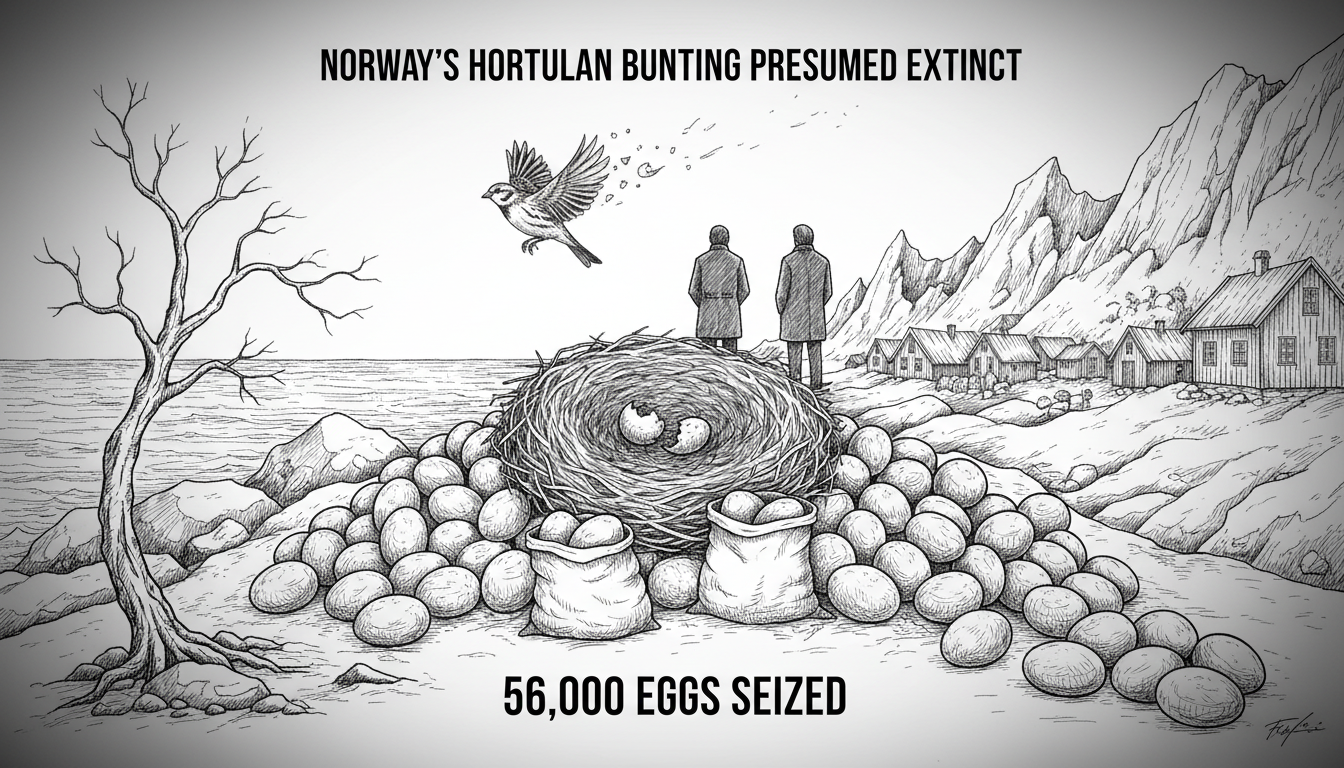
Norway's hortulan bunting, a small migratory songbird once established in the country's farmlands, is now presumed extinct. The final blow for the critically endangered species may have come not just from modern agriculture, but from a shadowy criminal network trading in its eggs. This week, two men from Møre og Romsdal were indicted as part of a nationwide investigation into the illegal trade of approximately 56,000 bird eggs, a haul that included eggs from the now-vanished hortulan bunting.
"We have a suspicion, and will ask police for access to these eggs in due course, so we can see if there is a connection to the hortulan's decline," said Jo Anders Auran, a senior advisor at the Norwegian Environment Agency's wildlife section. His statement points to a grim intersection of environmental crime and ecological collapse. The case involves 16 men aged 32 to 82 from across the country, revealing a persistent, organized threat to Norway's protected wildlife.
The Silent Disappearance of a Songbird
The hortulan bunting, a bird slightly smaller than a sparrow with a distinctive green-grey head and an orange-brown breast, established itself in Norway during the 1800s. For decades, its song—a phrase of 5-6 notes described as "tjy-tjy-tjy-tjy-vy-vy"—was a feature of certain rural landscapes. Its stronghold shrank to a small area in Hedmark county before fading into silence. Experts have long pointed to the intensification of agriculture since the 1950s as the primary driver. The shift to more efficient farming reduced habitat and, crucially, caused a long-term decline in insect populations, the bird's main food source.
Professor Svein Dale from the Norwegian University of Life Sciences has previously highlighted the devastating impact of mercury-based seed dressings used in the 1950s and 60s. These pesticides poisoned the food chain, hitting the hortulan bunting population hard. The species has been on Norway's Red List for years, its status worsening with each assessment. Its presumed extinction marks a significant failure in national conservation efforts, despite Norway's generally strong environmental laws.
A Criminal Trade in Biodiversity
The recent police operation sheds light on a parallel, illegal pressure on vulnerable species. The seizure of 56,000 eggs represents one of the largest of its kind in recent Norwegian history. This was not casual collection but a coordinated trade. "We are not strangers to the idea that the egg-collecting milieu could have had an impact on the population of the hortulan or other critically endangered species," Auran explained. For a species already teetering on the brink, the removal of even a few breeding pairs' eggs each season can be the difference between survival and extinction.
The trade operates in a clandestine market where rarity dictates value. Eggs from extinct or nearly extinct species command high prices from collectors who operate outside the law. The involvement of men across a wide age range, from their 30s to their 80s, suggests this is a deep-seated subculture, passed down through generations. It persists despite strict regulations under Norway's Wildlife Act, which prohibits the collection, possession, or trade of eggs from all wild bird species.
Connecting Crime to Ecological Collapse
Establishing a direct legal link between the egg traders and the final extinction of the hortulan bunting will be complex. Prosecutors must prove specific harm, a challenging task when the last confirmed sightings are years in the past. However, the circumstantial evidence is powerful. The discovery of hortulan eggs in the massive seizure places the criminal network at the scene of the ecological crime, even if their precise role as the final catalyst is difficult to quantify.
This case forces a re-evaluation of threats to biodiversity. Conservation policy has rightly focused on habitat loss, climate change, and pollution—the large-scale, systemic drivers. The illegal wildlife trade, often associated with ivory, rhino horn, or big cats, is now shown to operate at a micro-level in Norway, with potentially macro consequences. It is a reminder that poaching isn't confined to African savannas or Asian rainforests; it happens in Scandinavian forests and fields, targeting small birds whose disappearance barely registers in the public consciousness until they are gone.
A Broader Crisis for Norwegian Birds
The hortulan bunting's story is an extreme example of a wider pattern. Many farmland bird species in Norway and across Europe are in steep decline. The intensification of agriculture creates cleaner, more efficient landscapes that are ecological deserts for insects and the birds that depend on them. The illegal egg trade acts as an additional, targeted predator, one that selectively removes the next generation of the rarest species.
Authorities now face a dual challenge. First, they must rigorously prosecute the indicted network to its fullest extent, sending a clear deterrent message. Second, and more broadly, conservation strategies need to account for this type of direct, criminal intervention. Monitoring programs for critically endangered species may need to include surveillance for human predation, not just assessment of habitat quality. The collaboration between the Environment Agency and the National Criminal Investigation Service (Kripos) in this case is a model that must continue.
An Irreversible Loss and a Warning
The presumed extinction of the hortulan bunting in Norway is almost certainly irreversible. Reintroduction from other populations is theoretically possible but fraught with difficulty, as the original causes of its decline—modern farming and insect loss—largely remain. The bird's fate is a stark indicator of the health of the Norwegian agricultural landscape.
This tragedy, potentially compounded by crime, serves as a severe warning. It highlights how multiple stressors—legal and illegal, large-scale and targeted—can converge to wipe a species from a national map. As Jo Anders Auran and his colleagues examine the seized eggs, they will be looking for more than just evidence for a trial. They will be piecing together the final chapters of a species' history in Norway, searching for clues in delicate shells about how, and why, a piece of the country's natural heritage was allowed to vanish. The question now is which species, under similar pressures from a changing environment and criminal exploitation, will be next.