
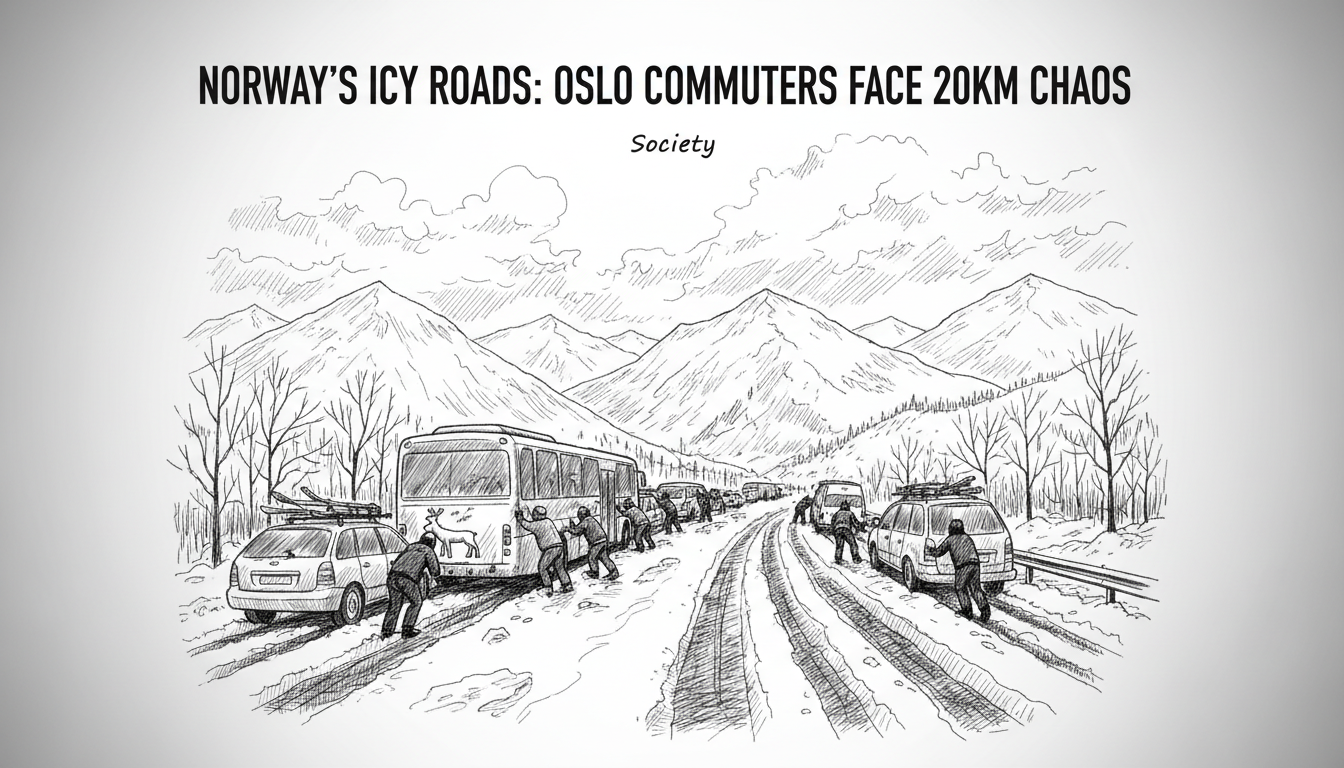
Norway's winter roads challenge drivers with thousands of incidents annually, as fresh snowfall and freezing temperatures created treacherous conditions across the Østlandet region Monday. The eastern traffic authority issued specific warnings for minor roads in and around Oslo, where untreated surfaces turned to slick ice, causing significant morning delays. Commuters faced slow-moving traffic stretching over 20 kilometers on key arteries like the E6 and E18, according to real-time monitoring from Vegtrafikksentralen Øst.
This morning’s disruptions highlight the annual battle fought by Norwegian authorities and motorists against a predictable yet hazardous foe. While Norway's systems for winter road management are among the world's most advanced, localized ice on smaller roads remains a persistent vulnerability. The situation tests the country's famed winter preparedness and the compliance of every driver on the road.
A System Geared for Winter
Vegtrafikksentralen Øst, the Traffic Management Centre for eastern Norway, operates as the nerve center during such events. Staff monitor a vast network of road cameras and weather stations, coordinating with the Norwegian Public Roads Administration (Statens vegvesen) on salting and plowing operations. Their primary tool is public communication, issuing warnings through apps, websites, and media.
“Our focus is on giving drivers the best possible information so they can adjust their speed and route,” a senior advisor at the center said in a statement. “The message for conditions like today is clear: reduce speed significantly, increase distance to the car ahead, and expect the unexpected, especially on lesser-traveled routes.” The center specifically noted that residential streets and rural connectors were most dangerous Monday morning.
The Critical Role of Winter Tires
Norwegian law mandates the use of winter tires from November 15th to March 31st, a period authorities can extend based on conditions. These tires, marked with a mountain/snowflake symbol or the letters M+S, are not a suggestion but a legal requirement. The rule is strictly enforced, with fines for non-compliance.
Road safety experts stress that tires are the single most important factor for vehicle control on ice. “A quality winter tire provides grip that a summer tire simply cannot, regardless of driving skill,” explains Lars Tingelstad, a former driving instructor and road safety consultant. “The problem we often see is overconfidence. People think ‘I have winter tires, so I can drive normally.’ That is a dangerous misconception. Winter tires improve safety margins; they do not eliminate physics.”
Why Small Roads Pose the Biggest Risk
The warning specifically highlighting minor roads around Oslo points to a known weakness in winter maintenance logistics. Major highways and arterial roads receive priority for salting and plowing. Treatment of smaller roads often depends on municipal resources and timing.
Meteorologists note that these roads are also more susceptible to black ice—a thin, nearly invisible coating that forms from moisture freezing directly on the pavement. “Temperature fluctuations around the freezing point, which are common in the Oslo region, are ideal for creating patchy ice,” says meteorologist Kari Våje. “A road in shadow can be a sheet of ice while one in sunlight is just wet. On a small road with less traffic and less treatment, that ice persists.”
The average winter temperature in Oslo sits between -5°C and 0°C (23°F and 32°F), creating this persistent freeze-thaw cycle. This makes forecasting road conditions as important as forecasting the weather itself.
Economic and Human Cost of Winter Roads
While official statistics for 2024 are not yet compiled, historical data shows winter conditions are a major contributor to annual traffic accidents in Norway. In a typical year, several thousand reported incidents are linked to snow, ice, or slush. These range from minor fender-benders to serious collisions, resulting in injuries, fatalities, and millions of kroner in material damage and lost productivity.
The economic impact of a morning like today extends beyond repair bills. Delays on the scale seen Monday morning disrupt supply chains, cause workers to be late, and increase fuel consumption. For Norway’s logistics-dependent economy, efficient road transport is critical even in February.
A Cultural Adaptation to Winter
Driving in Norway winter conditions is a learned skill. Norwegians grow up with the concept of ‘vinterdækk’ (winter tires) and ‘fjærmåler’ (following distance). Defensive driving is emphasized from the first lessons. Yet, every first major ice event of the season seems to catch some drivers off guard, suggesting complacency after milder autumn months.
Authorities repeat the same core advice annually: slow down, keep a generous distance, ensure your vehicle is properly equipped, and plan extra travel time. They also recommend checking the official road condition website, Vegvesen.no, or its app before departing.
Looking Ahead: Technology and Climate
The Norwegian Public Roads Administration continuously invests in technology to improve winter maintenance. This includes more precise weather forecasting for road sections, GPS-tracked salt trucks to optimize coverage, and sensors embedded in pavement to detect ice formation.
However, climate change introduces new complexities. Warmer winters can lead to more frequent shifts across the freezing point, increasing the risk of ice even as total snowfall may decrease in some areas. This makes the current challenge on Oslo’s small roads a potential glimpse of a more common future scenario, where wet-ice conditions become more prevalent than deep snow.
For now, the immediate forecast suggests continued cold in Østlandet. Drivers are warned that evening and overnight refreezing of melted snow will likely make Tuesday morning’s commute another demanding exercise in caution. The season’s battle with winter is far from over, and as today proved, vigilance on even a short trip across town cannot be overstated. The question remains: will drivers heed the warnings, or will overconfidence lead to another spike in incidents?