
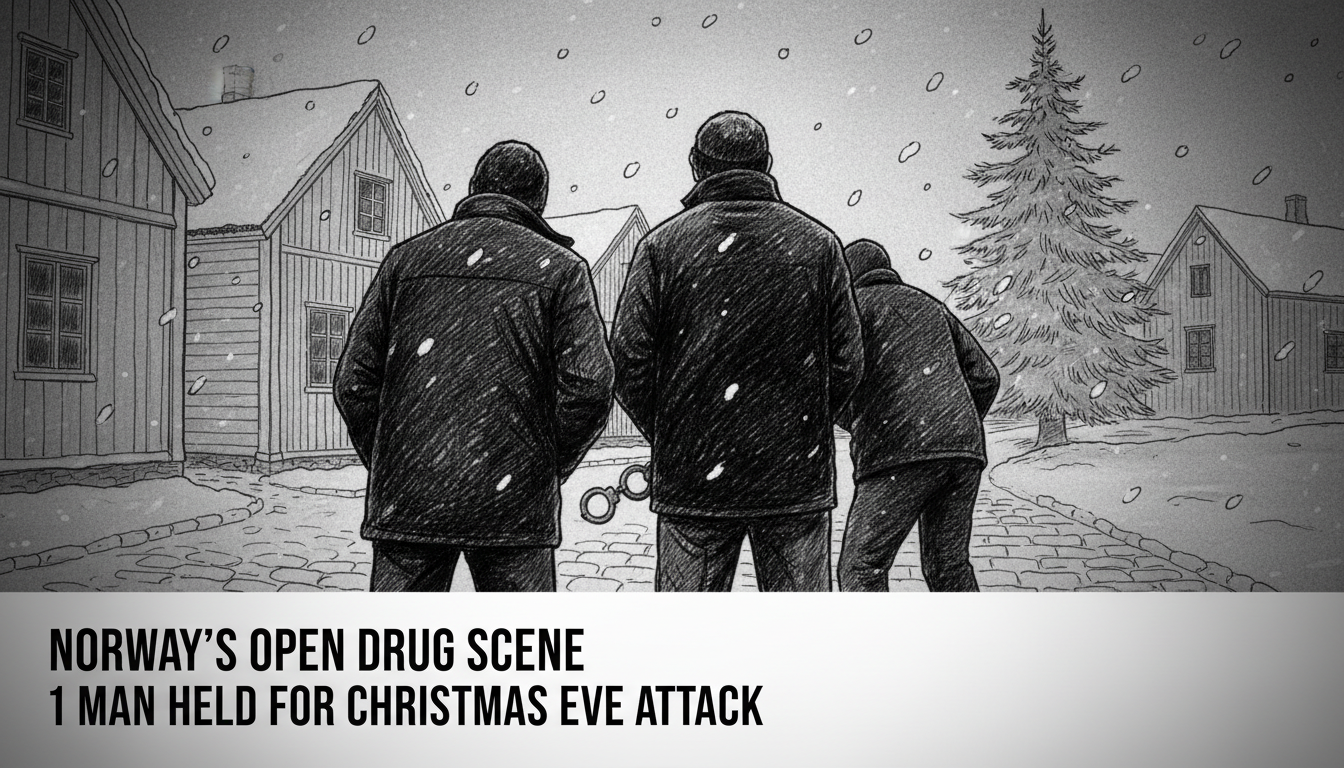
Norway's capital Oslo is confronting the persistent challenges of its open drug scene after a man in his late thirties was remanded in custody on Christmas Eve. The suspect faces charges of attempted murder following an incident in the city center. Oslo District Court ordered the man held for four weeks with a ban on all mail and visits, a strict measure reflecting the severity of the allegations. His defense lawyer, the prominent John Christian Elden, confirmed his client is part of Oslo's open drug environment, linking the case directly to the city's ongoing struggle with public narcotics use and associated violence.
This arrest casts a stark light on a well-documented problem area within one of Europe's safest capitals. While Norway's overall homicide rate remains low at approximately 0.5 per 100,000 inhabitants, incidents connected to the drug trade present a disproportionate threat to public order. The case forces a difficult conversation about safety, rehabilitation, and the limits of Norway's famously humane justice system when dealing with volatile street-level conflicts.
A Strict Custody Order in a Lenient System
The court's decision to impose both custody and a communication ban (brev- og besøksforbud) is noteworthy. In the Norwegian legal framework, pre-trial detention is not automatic. Prosecutors must demonstrate a specific risk: that the suspect will flee, tamper with evidence, or commit further crimes. The addition of a mail and visit ban is often used when there is a concern over witness intimidation or interference with the police investigation. This suggests authorities view the case as particularly sensitive.
"The use of pre-trial detention, especially with such restrictions, is always a serious infringement on personal liberty," explains Professor Lena F. Solberg, a legal scholar at the University of Oslo. "The courts balance this against concrete risks. In cases involving the open drug milieu, where networks are tight and conflicts can spiral quickly, the threshold for fearing evidence tampering or new violence may be met more readily." The initial four-week custody period can be extended by the court if the police investigation requires more time and the risks persist.
The Defense and the Defendant's World
The involvement of defense attorney John Christian Elden immediately raises the case's profile. Elden is a formidable figure in Norwegian courtrooms, known for representing clients in some of the country's most serious and high-profile criminal cases. His statement to the press was brief but significant, immediately framing his client as "a part of the open drug milieu in Oslo." This is not merely a personal detail; it is a strategic contextualization. It anchors the incident within a specific, recognized social problem, potentially shaping how the public and the court perceive the alleged motives and circumstances.
By acknowledging this connection, Elden may be laying groundwork for a defense that considers the chaotic and often violent context of street-level drug dealing and use. It implicitly points to a environment where disputes are frequently settled outside the law, and where participants are both perpetrators and victims of a destructive system. This narrative engages directly with Norway's ongoing debate about whether to treat drug abuse primarily as a criminal issue or a public health one.
Oslo's Persistent Challenge: The Open Drug Scene
The term "open drug milieu" refers to specific areas in Oslo, such as those near the central railway station, where drug use and small-scale dealing occur visibly in public spaces. These areas have been a focal point for municipal and police efforts for decades. While Norway's national crime rates are low, the percentage of drug-related offenses in Oslo consistently exceeds the national average. This creates pockets of concentrated social and legal problems that challenge the city's overall sense of security.
Police and health services employ a dual strategy of enforcement and outreach. Patrols monitor these areas to prevent dealing and violence, while health workers offer assistance, clean needles, and pathways to treatment. Despite these efforts, the scenes persist, fueled by addiction, poverty, and organized crime supplying the drugs. Incidents of violence, like the alleged attempted murder now before the courts, are a recurring symptom of this entrenched issue. They represent the failure of social safety nets for some individuals and the brutal economy of the illicit market.
The Norwegian Paradox: Low Crime Amidst High-Profile Cases
This case presents a paradox familiar to Norwegians. The country enjoys some of the lowest crime statistics in the world, a point of national pride. Its prison system is famously focused on rehabilitation and restorative justice, with short sentences by international standards and an emphasis on reintegration. Yet, when a serious violent crime occurs, especially in the heart of the capital, it triggers deep public concern and a re-examination of these liberal principles.
"There is a constant tension between our humanitarian ideals and the demand for immediate public safety," says criminologist Arne M. Nilsen. "A case like this tests that balance. The system is designed for rehabilitation, but pre-trial measures are designed to prevent immediate danger. The question for society is whether we are addressing the root causes of what drives people into the open drug milieu in the first place, or just managing the symptoms when they erupt into violence." The low homicide rate offers little comfort to residents who feel unease near drug scenes or who read about a Christmas Eve attempted murder.
A Legal Process Begins
The suspect now enters a period of investigation. The police will use the custody period to gather evidence, interview witnesses, and build their case. The communication ban aims to protect the integrity of this process. For the defendant, the coming weeks will be spent in a cell at a police detention center, separated from the outside world while the machinery of justice turns.
John Christian Elden's role will be to ensure his client's rights are protected during the investigation and to begin preparing a defense. The case will likely hinge on forensic evidence, witness testimony, and the establishment of intent—the key element that distinguishes attempted murder from other serious assaults. Given the setting, the court may also hear arguments about the defendant's mental state and the influence of substance abuse.
A Broader Societal Reflection
Beyond the specifics of the legal charges, this incident serves as another catalyst for a necessary but difficult discussion. How does a prosperous, egalitarian society like Norway continue to have a visible, problematic open drug scene in its capital? Are the current combinations of policing, social work, and health services effective? When violence spills out from this milieu, does it call for a tougher stance, or a redoubled commitment to health-focused interventions?
Experts argue that punitive crackdowns alone have failed everywhere they have been tried. Norway's own path has gradually shifted toward a more health-oriented approach, but progress is slow and funding is contested. Each violent incident risks swinging the pendulum back toward pure law-and-order rhetoric. The challenge for policymakers is to address legitimate public fear without abandoning evidence-based strategies that focus on harm reduction and treatment.
As the Oslo District Court oversees this single case, the larger verdict is still out on how the city will manage the complex, human tragedy of its open drug environment. The coming weeks will reveal more about one alleged crime on a December night. The coming years will determine whether such events become rarer, or remain a tragic fixture of life in an otherwise tranquil city.
The path forward requires navigating the delicate balance between compassion and security, a test for a justice system admired worldwide but not immune to the harsh realities of street crime.