
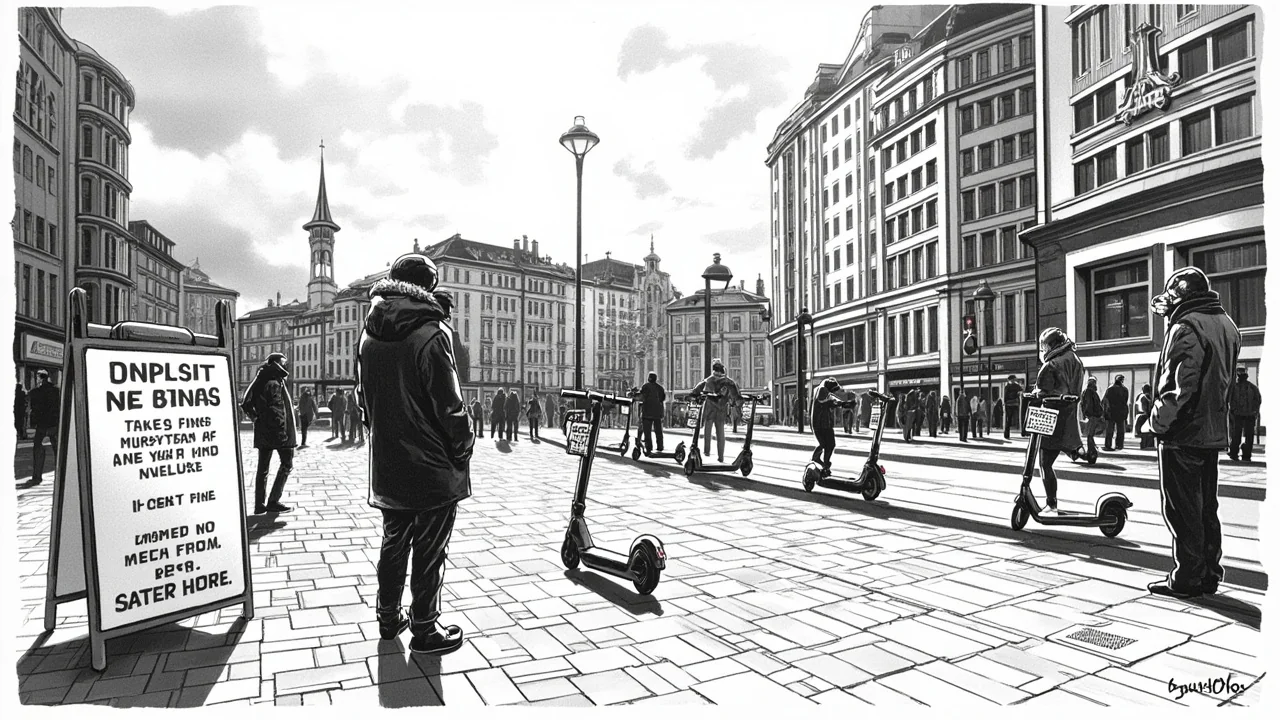
Norway's capital issued over 25,000 fines for illegally parked electric scooters in 2025. This figure represents a near doubling from the previous year, according to data from Oslo's Urban Environment Agency. The sharp increase follows a city council decision to expand its fleet of enforcement officers and double the number of scooters permitted on city streets.
"It results in greater coverage of parking control across the entire city," said agency press officer Hanne Sofie Fremstad. The city now allows 16,000 e-scooters, up from 8,000, and they are distributed across a wider area beyond the inner city center. Each parking violation carries a fine of 900 kroner, which is sent to the scooter company and then passed on to the user responsible.
A Clash of Urban Mobility Visions
This enforcement surge highlights a fundamental tension in Oslo's transport policy. The city government, led by the Labour Party and Green Party coalition, has aggressively promoted cycling and zero-emission transport. Electric scooters fit neatly into this green mobility vision. Yet their rapid proliferation has created significant public nuisance and safety concerns. Pavements in neighborhoods like Grünerløkka and Frogner are often cluttered with discarded scooters, blocking pedestrian access and creating hazards for the visually impaired.
"The scooters are a useful last-mile solution, but they cannot be a free-for-all," said Marius A. Holm, a city council representative from the Green Party. "Orderly parking is non-negotiable for public acceptance. The fines are a tool to compel the private operators to manage their assets properly." The policy aims to shift responsibility from the public sector to the scooter companies, which include international operators like Tier and Voi, as well as Norwegian start-ups.
The Mechanics of Enforcement Expansion
The dramatic rise in fines is not solely due to more scooters or worse user behavior. It is a direct result of a bureaucratic reorganization. Previously, only a specialized unit handled scooter parking violations. In 2025, the city empowered its broader force of municipal enforcement officers—formerly known as parking wardens—to issue penalties. This move effectively multiplied the number of officials with the authority to write tickets on the spot.
These officers patrol areas with high scooter density, such as outside central train stations, popular restaurants along the Aker Brygge waterfront, and major public squares. They enforce clear rules: scooters cannot block sidewalks, ramps, building entrances, or designated bicycle parking. The 900-kroner fine is a fixed penalty, designed to be a significant deterrent. For context, it is roughly equivalent to a fine for illegal car parking in a disabled bay.
Operator Responsibility and User Backlash
The fine system places the legal and administrative burden on the scooter companies. When an officer logs a violation with the scooter's unique ID, the ticket is issued to the company registered to that fleet. The company must then use its ride data to identify the user who ended the trip at that location and charge them the fine, plus an administrative fee. This model is intended to make operators invest in better geofencing technology and user education to avoid penalties.
However, it has sparked complaints from users. Many argue they park scooters in seemingly appropriate spots, only to receive a fine days later because the location was deemed non-compliant. "I parked it neatly by a bike rack, not blocking anyone," said Kari Larsen, a student who received a 1,100-kroner charge (900kr fine + 200kr fee) from a operator. "The rules feel opaque and the appeal process with the company is frustrating." This friction points to a communication gap between the city's strict regulations and user understanding on the ground.
The Economic and Behavioral Calculus
From the city's perspective, the fine revenue is secondary to achieving compliance. The 25,000 fines at 900 kroner each represent a theoretical value of 22.5 million kroner. However, the actual financial impact is complex. The city incurs administrative costs for enforcement, and the revenue does not directly fund the scooter program. The primary goal is behavioral change. City planners hope consistent enforcement will train both users and companies to treat parking with greater seriousness.
Transport analysts see this as a critical test for the "sharing economy" model in public spaces. "Private companies profit from utilizing public infrastructure—our sidewalks," noted Lars B. Hansen, a mobility researcher at the University of Oslo. "Oslo is asserting that this comes with obligations. The fines are a market signal, internalizing the cost of disorder. If operators cannot control parking, the city may revoke their licenses." This stick complements the carrot of a larger permitted fleet size.
Looking Beyond the Inner City
A key component of the 2025 policy was geographic expansion. Scooters are no longer confined to the dense central boroughs. They are now available in outer districts like Grorud and Nordstrand. This was a political decision to ensure equitable access to new mobility options across the city. Yet, it also exported parking challenges to areas with narrower sidewalks and less existing cycling infrastructure.
Enforcement in these suburban areas presents new challenges. Patrol coverage is thinner, and residential complaints often focus on scooters left on private property or in quiet residential streets. The city is experimenting with designated parking zones marked with physical stickers or digital geofences in these areas, hoping to create clearer norms.
The Road Ahead for Micromobility
Oslo's experience serves as a case study for cities worldwide grappling with e-scooter management. The Norwegian approach is characterized by strict regulation, high fines, and placing liability on operators. The near-doubling of fines in one year demonstrates a political will to enforce these rules aggressively. The next phase will likely involve more sophisticated technology, such as mandatory photo verification at trip-end to prove proper parking before the user's ride fee is finalized.
The ultimate question is whether this stringent regime will succeed in integrating e-scooters seamlessly into urban life or stifle their use through heavy-handed penalties. The city council will review the policy's effectiveness in late 2026, assessing metrics beyond fine quantity, including accident rates, public satisfaction, and actual changes in parking behavior. For now, the message from Oslo's streets is clear: park properly, or pay the price. The era of laissez-faire scooter use in the Norwegian capital is decisively over.